Please ensure Javascript is enabled for purposes of website accessibility U.S. Exceptionalism Expected to Prevail
es
es
intermediary
intermediary
false
true
Gathering data
Disclaimer Not Available

U.S. exceptionalism expected to prevail

U.S. exceptionalism expected to prevail

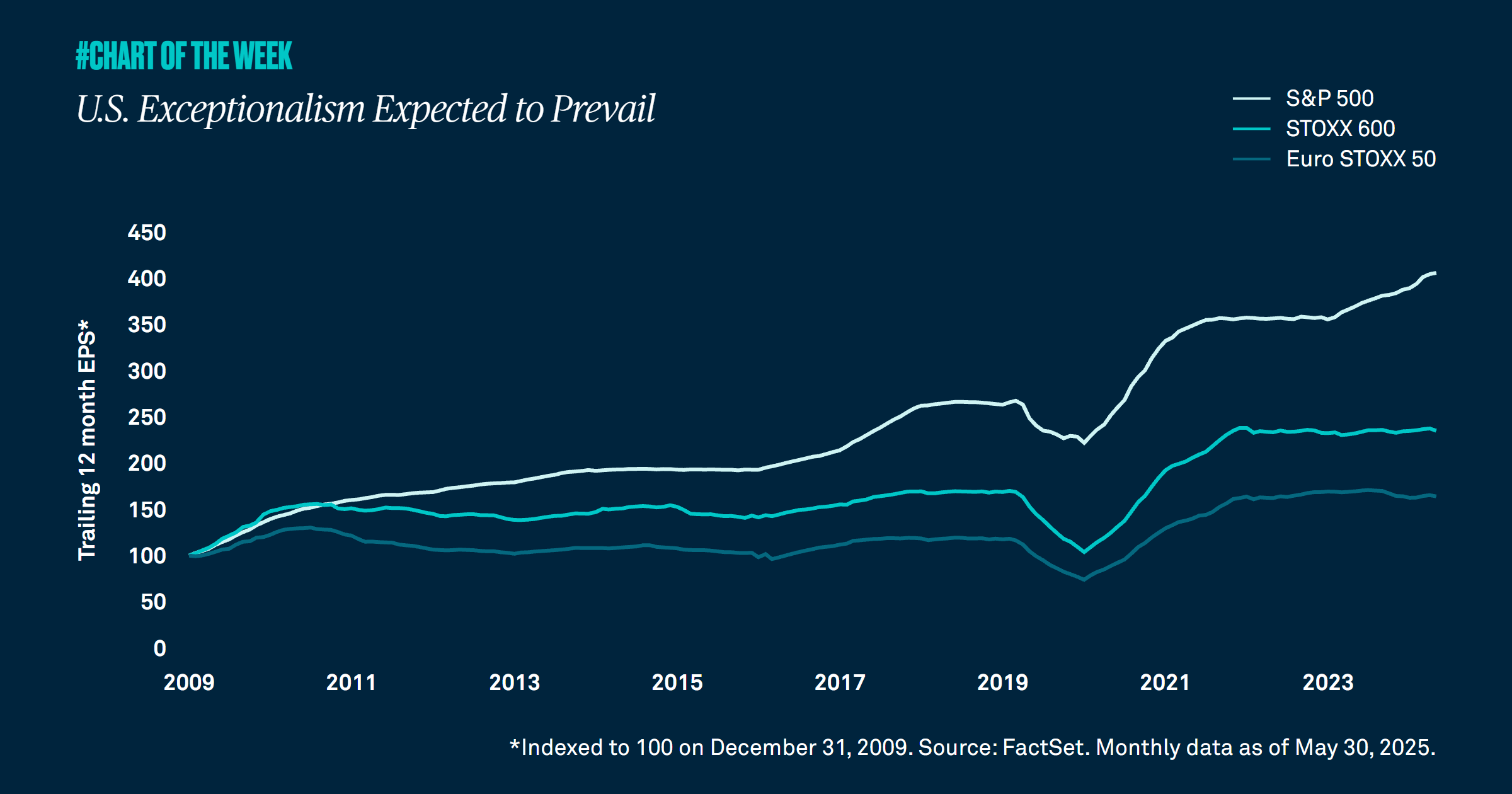
International equity markets are outperforming the U.S. year to date. Is this a durable trend? According to relative earnings growth, the U.S. still has an advantage.
 

U.S. Exceptionalism Expected to Prevail


A popular topic of conversation among investors has been the idea that after a healthy run, U.S. exceptionalism may be out of steam. Over the period of January 1 to May 31, international equity markets have outperformed the U.S. for the first time since 2017.  Still, we believe the S&P 500 will continue its strategic outperformance. Why? One key reason is superior earnings growth. 

Earnings can help predict relative returns across different regions when one examines their long-term performance trends. Since 2010, S&P 500 earnings grew at an annualized rate of 9.6%, outpacing the STOXX Europe 600 by 1.7 times and three times for the more concentrated EURO STOXX 50. Additionally, this year S&P 500 earnings are expected to grow 8.8% compared to 2% for the STOXX Europe 600 and 3.6% for the EURO STOXX 50. 

As we discussed in previous weeks, greater productivity and labor market characteristics in the U.S. are priming the domestic economy for faster growth than its peers abroad. Economic growth feeds stock market returns and earnings growth, which is anticipated to rank highest in the U.S. For these reasons, we expect U.S. exceptionalism to resume and strategic outperformance to persist. As a result, we continue to favor U.S. equities over the rest of the world. 
CONTENIDO RELACIONADO
Returns after oil spikes
Chart of the week | Macroeconómico

The Strait of Hormuz, which moves about 20% of global oil, has seen many ships that normally travel through it curtail their activity. Consequently, WTI oil was up over 36% in the five days after the oil supply shock began. Yet equities barely budged, signaling a temporary supply shock, not a larger crisis. Historically, after similar price spikes equities tend to move higher while oil prices decline — further evidence for avoiding emotion-driven investing.

Expandiéndose hacia el valor
Artículo | Renta variable

Esperamos que el liderazgo del mercado se amplíe más allá de la tecnología de mega capitalización en los mercados de renta variable estadounidenses. Para carteras con fuerte crecimiento, la brecha cada vez menor entre crecimiento y valor indica la posible necesidad de añadir inversiones de valor para reducir el riesgo de concentración y mejorar la diversificación.

Impact of geopolitics over time?
Chart of the week | Macroeconómico

Tensions between the U.S./Israel and Iran have recently boiled over into a military conflict, which has given many investors the jitters. However, our research shows that equity market pullbacks resulting from geopolitical events are often short lived with the S&P 500 typically higher in the months following these events.

Conflicto con Irán: implicaciones para el mercado
Macroeconómico

El ataque de Estados Unidos e Israel contra Irán, que resultó en la eliminación del liderazgo iraní, es un desarrollo serio para la estabilidad política regional y global de los precios de la energía, ya que podría desencadenar desequilibrios moderados o materiales entre oferta y demanda.

Gathering data
Disclaimer Not Available

Este material es una comunicación de marketing.