
Key Takeaways
- The rise in the 10-year U.S. Treasury yield above 5% has raised concerns about the outlook for stocks.
- Risk assets sensitive to a rate cycle are likely to waver as the market prices in three to four additional hikes through the end of 2027.
- While higher yields can create short-term pressure on equities, history shows stocks can deliver positive returns even when the benchmark yield moves past 5%.
- Resilient economic growth and healthy corporate earnings should help offset that pressure.
- Investors should keep higher rates in perspective and remain focused on diversification, quality and long-term discipline.
What is driving yields higher?
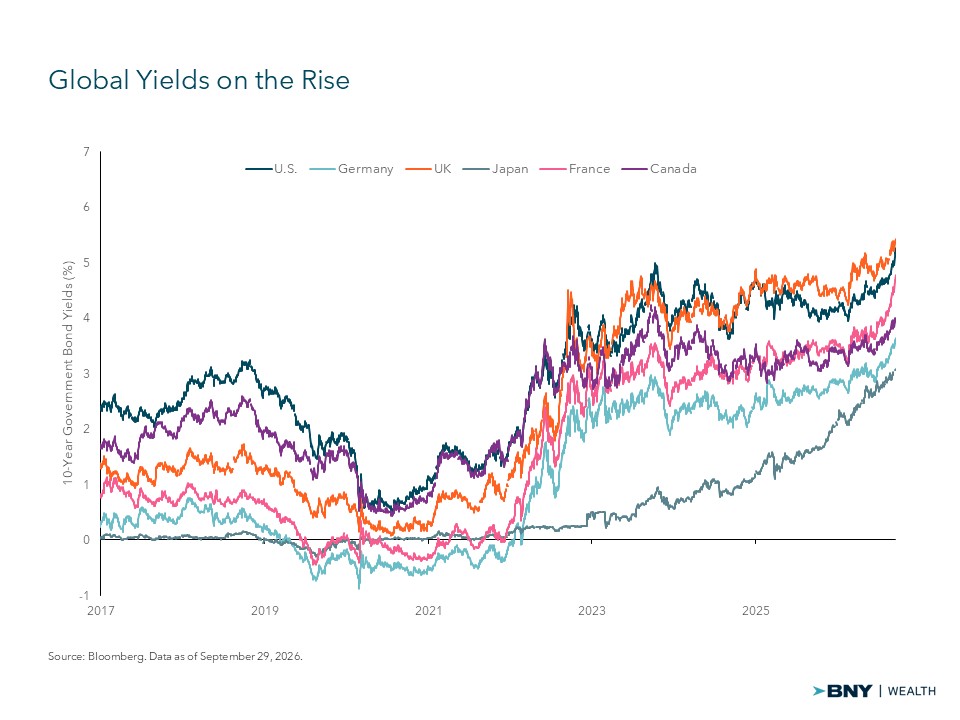
Today’s higher-rate environment reflects a mix of persistent inflation, resilient economic growth, large-scale artificial intelligence-related investment and elevated government borrowing. More recently, an escalation of the conflict in Iran and WTI oil prices at $90 or more have also worked to push the U.S. 10-year Treasury yield above 5%. With inflation still above target, the 10-year yield is pricing in a Federal Reserve that has more work to do — and more rate hikes ahead.
This is not just a U.S. story. Across many developed economies, growth is holding up better than expected, inflation remains sticky and government debt has increased. That combination has driven global government bond yields higher and prompted a global tightening cycle with central banks striving to bring inflation back toward target.
Putting higher yields in context
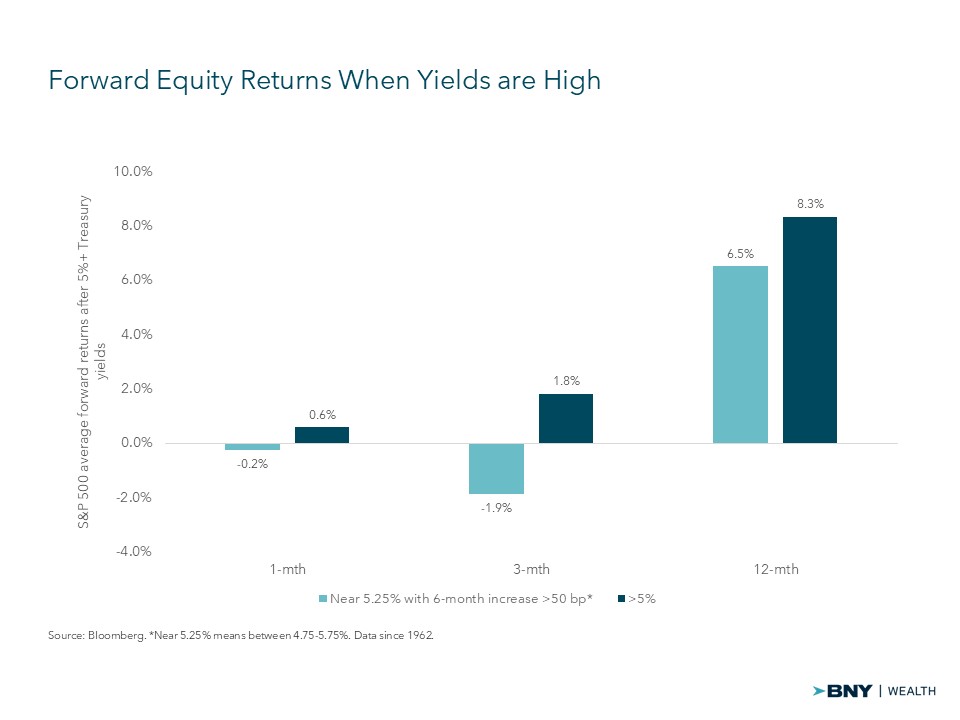
While equities may remain choppy in the near term, history has shown that when the 10-year Treasury yield rises above 5%, stocks can still deliver solid returns over the following 12 months. Our analysis also examines periods when bond yields rise sharply toward 5.25% or higher. In both scenarios, stocks on average remain muted in the following one to two quarters but deliver returns of 6.5-8% in the next 12 months.
The current environment illustrates a similar pattern of near-term softness. Specifically, interest-rate sensitive areas of the market, such as small cap stocks, have come under pressure recently. However, higher yields are not necessarily bearish for stocks overall. For example, the Magnificent 7 have recently regained momentum, lending support to the overall S&P 500. Given the group’s strong cash position, growing evidence of monetization from AI capital expenditures and 35% weight in the index, overall S&P 500 returns could hold up despite narrowing breadth and as the market adjusts to higher yields.
Past performance is no guarantee of future results.
Is the economy strong enough to support equities?
The higher-for-longer rate environment may create near-term volatility, but the broader economic backdrop remains intact. U.S. growth is expected to remain above 2% this year and next while global growth is expected to increase to 3.1% from 3%. Manufacturing also remains strong with the global manufacturing purchasing managers’ index near the highest since 2022, which is positive for growth.
Corporate fundamentals are similarly healthy. Earnings growth in 2026 is strong globally, and while that pace is likely to moderate in 2027, growth should remain above historical averages. We also expect the Fed to deliver at least three rate hikes, which is in line with market pricing. Although stocks often weaken when a hiking cycle begins, equities have historically recovered over the following 12 months as long as growth and earnings continue to expand.
Implications for investors
For investors, the message is stay diversified, emphasize quality and maintain an appropriate level of equity exposure. Because we don’t anticipate a recession, we view pullbacks as opportunities to add equity exposure. At the same time, for investors with concentrated equity positions, this may be a prudent time to consider adding downside protection, especially because hedging costs are currently low.
More broadly, our message to all investors is even in a higher rate environment, staying anchored to long-term investment plans, remaining disciplined through periods of volatility and selectively capitalizing on periods of weakness can help protect and grow wealth.