Please ensure Javascript is enabled for purposes of website accessibility Higher Margins Drive Robust Earnings
sg
en
institutional
institutional
false
true
Gathering data
Disclaimer Not Available

Higher margins drive robust earnings

higher-margins-drive-robust-earnings-apac

Second quarter earnings season is winding down. Nearly all companies have reported, and the majority beat expectations as margin estimates continue to rise.
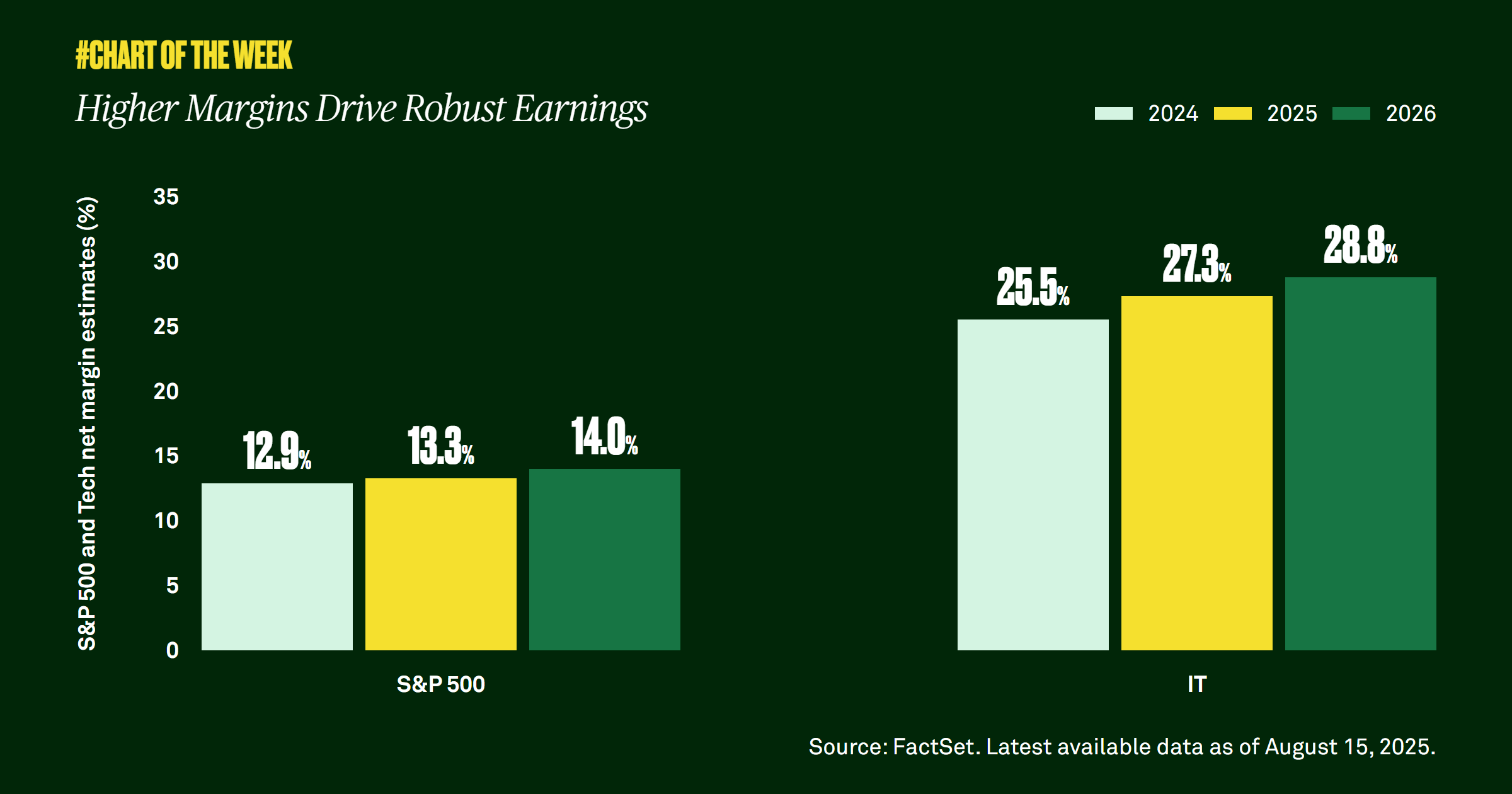
 

Second quarter earnings season is winding down, with ~92% of S&P 500 companies having reported. Over 80% of those companies beat analysts’ expectations, pleasing many investors and correcting a downward shift in S&P 500 margin estimates that has stabilized since May.

Margins illustrate the quality and durability of corporate earnings by demonstrating how effectively a company controls costs and converts sales into profits. In 2025, net margins are expected to reach 13.3%, up from 12.9% in 2024, as well as increase another 0.7% to 14.0% in 2026. Notably, estimates for technology companies are significantly better than those of the entire S&P 500.

In fact, technology enhancements are the key driver of higher margins for the index. Specifically, the continued development and broadening adoption of artificial intelligence (AI) should bolster companies’ productivity and, in turn, lead to higher margins. Some of the ways that AI increases margins include improving operational efficiency, employing data-driven decision making, enhancing supply chain optimization, and enabling product and service innovations.

The immense progress in AI and its encouraging potential support our constructive view of equities. Improving estimates for both margins and earnings underscore our overweight position in large cap stocks and should push the market higher by year end. 
RELATED CONTENT
Is the job market stabilizing?
Chart of the week | Macroeconomic

After sluggish job growth in 2025, investors are looking for signs that the labor market may be stabilizing. With consumer spending driving 70% of economic activity, an improving labor market is essential to sustaining economic growth.

Will markets remain resilient?
Chart of the week | Macroeconomic

Global equities have risen an annualized 11% since 2020 despite repeated shocks, as resilient growth and earnings have helped markets recover from periods of volatility. While the U.S.-Iran conflict poses near-term inflation and growth risks, markets remain constructive as earnings expectations continue to improve.

Earnings breadth still improving
Chart of the week | Macroeconomic

Rising earnings estimates continue to support equities despite geopolitical and macroeconomic uncertainty. With profit growth broadening across S&P 500 industries, resilient corporate earnings underpin our constructive outlook for the stock market.

Global Momentum in Manufacturing
Chart of the week | Macroeconomic

April PMIs (Purchasing Managers’ Indices) point to a meaningful improvement in global manufacturing momentum, with the U.S., Eurozone and Japan all posting stronger-than-expected and firmly expansionary results. The breadth of the rebound suggests improving global demand, supporting a constructive outlook for growth despite ongoing geopolitical tensions.

Gathering data
Disclaimer Not Available

CONTACT US  |  +65 6432 0222