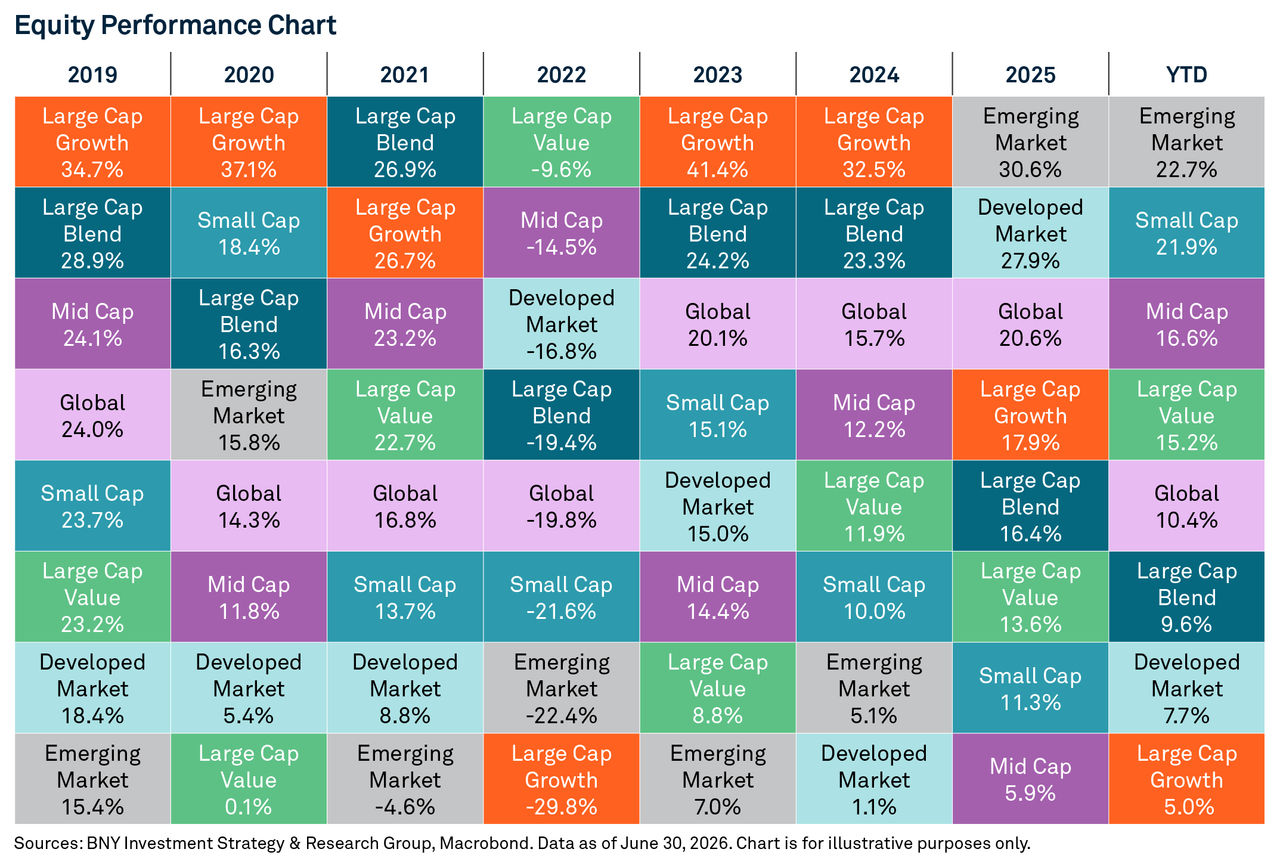
Large-cap growth has been difficult to ignore, delivering strong performance over the last few years. But the equity quilt below reminds us that no segment stays on top indefinitely. History shows that periods of narrow market leadership are often followed by broader participation. What leads one year can quickly give way to another the next year.
For example, year-to-date, we see small-cap and emerging market equities moving back toward the top following a period of relative underperformance. Maintaining exposure across styles, market capitalizations, and regions can help investors capture a broader range of return opportunities over time.
Glossary
MSCI EAFE: The MSCI EAFE Index is an index that tracks the performance of Developed Market equities across Europe, Australasia and the Far East excluding the US and Canada.
MSCI EM: The MSCI EM index tracks the performance of Emerging Market Equities.
MSCI All-Country World: The MSCI All-Country World is an index that tracks the performance of both Developed and Emerging Market equities.
Russell 1000 Growth: The Russell 1000 Growth Index measures the performance of US large cap growth stocks.
Russell 1000 Value: The Russell 1000 Value Index measures the performance of US large cap value stocks.
Russell 2000: The Russell 2000 Index is a small-cap stock market index of the bottom 2,000 stocks in the Russell 3000 Index.
S&P 500: The S&P 500 is an index designed to track the performance of the largest 500 US companies.
S&P 400 Midcap: Standard and Poor’s Midcap 400 Index is a capitalization-weighted index which measures the performance of the mid-range sector of the U.S. stock market.
Important information
BNY Investments is the brand name for the investment management business of BNY and its investment firm affiliates worldwide. BNY is the corporate brand of The Bank of New York Mellon Corporation and may be used to reference the corporation as a whole or its various subsidiaries generally.
The information contained herein reflects general views and is provided for informational purposes only. This material is not intended as investment advice nor is it a recommendation to adopt any investment strategy.
Opinions and views expressed are subject to change without notice.
Past performance is no guarantee of future results.
Issuing entities
This material is only for distribution in those countries and to those recipients listed, subject to the noted conditions and limitations: •United States: by BNY Mellon Securities Corporation (BNYSC), 240 Greenwich Street, New York, NY 10286. BNYSC, a registered broker-dealer and FINRA member, has entered into agreements to offer securities in the U.S. on behalf of certain BNY Investments firms. •Europe (excluding Switzerland): BNY Mellon Fund Management (Luxembourg) S.A., 2-4 Rue EugèneRuppertL-2453 Luxembourg. • UK, Africa and Latin America (ex-Brazil): BNY Mellon Investment Management EMEA Limited, BNY Mellon Centre, 160 Queen Victoria Street, London EC4V 4LA. Registered in England No. 1118580. Authorised and regulated by the Financial Conduct Authority. • South Africa: BNY Mellon Investment Management EMEA Limited is an authorised financial services provider. • Switzerland: BNY Mellon Investments Switzerland GmbH, Bärengasse 29, CH-8001 Zürich, Switzerland. • Middle East: DIFC branch of The Bank of New York Mellon. Regulated by the Dubai Financial Services Authority. • South East Asia and South Asia: BNY Mellon Investment Management Singapore Pte. Limited Co. Reg. 201230427E. Regulated by the Monetary Authority of Singapore. • Hong Kong: BNY Mellon Investment Management Hong Kong Limited. Regulated by the Hong Kong Securities and Futures Commission. • Japan: BNY Mellon Investment Management Japan Limited. BNY Mellon Investment Management Japan Limited is a Financial Instruments Business Operator with license no 406 (Kinsho) at the Commissioner of Kanto Local Finance Bureau and is a Member of the Investment Trusts Association, Japan and Japan Investment Advisers Association and Type II Financial Instruments Firms Association. • Brazil: ARX Investimentos Ltda., Av. Borgesde Medeiros, 633, 4th floor, Rio de Janeiro, RJ, Brazil, CEP 22430-041. Authorized and regulated by the Brazilian Securities and Exchange Commission (CVM). • Canada: BNY Mellon Asset Management Canada Ltd. is registered in all provinces and territories of Canada as a Portfolio Manager and Exempt Market Dealer, and as a Commodity Trading Manager in Ontario. All issuing entities are subsidiaries of The Bank of New York Mellon Corporation.
No part of this material may be reproduced in any form, or referred to in any other publication, without express written permission. All information contained herein is proprietary and is protected under copyright law.
NOT FDIC INSURED | NO BANK GUARANTEE | MAY LOSE VALUE |
©2026 THE BANK OF NEW YORK MELLON CORPORATION
MARK-983852-2026-08-10
GU-925- 13 August 2027