For investors still holding cash allocations, the current fixed income environment may offer a potential opportunity to enhance income without taking on significant interest rate risk.
Key points
- For investors wanting a higher income than that offered by cash but who are nervous about exposure to interest rate risk and spread volatility, there are a number of income-driven strategies that offer the potential to capture credit risk premia without materially increasing interest rate sensitivity.
- In the current market environment, we believe that the case for moving selectively beyond cash into income strategies – such as short-dated and floating-rate credit – that offer return profiles differentiated from broad fixed income allocations is compelling.
- By focusing on shorter maturities and robust credit structures, investors can potentially access more stable, carry-driven returns, while retaining the flexibility to reinvest as market conditions evolve.
For investors still holding cash allocations, we believe the current fixed income environment may offer a potential opportunity to enhance income without taking on significant interest rate risk. Policy rates across developed markets remain at levels we consider attractive. At the same time, concerns about government borrowing are contributing to greater volatility in longer-dated bonds, reinforcing the appeal of strategies that seek to generate income without relying on duration exposure.
In recent months, higher energy prices and damage to energy infrastructure in the Middle East have increased upside risks to inflation, leading markets to price in the possibility of further policy tightening in the US, UK and euro area. Against this backdrop, extending from cash into short-dated bonds may offer an opportunity to lock in attractive yields.
In this environment, investors willing to move gradually along the risk spectrum may benefit from allocating to credit sectors that offer higher income than cash, while keeping interest rate sensitivity relatively low. In our view, short-dated global credit, floating-rate credit and asset-backed securities may offer a practical way to capture today’s elevated yields while limiting the duration-related volatility often associated with broader fixed income allocations.
Policy expectations shift toward a more restrictive regime
Recent developments have materially changed the outlook for central bank policy rates across several key markets. In the United States, expectations have shifted towards a gradual series of rate hikes, although this could change depending on how growth and inflation evolve. In the UK, the Bank of England is expected to reverse its recent easing in response to persistent services inflation and wage pressures. Likewise, in the euro area, markets have repriced sharply, with investors now expecting European Central Bank rate hikes over the coming quarters as energy-driven inflation risks intensify.
Figure 1: Market pricing of policy rates1
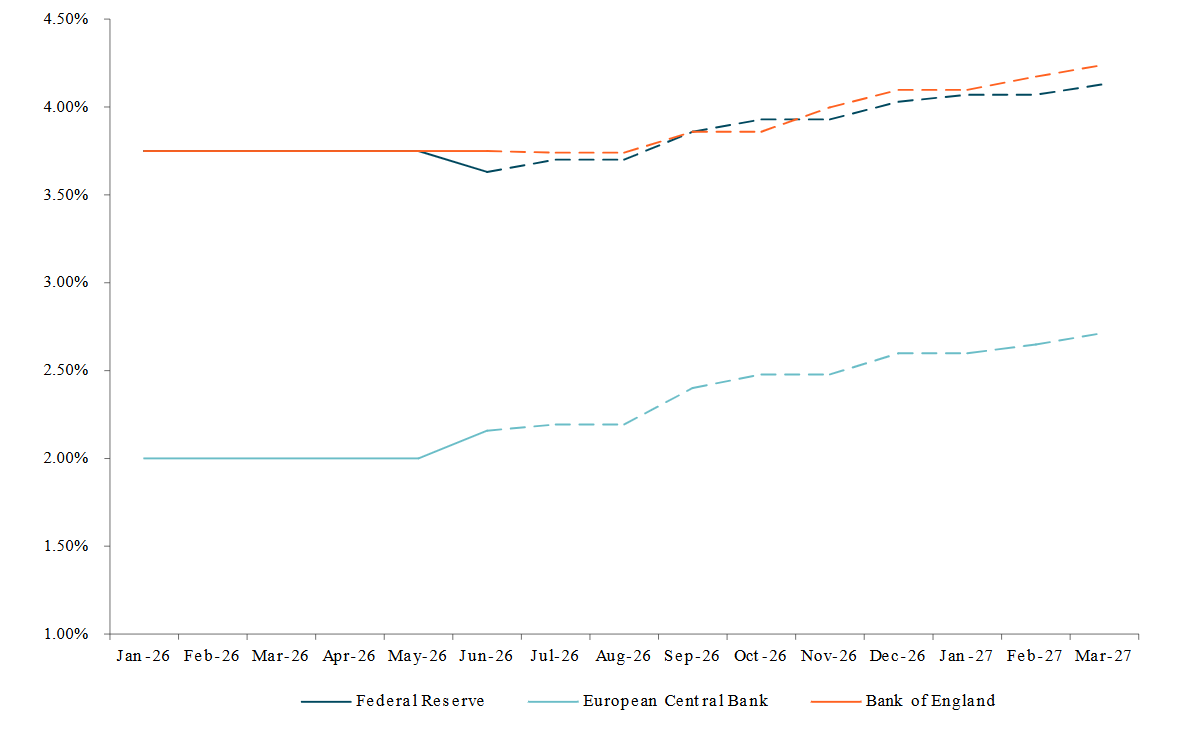
Chart is for illustrative purposes only.
How contractual income can aid portfolio resilience
We believe the trade-off between duration and income is particularly relevant in credit markets. The additional income available from extending duration is limited when weighed against the greater sensitivity of longer-dated assets to changes in interest rates.
By contrast, shorter-dated and floating-rate credit exposures have historically been less sensitive to moves in government bond yields. Returns are driven more directly by contractual income, supported by the additional yield often investors receive for taking credit risk.
Four ways to potentially deliver attractive income while mitigating duration risk
1. Global short-dated investment grade credit: resilient income?
We think global short-dated investment grade credit may offer an attractive source of high quality, resilient income.
Firstly, according to ICE Bank of America, yields available from short-dated investment grade credit are 90% of the level offered by the wider global investment grade market at 4.2% and 4.7%, respectively2. As a result, investors can potentially capture income available in global investment grade credit while taking materially less duration risk.
Secondly, the volatility profile of the asset class is less pronounced than that of broader global investment grade credit. Figure 2 shows that short-dated investment grade credit has historically exhibited lower realised volatility than across the maturity spectrum. This reflects not only lower interest rate sensitivity but also reduced exposure to movements in credit spreads, resulting in a more stable return profile. The disparity in volatility levels is particularly clear during periods of market stress, when shorter-maturity exposures have tended to experience more contained drawdowns, reflecting their lower sensitivity to both duration and spread volatility, as well as the natural pull-to-par effect as bonds approach maturity, which helps mitigate the persistence of losses.
Thirdly, as shown in Figure 3, short-dated investment grade credit has historically experienced shallower drawdowns than the broader global investment grade universe during major dislocations, including the global financial crisis, the COVID-19 shock and the inflation-driven sell-off.
Figure 2: Global short-dated Investment Grade credit has historically shown lower volatility3
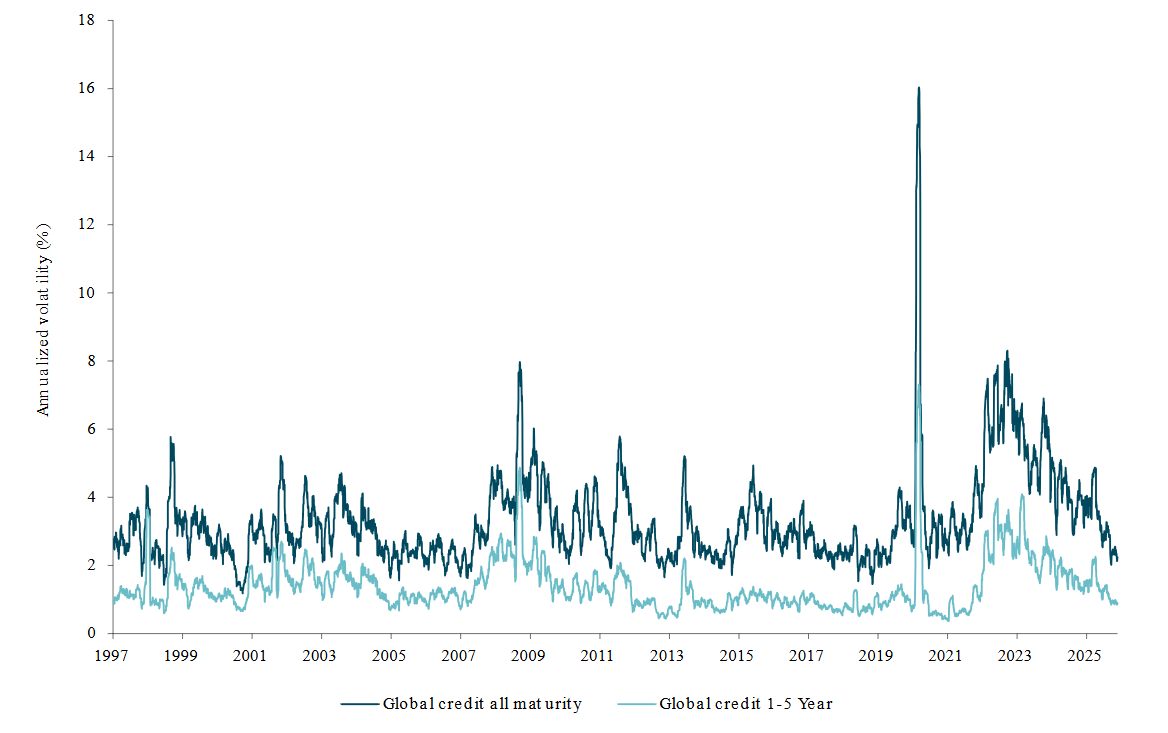
Chart is for illustrative purposes only. See end of article for index definitions.
Figure 3: Short-dated Investment Grade credit (1-5 years) has experienced lower drawdowns in market crises4
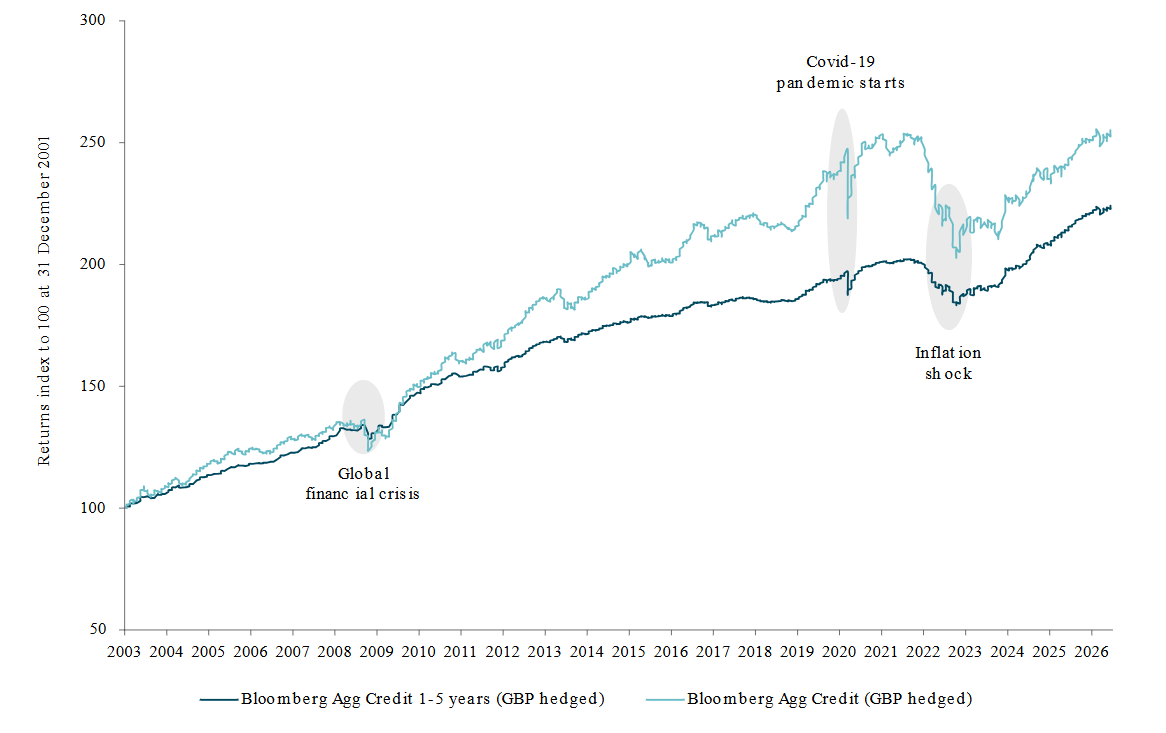
Chart is for illustrative purposes only. The chart looks at the severity of market drops in times of market crisis. It indicates that, in times of crisis, shorter maturity investment grade bonds have historically experienced smaller losses compared to a broader universe of investment grade bonds. See end of article for index definitions.
In addition, returns within short-dated bond issues tend to be driven more by contractual income than by capital appreciation, as the shorter maturity profile limits price sensitivity to changes in interest rates and credit spreads. As a result, the asset class is less reliant on favourable rate movements and supportive of more predictable outcomes.
Shorter maturities can also allow investors to reinvest proceeds more frequently at prevailing market yields, providing flexibility, while the incremental yield available from extending duration remains limited when set against the additional volatility incurred.
2. Global short‑dated high yield: focus on potential cash flows
High yield credit carries more credit risk than investment grade credit, but we believe a short-dated approach focused on cash flows can help mitigate that additional risk. The extra income available in global short-dated high yield may be especially attractive at a time when investors are more focused on earning steady income than relying on bond prices to rise. By investing in bonds that typically mature within the next two years, investors can earn higher yields than cash while seeking to mitigate risk. Most of the return comes from regular interest payments, making outcomes likely more predictable and less dependent on market movements.
From a credit perspective, the short maturity profile means investors are exposed to fewer unknowns about a company’s longer-term future and have greater visibility over repayment and likely investment outcomes.
Another benefit is flexibility. Because these bonds mature more quickly, investors can reinvest sooner at prevailing market rates. This makes it easier to adapt if interest rates or market conditions change, rather than being locked into longer-term investments.
It is also worth noting that the high yield market has improved in quality in recent years. A larger share of bonds now comes from issuers rated BB, the stronger end of the high yield spectrum (Figure 4).
Figure 4: High yield credit quality has improved5
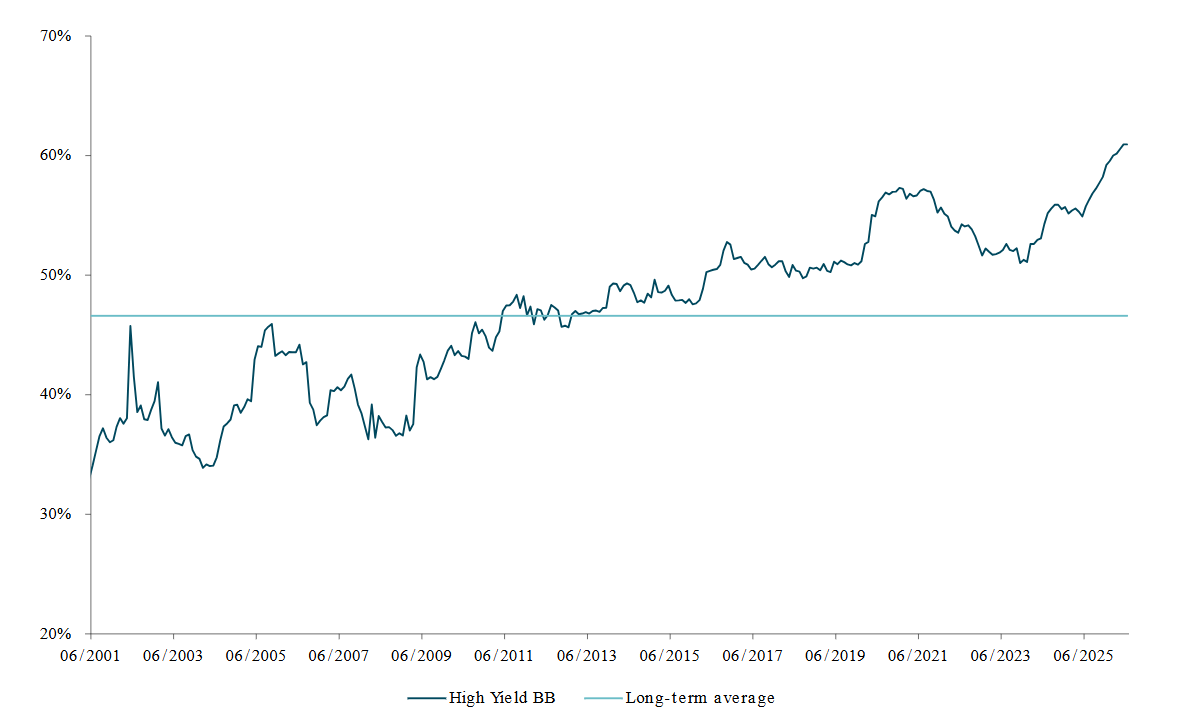
Chart is for illustrative purposes only. The line chart shows high yield bonds with a BB credit rating as a percentage of the high yield bond universe, as represented by a weighted combination of both developed European and developed US high yield bonds, in US dollar terms.
3. Floating-rate credit: income that adapts
Floating-rate credit can also play an important role in today’s environment, where interest rates remain uncertain but are likely to stay relatively high. These instruments typically pay coupons that reset regularly in line with market rates, meaning income adjusts over time rather than staying fixed. As a result, they tend to have very low sensitivity to changes in interest rates, which can help reduce price volatility compared with traditional fixed-rate bonds.
If rates remain elevated or rise further, the income generated by floating-rate credit adjusts accordingly. By contrast, fixed-rate bonds lock in a set level of income, which may become less attractive if market yields move higher. Floating-rate instruments can therefore be more resilient in periods of rising or volatile rates, with prices generally more stable than those of fixed-rate bonds. In this context, floating-rate corporate credit can potentially provide a useful complement for investors looking to move beyond cash, offering enhanced income potential while maintaining a relatively defensive profile against rate changes. As with all credit investing, careful security selection remains important, particularly given evolving credit conditions.
4. Asset‑backed securities: structured, floating‑rate income
Asset-backed securities (ABS) can offer another way to earn income while maintaining relatively low interest-rate sensitivity. Many ABS investments have floating-rate coupons and can provide diversification away from traditional corporate credit risk. This means their income adjusts with market rates, while their prices are less sensitive to changes in government or corporate bond yields. As a result, ABS has historically exhibited low-to-moderate correlation with government bonds, supporting its role as a diversifier within fixed income allocations.
Unlike traditional corporate credit, ABS is backed by pools of underlying assets such as mortgages, consumer loans or auto loans. This creates a diversified and granular source of cash flows, as returns depend on many individual borrowers rather than a single issuer. These loans are often secured against underlying assets, while ABS structures also include built-in protections designed to absorb losses. Features such as subordination, excess spread and sequential payments create layers of defence, meaning the more senior parts of the structure are better protected if some of the underlying loans perform poorly.
These characteristics support our view that ABS can complement other short-dated and floating-rate credit strategies. By combining adaptable income, diversification and structural buffers, and by offering a return profile that is less dependent on duration, ABS can be used to seek cash-plus returns while maintaining a controlled approach to both interest rate and credit risk.
Conclusion
Taken together, we believe the current environment continues to favor income-driven strategies that are less reliant on duration. With policy uncertainty likely to persist and yields still elevated, the case for moving selectively beyond cash is increasingly compelling, particularly where investors can seek credit premia without materially increasing interest rate sensitivity.
In this context, short-dated and floating-rate credit offer a differentiated return profile, combining attractive levels of contractual income with a lower exposure to both rate and spread volatility. By focusing on shorter maturities and robust credit structures, investors can potentially access more stable, carry-driven returns, while retaining flexibility to reinvest as market conditions evolve.
In our view, this provides a more efficient way to enhance portfolio income, allowing investors to step out of cash in a controlled manner while maintaining resilience across a range of interest rate scenarios.
1Source: Bloomberg, data as of July 27, 2026. Dashed line indicates projections. Chart is for illustrative purposes only.
2Bloomberg, as of May 28, 2026. ICE BofA 1-5 Year Global Corporate Index and ICE BofA Global Corporate Index.
3Insight Investment and ICE BofA Bond Indices as of December 31, 2025. For illustrative purposes only. 30-day rolling total return volatility (annualised) is based on ICE BofA 1-5 Year Global Corporate Index and ICE BofA Global Corporate Index.
4Insight and Bloomberg as of September 30, 2025. Chart compares the Bloomberg Agg Credit 1-5 years (USD hedged) and the Bloomberg Agg Credit (USD hedged) during times of market stress.
5Source: Bank of America Global Research, data as of June 30, 2026. The high yield data shown is a combination of developed market European high yield and US high yield issues, denominated in US$. The line chart shows high yield bonds (both European and US) with a BB credit rating as a percentage of the European and US high yield universe. It shows that, over time, the percentage of BB-rated credits within the high yield universe has increased. Companies or bonds rated 'BB' by Standard & Poor’s (or 'Ba" by Moody’s) sit at the upper end of the sub-investment grade (high yield) credit rating spectrum, so if more bonds or companies in the sub-investment grade universe have moved into the upper echelon of this universe, it signals that the aggregate credit quality of the universe has improved.
Updated as of October 1, 2026.
Important Information
All investments involve risk including loss of principal. Certain investments involve greater or unique risks that should be considered along with the objectives, fees, and expenses before investing. Past performance is not necessarily indicative of future results. Asset allocation and diversification do not ensure a profit or protect against a loss.
Asset class comparisons such as comparing cash to bonds have limitations because different asset classes may have characteristics that materially differ from each other. Because of these differences, comparisons should not be relied upon solely as a measure when evaluating an investment for any particular portfolio. Comparisons are provided for illustrative purposes only.
Index glossary
ICE BofA 1–5 Year Global Corporate Index. A global corporate bond index tracking investment-grade, fixed-rate debt issued by corporate borrowers, with remaining maturities between 1 and 5 years. It is used as a benchmark for short- to intermediate-duration global corporate bond portfolios.
ICE BofA Global Corporate Index. A broad global benchmark measuring the performance of investment-grade corporate bonds issued across multiple sectors and maturities. It captures fixed-rate corporate debt from multiple currencies and regions.
Bloomberg Global Aggregate Credit (All Maturities). A component of the Bloomberg Global Aggregate Index that includes investment-grade corporate and government-related debt from developed and emerging markets, across all maturities. It is commonly used to benchmark diversified global investment-grade credit exposure.
Bloomberg Global Aggregate Credit 1–5 Years. A shorter-duration subset of the Bloomberg Global Aggregate Credit Index covering investment-grade corporate and government-related bonds with 1 to 5 years remaining maturity. It is often used for benchmarking lower-duration global credit strategies.
“BLOOMBERG” and the Bloomberg indices listed herein (the “Indices”) are service marks of Bloomberg Finance L.P. and its affiliates, including Bloomberg Index Services Limited (“BISL”), the administrator of the Indices (collectively, “Bloomberg”) and have been licensed for use for certain purposes by the distributor hereof (the “Licensee”). Bloomberg is not affiliated with Licensee, and Bloomberg does not approve, endorse, review, or recommend the financial products named herein (the “Products”). Bloomberg does not guarantee the timeliness, accuracy, or completeness of any data or information relating to the Products.
Investors cannot invest directly into any index.
Terminology
Short-dated global credit. Global corporate bonds with maturities typically of one to three years. These shorter maturity bonds offer lower interest rate and credit risk compared to longer-dated bonds. Their lower volatility profile provides an option for investors seeking stability and resilience in a volatile market or in times of economic uncertainty.
Floating-rate credit. Loans or bonds whose interest rate changes periodically based on a benchmark market index. This type of variable rate (or adjustable rate) is common in various debt instruments, including mortgages and corporate loans, where the cost of borrowing adjusts with economic shifts.
Asset-backed securities (ABS). Pools of loans packaged and sold as securities – a process known as “securitisation”. Typically, the assets backing these are home mortgages or credit card receivables.
Short-dated Investment Grade (IG) credit. Investment-grade corporate bonds with maturities typically of one to three years. These shorter maturity bonds offer lower interest rate and credit risk compared to longer-dated bonds. Their lower volatility profile provides an option for investors seeking stability and resilience in a volatile market or in times of economic uncertainty.
Credit ratings. Credit ratings are an assessment of the creditworthiness of a company or government, indicating the likelihood that they will meet their financial obligations on time. Investors use credit ratings to determine the risk of buying bonds or other debt from issuing entities. Specialised credit rating agencies that issue ratings on companies and governments include Moody’s, S&P Global and Fitch Ratings.
Risks: Bonds are subject generally to interest-rate, credit, liquidity, call and market risks, to varying degrees. Generally, all other factors being equal, bond prices are inversely related to interest-rate changes and rate increases can cause price declines. Investment grade is a rating of fixed-income bonds, bills, and notes by credit rating agencies. High yield bonds involve increased credit and liquidity risk than higher rated bonds and are considered speculative in terms of the issuer’s ability to pay interest and repay principal on a timely basis. Municipal income may be subject to state and local taxes for out-of-state residents. Some income may be subject to the federal alternative minimum tax for certain investors. Capital gains, if any, are taxable. Asset-Backed Securities (ABS) are financial securities such as a bond or note collateralized by a pool of assets such as loans, leases, credit card debt, royalties, or receivables. Mortgage-Backed Securities (MBS) are investments similar to a bond made up of a bundle of home loans bought from the banks that issued them. Investors in MBS receive periodic payments similar to bond coupon payments. Floating rate loan securities may include irregular trading activity, wide bid/ask spreads and extended trade settlement periods. The value of any collateral, if any, securing a floating rate loan can decline, and may be insufficient to meet an issuer’s obligations in the event of non-payment of schedule interest or principal or may be difficult to readily liquidate. Although generally less sensitive to interest rate changes than fixed-rate instruments, the value of floating rate loans securities may decline if their interest rates do not rise as quickly, or as much, as general interest rates.
Bond ratings reflect the rating entity’s evaluation of the issuer’s ability to pay interest and repay principal on the bond on a timely basis. Bonds rated BBB/Baa or higher are considered investment grade, while bonds rated BB/Ba or lower are considered speculative as to the timely payment of interest and principal. Credit ratings reflect only those assigned by Nationally Recognized Statistical Rating Organizations (NRSRO) that have rated fund holdings. Split-rated bonds, if any, are reported in the higher rating category.
This information contains projections or other forward-looking statements regarding future events, targets or expectations, and is only current as of the date indicated. There is no assurance that such events or expectations will be achieved, and actual results may be significantly different from that shown here. The information is based on current market conditions, which will fluctuate and may be superseded by subsequent market events or for other reasons.
BNY Investments is the brand name for the investment management business of BNY and its investment firm affiliates worldwide. BNY is the corporate brand of The Bank of New York Mellon Corporation and may be used to reference the corporation as a whole or its various subsidiaries generally.
The information contained herein reflects general views and is provided for informational purposes only. This material is not intended as investment advice nor is it a recommendation to adopt any investment strategy.
Opinions and views expressed are subject to change without notice.
Past performance is no guarantee of future results.
Issuing entities
This material is only for distribution in those countries and to those recipients listed, subject to the noted conditions and limitations: • United States: by BNY Mellon Securities Corporation (BNYSC), 240 Greenwich Street, New York, NY 10286. BNYSC, a registered broker-dealer and FINRA member, has entered into agreements to offer securities in the U.S. on behalf of certain BNY Investments firms. • Europe (excluding Switzerland): BNY Mellon Fund Management (Luxembourg) S.A., 2-4 Rue EugèneRuppertL-2453 Luxembourg. • UK, Africa and Latin America (ex-Brazil): BNY Mellon Investment Management EMEA Limited, BNY Mellon Centre, 160 Queen Victoria Street, London EC4V 4LA. Registered in England No. 1118580. Authorised and regulated by the Financial Conduct Authority. • South Africa: BNY Mellon Investment Management EMEA Limited is an authorised financial services provider. • Switzerland: BNY Mellon Investments Switzerland GmbH, Bärengasse 29, CH-8001 Zürich, Switzerland. • Middle East: DIFC branch of The Bank of New York Mellon. Regulated by the Dubai Financial Services Authority. • South-East Asia and South Asia: BNY Mellon Investment Management Singapore Pte. Limited Co. Reg. 201230427E. Regulated by the Monetary Authority of Singapore. • Hong Kong: BNY Mellon Investment Management Hong Kong Limited. Regulated by the Hong Kong Securities and Futures Commission. • Japan: BNY Mellon Investment Management Japan Limited. BNY Mellon Investment Management Japan Limited is a Financial Instruments Business Operator with license no 406 (Kinsho) at the Commissioner of Kanto Local Finance Bureau and is a Member of the Investment Trusts Association, Japan and Japan Investment Advisers Association and Type II Financial Instruments Firms Association. • Brazil: ARX Investimentos Ltda., Av. Borges de Medeiros, 633, 4th floor, Rio de Janeiro, RJ, Brazil, CEP 22430-041. Authorized and regulated by the Brazilian Securities and Exchange Commission (CVM). • Canada: BNY Mellon Asset Management Canada Ltd. is registered in all provinces and territories of Canada as a Portfolio Manager and Exempt Market Dealer, and as a Commodity Trading Manager in Ontario. All issuing entities are subsidiaries of The Bank of New York Mellon Corporation.
No part of this material may be reproduced in any form, or referred to in any other publication, without express written permission. All information contained herein is proprietary and is protected under copyright law.
NOT FDIC INSURED | NO BANK GUARANTEE | MAY LOSE VALUE |
©2026 THE BANK OF NEW YORK MELLON CORPORATION
MARK-982628-2026-08-06
GU-922 - 29 January 2027