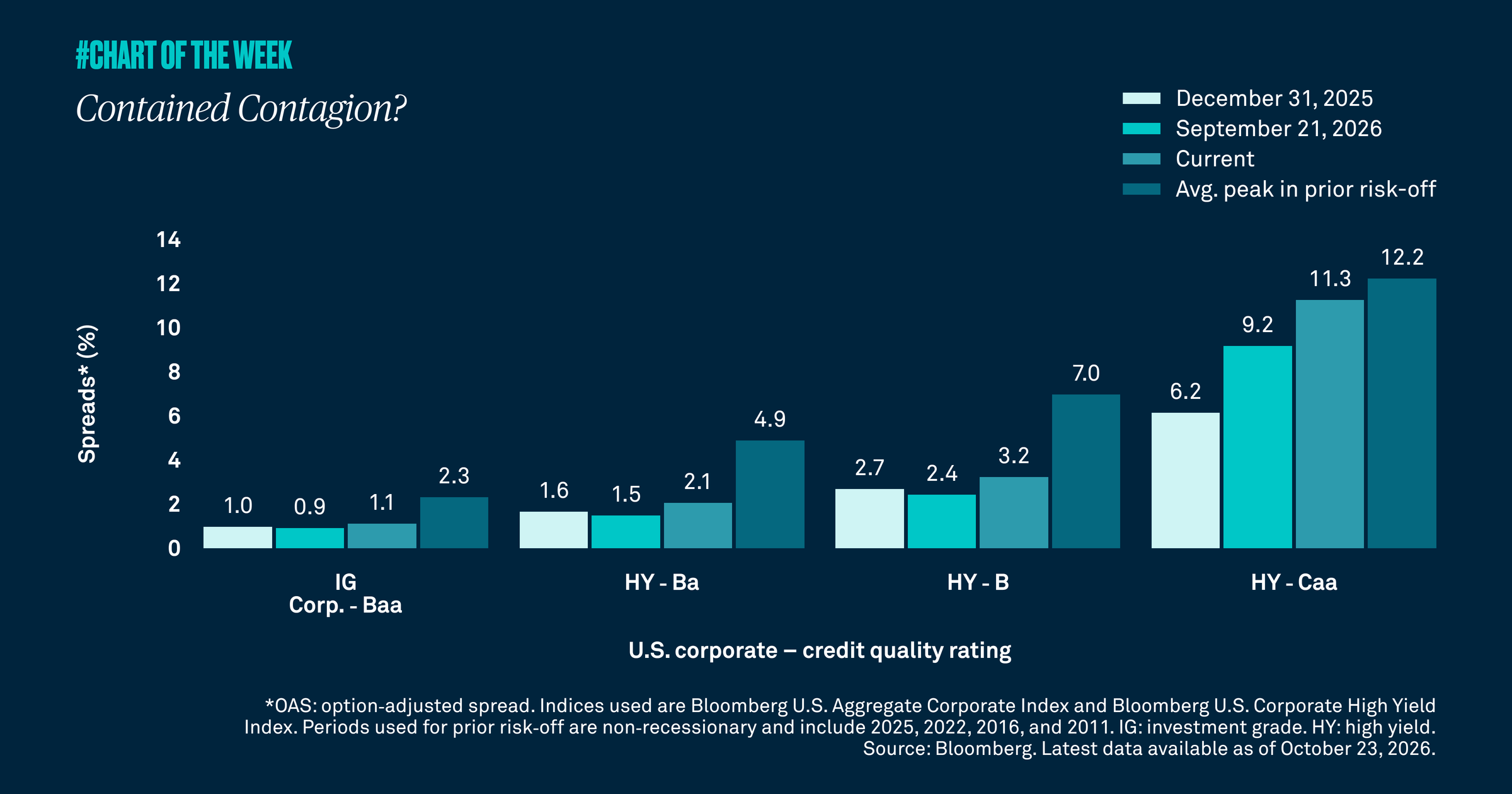
U.S. high yield credit spreads have widened year to date, reflecting greater investor caution about perceived default risk. The move also raises concerns about possible credit contagion. However, because spread widening has been concentrated in the lowest-quality issuers rather than higher-quality issuers, we don’t anticipate broader market stress.
When high yield credit spreads widen, it signals that investors are demanding greater compensation to hold riskier corporate debt. That typically reflects rising concern about higher default risk or a weaker economic outlook. As stress builds in credit markets, financial conditions also tend to tighten.
In the U.S., high yield spreads have widened notably year to date, raising concern among some investors about the potential for credit contagion — when stress in one segment of the market spreads more broadly and fuels risk aversion across asset classes.
So far, however, the widening has been concentrated largely among the lowest-quality issuers. Spreads for higher-quality companies also remain well below the levels seen in prior risk-off periods. That suggests investors are repricing risk at the weakest end of the market rather than signaling systemic stress across the broader economy or credit system.
In our view, the market is differentiating between fragile borrowers and fundamentally stronger issuers, a sign of normal credit discipline, not broad contagion. We therefore remain constructive on the U.S. economic outlook, while continuing to monitor whether stress begins to spread to higher-quality issuers.