
Flexible, low-risk bond strategies that are unconstrained by benchmarks have multiple applications in today’s markets.
A strategy designed to seek positive returns, regardless of wider market moves, can play a distinct role within portfolios. Amid continuing market volatility and uncertainty, many investors are turning to absolute return bond strategies to accomplish three objectives:
- Reduce broad credit exposure when spreads are tight
- Increase resilience in the face of tail risks
- Pursue relatively low-risk, cash-plus returns as a strategic allocation.
1. Reduce broad credit market exposure
Adding an absolute return bond strategy to a portfolio can potentially reduce the impact of market downturns. While the performance of traditional active fixed income strategies is largely driven by their sensitivity to broad bond market movements, absolute return bond strategies typically exhibit little or no benchmark risk exposure.
When credit spreads are tight, such strategies can reduce broad credit market risk exposure and preserve gains should spreads widen again to more typical levels. Managers can dynamically shift allocations by holding liquid positions that can be adjusted quickly.
An absolute return bond strategy is not the only way to address concerns around credit market exposure. For example, an investor may choose a strategy that emphasises shorter-dated assets, or use asset-backed securities, which can offer a yield premium relative to corporate bonds of a similar credit rating.
2. Increase tail-risk resilience
Given heightened geopolitical uncertainty, many investors are concerned about tail risks and how to minimise them. It can be difficult for investors to assess large, unexpected market moves that fall outside the normal distribution of returns. However, absolute return bond strategies are designed to mitigate these challenges through diversification, high liquidity instruments and keen risk awareness.
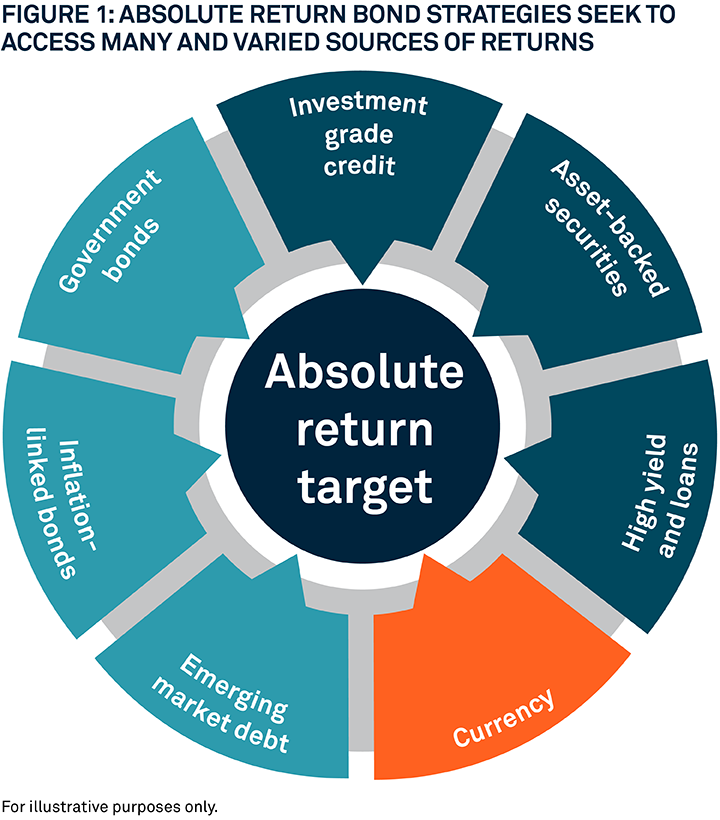
- Diversification: Absolute return bond managers have flexibility to dynamically allocate positions across bond asset classes while actively adjusting exposures to duration, yield curve positioning, currency, inflation, and credit relative value. Figure 1 illustrates some key potential sources of return.
Each position can be calibrated to contribute a specific amount of risk, and when fear in any market rises, short positions can be taken. - Liquidity: Portfolio views can be implemented using highly liquid instruments. This can be crucial, as tail-risk events typically unfold rapidly, and liquidity in cash bond markets can become challenged in these scenarios.
- Risk awareness: An absolute return bond manager is typically acutely sensitive to risk and seeks to adjust risk exposures as needed if conditions change. This is particularly important as momentum can mean that markets poorly price tail risks.
3. Make idle cash work harder
In the current environment, many investors are adopting a more cautious stance, with substantial allocations to cash and government bonds aimed at preserving value or bolstering hedging programmes. But could these investments work harder? Are investors leaving money on the table by waiting for a more opportune time to reintroduce market exposure?
Absolute return bond strategies have the potential to deliver cash-plus returns with relatively low volatility, which could help investors build resilience over time. Remaining over-invested in cash or cash equivalents is, in our view, unlikely to improve investors’ ability to deal with future market crises.
We find that a conservative absolute return bond strategy can be an attractive complement to investors’ allocations to cash or asset-backed securities, given its liquidity, cash-plus target and low volatility.
Pursue intentional risks and returns
A fully flexible approach to portfolio construction can be a useful way to reduce volatility. It means that, whenever markets are overly fearful or exuberant, a manager has the broadest choice of mispriced securities or markets to buy or sell. Trades can be implemented using highly liquid instruments, with a hyper-sensitivity to unrewarded risk and ultimately in pursuit of a cash-plus target.
We believe these strategies can help investors diversify fixed income holdings at a time when credit spreads are relatively tight, provide protection against unanticipated tail risk events, or simply seek to deliver enhanced cash-plus returns to build further resilience over time.
The value of investments and the income received can fall as well as rise and investors may not get back the original amount invested.
3296170 Exp: 27 October 2026