Please ensure Javascript is enabled for purposes of website accessibility Is the job market stabilizing?
hk
en
institutional
institutional
false
true
Gathering data
Disclaimer Not Available

Is the job market stabilizing?

Is the job market stabilizing?

After sluggish job growth in 2025, investors are looking for signs that the labor market may be stabilizing. With consumer spending driving 70% of economic activity, an improving labor market is essential to sustaining economic growth. 
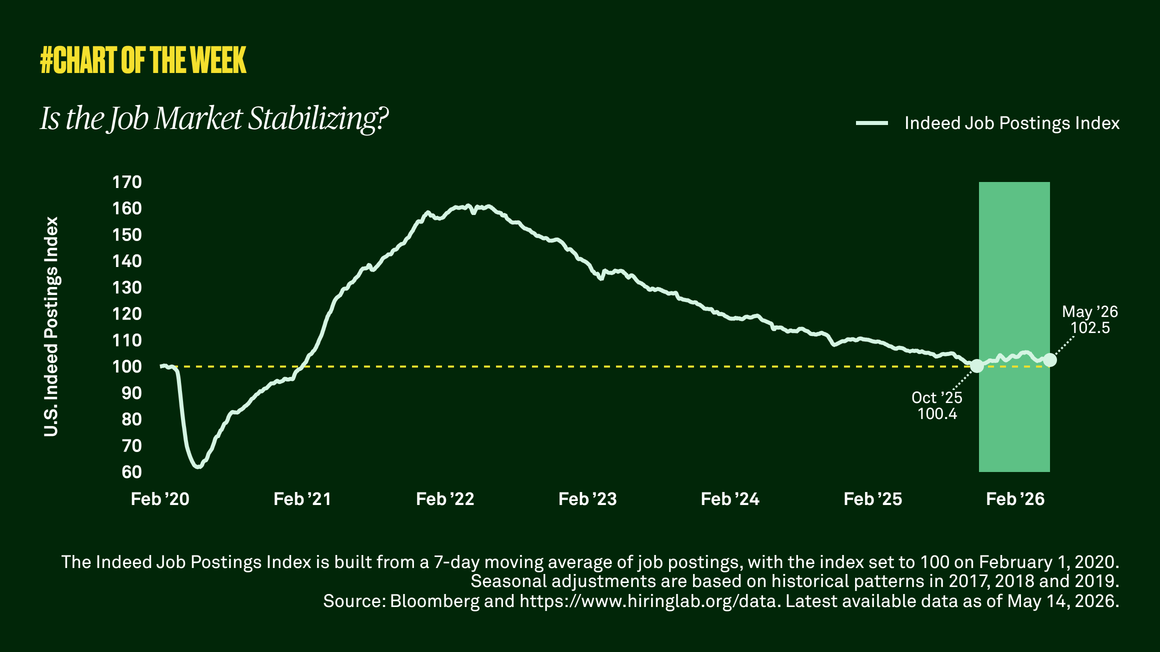

Since April 2022, job availability, as measured by the Indeed Job Postings Index, has trended lower, softening confidence in the labor market. With consumer spending accounting for 70% of gross domestic product (GDP), lower confidence in the ability to find jobs could prompt consumers to pull back spending — and weigh on economic growth.

Recently, however, the Indeed Job Postings Index has shown signs of stabilizing, along with other job market indicators. The Index has been in an uptrend since last October and job growth year to date stands at 304,000, compared to the 116,000 jobs for all of 2025. Initial weekly jobless claims — a timelier measure of labor market health — have averaged 204,000 over the last four weeks, the lowest in four years. Continuing jobless claims have also fallen from their peak of 1.96 million in July of 2025 to 1.77 million – the lowest in over two years. And, despite recent headlines, layoffs year to date through April are the lowest since 2022.

While job growth may be resetting to a lower monthly average because of aging demographics, reduced immigration and improved productivity, stabilization of the labor market may be another positive sign for the consumer and the broader economy.
RELATED CONTENT
Is the market rally broadening?
Chart of the Week | Macroeconomic

Stocks, as measured by the S&P 500, are up over 13% through early August. The solid gains have been fueled by a resilient economy, steady consumer spending, optimism around artificial intelligence and better-than-expected earnings growth. Still, some investors worry the advance may be too concentrated in technology and that AI-capex monetization may fall short of expectations. A closer look suggests that it is not just tech moving the market higher.

Fed friction?
Chart of the Week | Macroeconomic

Markets are navigating tensions between a Fed that offers less guidance and an inflation backdrop that remains sticky. Added uncertainty from Middle East tensions and energy-price swings is further shaping sentiment, with recent moves in Treasury yields suggesting the market wants the Fed to hike. However, with yield volatility expected to linger in the near term, we see today’s elevated Treasury yields as an especially compelling opportunity in fixed income.

cotw_27_07_2026
Chart of the Week | Macroeconomic

The war in Iran has increased volatility across fixed income markets, pushing municipal bond yields higher as investors reassess inflation risk, energy costs and the path of Federal Reserve policy. Even so, historically elevated municipal bond yields present a compelling opportunity for tax-sensitive investors.

Sizing up small caps
Chart of the Week | Macroeconomic

Small caps have outperformed this year despite the threat of higher interest rates, suggesting the rally is being driven by more than just diversification away from large cap tech stocks. Improving earnings expectations and a resilient U.S. economy support our view that small caps have further upside from here.

Gathering data
Disclaimer Not Available

CONTACT US  |  +852 3926 0600