
Artificial intelligence (AI)-related funding needs are expected to support elevated credit issuance over the next few years. This may create potential investment opportunities but also material risks, reinforcing the importance of careful positioning and rigorous credit selection.
According to S&P Global estimates, the volume of credit issuance funding the buildout of AI capabilities could be as high as US$400bn in 2026.1 This figure includes the capital expenditure needs of hyperscalers as well as software and technology providers. If realised, this is likely to make 2026 the largest year for investment-grade credit issuance.2
The market has so far absorbed the additional supply, but we remain cautious about supply outpacing demand. Spreads have stabilised in recent months as some companies have issued equity alongside debt, and this has helped to reassure markets; however, large volumes of issuance are still expected in the years ahead. We are concerned that each wave of issuance risks pushing spreads wider, as investors are aware that many further waves of funding may lie ahead.
Spreads in AI-related sectors have underperformed
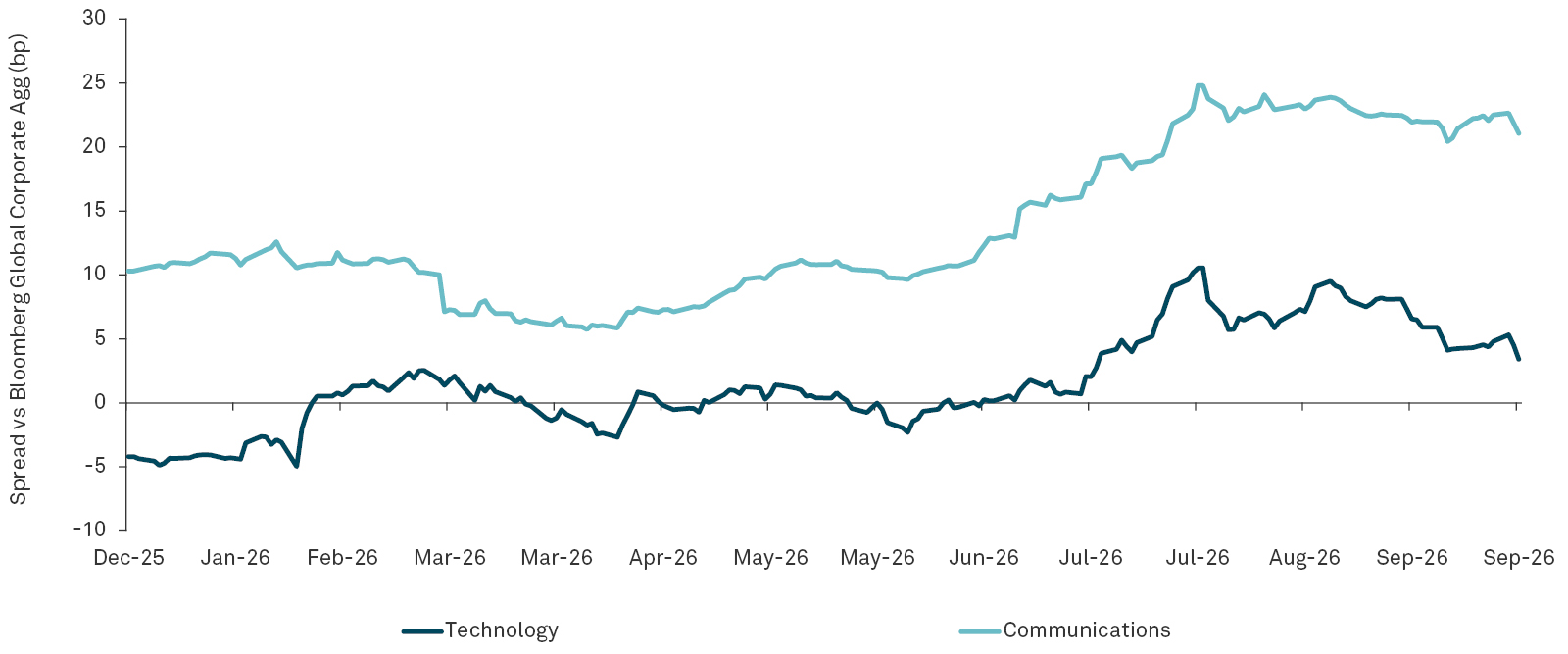
Source: Insight and Bloomberg. Data as of 30 September 2026. Chart is for illustrative purposes only.
A second risk stems from the scale of hyperscaler issuance. With this debt typically being AA-rated, it may attract significant demand from index-tracking credit funds. This has the potential to crowd out other corporate issuers and put pressure on spreads elsewhere in the market. Identifying and recognising these risks is a core part of our active investment process.
High-yield markets appear less affected
The majority of AI-related funding has occurred in the investment-grade credit market so far. By comparison, high-yield credit has approximately a third of the exposure to AI capital raising. In May, high-yield issuance from companies involved in data centres, cloud computing, semiconductors or digital infrastructure comprised 6.2% of total US high-yield issuance – compared with 17.8% in investment-grade credit.3
High-yield debt has the lowest levels of AI exposure
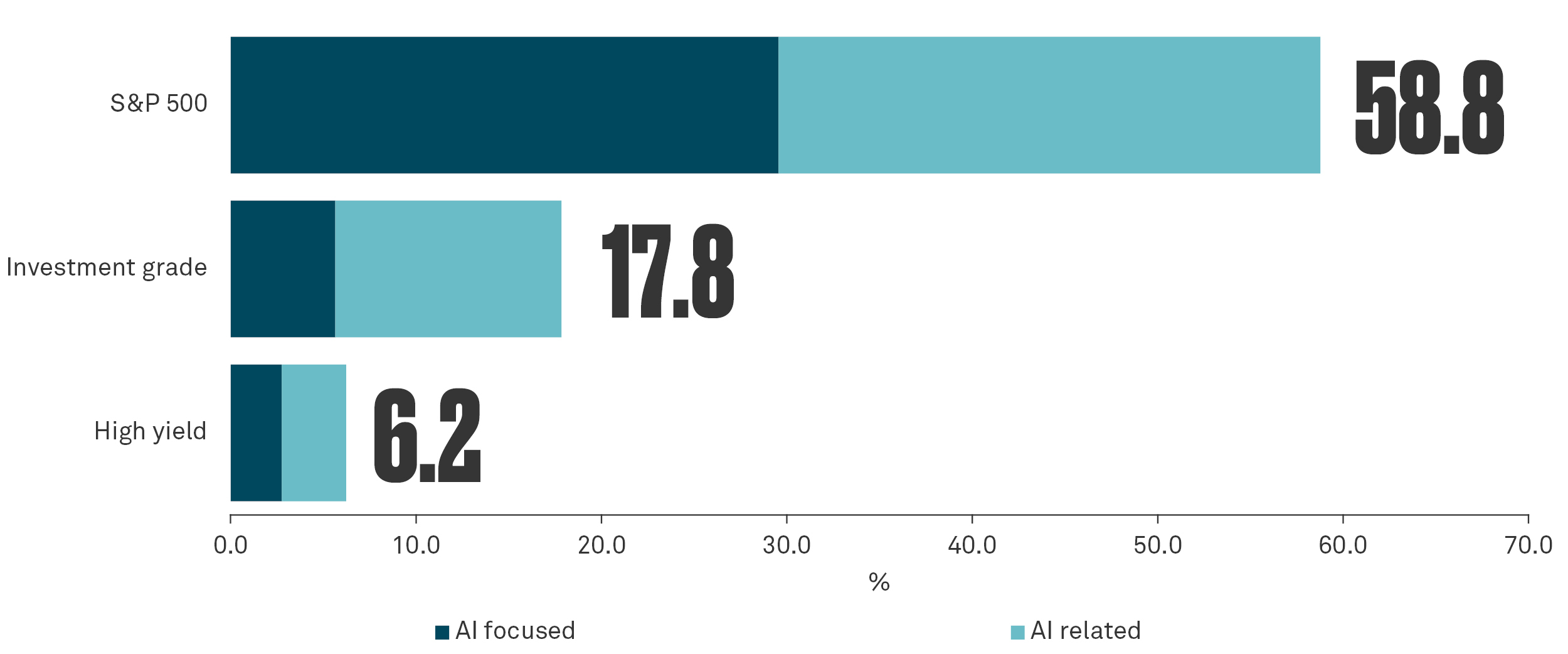
Source: Goldman Sachs, JP Morgan, Insight, Bloomberg (Bloomberg US Corporate Index, Bloomberg US Corporate High Yield Index, S&P 500 Index), 6 August 2026. Chart is for illustrative purposes only.
Another insulating factor for high-yield markets is the lower weighting of software issuers. Software is widely regarded by market participants as among the sectors most exposed to AI disruption. Software issuers are typically in the investment-grade universe. By contrast, the high-yield market has greater exposure to sectors such as basic industry, energy and capital goods, where disruption risks appear more limited, or where AI could even be used to increase margins and profitability.
If AI proves to be highly disruptive to investment-grade software issuers, some could be downgraded to high-yield, becoming so-called “fallen angels”. This could create both risks and opportunities. Careful credit analysis will be needed to pinpoint which businesses are at risk from downgrade and which are simply caught up in the broad-based shift in market sentiment. For those downgraded, it will be important to distinguish between companies facing impairment and those capable of recovering and adapting. High-yield indices may include fallen angels after downgrade, even if they are passing through on the way to default.
Dividing potential risk and opportunity
The credit issuance of hyperscalers may be considered attractive on paper. It is backed by companies with high credit ratings (typically AA), and with large proven cash flows, which have historically had little need for issuance in the debt markets. For this reason, some of the deals had been oversubscribed.
However, the projected scale of issuance has materially changed the outlook. This is not because of any expectation that these credits may significantly deteriorate, or that valuations have become unattractive, but simply because the scale of future issuance may keep pushing spreads wider, potentially eroding the benefit from holding the issuance.
We observe that investors routinely assess new issuance to determine whether the risks are adequately compensated, and significant variations between hyperscaler deals have become apparent over time. Markets may adopt a broad range of funding structures over time to attract funding from different investors, and we believe investor protections can vary across deals, making careful analysis important when evaluating individual opportunities.
Bond indices projected to change
Over the long term, we believe the scale of issuance could have a significant impact on global credit indices. The size of the technology sectors has increased during 2026, and this trend could continue for years to come.
Weight of global technology sector as % of Bloomberg Global Aggregate Corporate Index
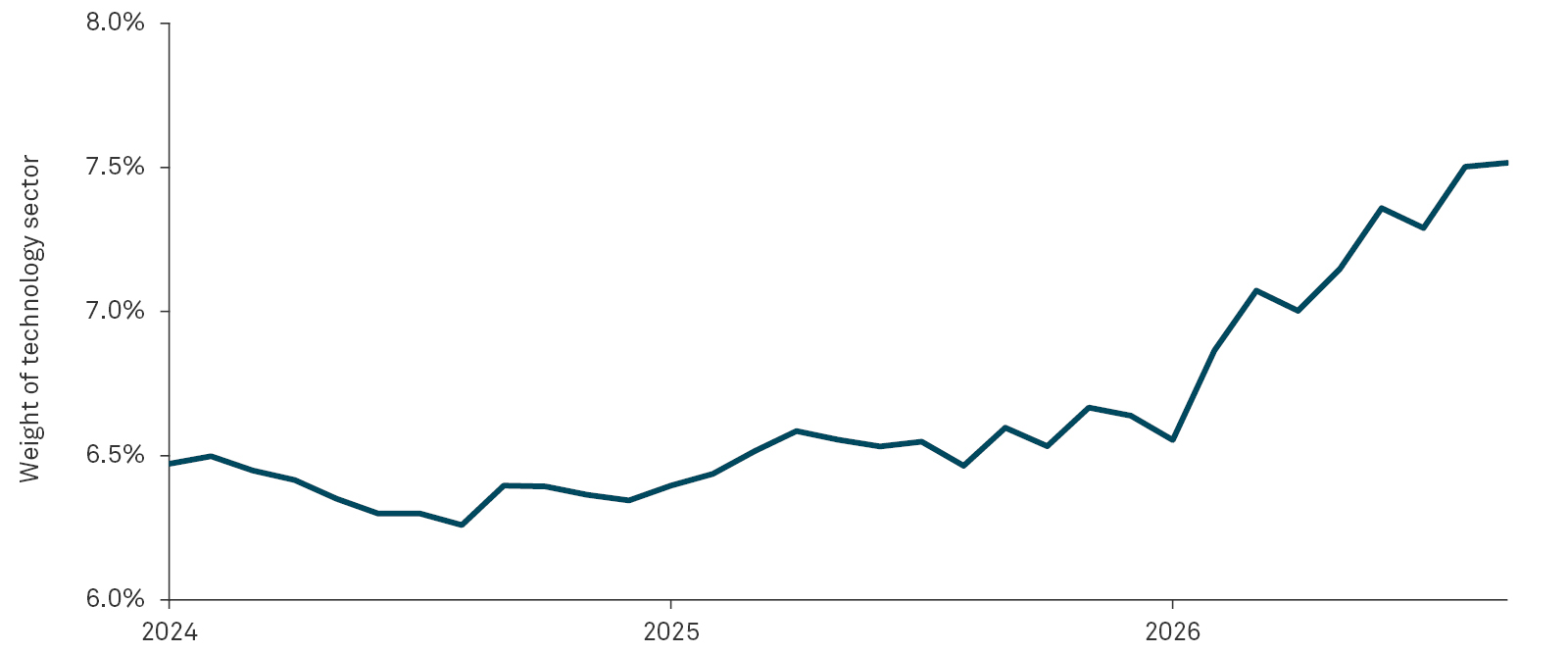
Source: Insight and Bloomberg. Data as of 30 September 2026. Chart is for illustrative purposes only.
A large proportion of this debt is issued in longer maturities so that it matches the life of the infrastructure it is funding. This is likely to push the duration of credit indices longer but also increase the liquidity pool in longer-dated credit.
Navigating AI-driven change in credit markets
We expect uncertainty and volatility around AI issuance to remain a feature of credit markets for the foreseeable future. In this context, we believe that identifying where markets may have mispriced these risks may become an important source of potential investment opportunity.
Endnotes
1S&P Global. 27 July 2026
2S&P Global. 27 July 2026
3Goldman Sachs, JP Morgan, Insight, Bloomberg (Bloomberg US Corporate Index, Bloomberg US Corporate High Yield Bond Index, S&P 500 Index), 6 August 2026.
About Insight Investment
Insight Investment is a leading global investment manager and fixed income specialist firm within BNY Investments.
Appendix
AA-rated bonds are fixed-income securities judged to have a very strong capacity to meet financial commitments, with only slightly more risk than top-tier AAA bonds. They are considered high-grade investments that are safe but not immune to adverse economic conditions.
Artificial intelligence (AI) is a term for computer systems that can perform tasks typically requiring human intelligence, such as visual perception, speech recognition, decision-making, and language translation.
Credit ratings are an assessment of the creditworthiness of a company or government, indicating the likelihood that they will meet their financial obligations on time. Investors use credit ratings to determine the risk of buying bonds or other debt from issuing entities. Specialised credit rating agencies that issue ratings on companies and governments include Moody’s, S&P Global and Fitch Ratings.
Credit spread is the difference in yield between a bond and a comparable “risk-free” government bond (typically a US Treasury) of the same maturity. A wide credit spread means the yield gap between the corporate bond and the risk-free benchmark is large. A narrow credit spread means the yield gap between the corporate bond and the risk-free benchmark is small.
Duration is a measure of how sensitive a bond's price is to changes in interest rates. The longer the duration, the more sensitive the price.
Fallen angels are bonds that were investment grade but have been downgraded to high yield.
Fixed-rate bonds pay the same interest rate for the whole life of the bond. This means investors know in advance how much interest they will receive and when.
Hyperscalers are very large technology companies that run huge networks of data centres and provide cloud computing services at scale.
Investment grade refers to bonds or other debt securities that have been rated by credit rating agencies as having a relatively low risk of default.
Liquidity is how easily an investment can be bought or sold without much effect on its price.
Maturity is the date a bond's money is repaid. Longer-dated bonds are repaid further in the future.
The Bloomberg Global Aggregate Corporate Index is a flagship, multi-currency benchmark that measures global investment-grade, fixed-rate corporate debt.
The Bloomberg US Corporate High Yield Bond Index measures the US dollar-denominated, high yield, fixed-rate corporate bond market.
The Bloomberg US Corporate Index measures the US dollar-denominated, investment grade, fixed-rate, taxable corporate bond market.
The S&P 500 Index is a widely accepted, unmanaged index of US stock market performance.
“BLOOMBERG” and the Bloomberg indices listed herein (the “Indices”) are service marks of Bloomberg Finance L.P. and its affiliates, including Bloomberg Index Services Limited (“BISL”), the administrator of the Indices (collectively, “Bloomberg”) and have been licensed for use for certain purposes by the distributor hereof (the “Licensee”). Bloomberg is not affiliated with Licensee, and Bloomberg does not approve, endorse, review, or recommend the financial products named herein (the “Products”). Bloomberg does not guarantee the timeliness, accuracy, or completeness of any data or information relating to the Products.
Risks
Bonds are subject generally to interest-rate, credit, liquidity, call and market risks, to varying degrees. Generally, all other factors being equal, bond prices are inversely related to interest-rate changes and rate increases can cause price declines. Investment grade is a rating of fixed-income bonds, bills, and notes by credit rating agencies. High yield bonds involve increased credit and liquidity risk than higher rated bonds and are considered speculative in terms of the issuer’s ability to pay interest and repay principal on a timely basis.
Bond ratings reflect the rating entity’s evaluation of the issuer’s ability to pay interest and repay principal on the bond on a timely basis. Bonds rated BBB/Baa or higher are considered investment grade, while bonds rated BB/Ba or lower are considered speculative as to the timely payment of interest and principal. Credit ratings reflect only those assigned by Nationally Recognized Statistical Rating Organizations (NRSRO) that have rated fund holdings. Split-rated bonds, if any, are reported in the higher rating category.
This information contains projections or other forward-looking statements regarding future events, targets or expectations, and is only current as of the date indicated. There is no assurance that such events or expectations will be achieved, and actual results may be significantly different from that shown here. The information is based on current market conditions, which will fluctuate and may be superseded by subsequent market events or for other reasons.
Important information
BNY Investments is the brand name for the investment management business of BNY and its investment firm affiliates worldwide. BNY is the corporate brand of The Bank of New York Mellon Corporation and may be used to reference the corporation as a whole or its various subsidiaries generally.
The information contained herein reflects general views and is provided for informational purposes only. This material is not intended as investment advice nor is it a recommendation to adopt any investment strategy.
Opinions and views expressed are subject to change without notice.
Past performance is no guarantee of future results.
Issuing entities
This material is only for distribution in those countries and to those recipients listed, subject to the noted conditions and limitations: • United States: by BNY Mellon Securities Corporation (BNYSC), 240 Greenwich Street, New York, NY 10286. BNYSC, a registered broker-dealer and FINRA member, has entered into agreements to offer securities in the U.S. on behalf of certain BNY Investments firms. • Europe (excluding Switzerland): BNY Mellon Fund Management (Luxembourg) S.A., 2-4 Rue EugèneRuppertL-2453 Luxembourg. • UK, Africa and Latin America (ex-Brazil): BNY Mellon Investment Management EMEA Limited, BNY Mellon Centre, 160 Queen Victoria Street, London EC4V 4LA. Registered in England No. 1118580. Authorised and regulated by the Financial Conduct Authority. • South Africa: BNY Mellon Investment Management EMEA Limited is an authorised financial services provider. • Switzerland: BNY Mellon Investments Switzerland GmbH, Bärengasse 29, CH-8001 Zürich, Switzerland. • Middle East: DIFC branch of The Bank of New York Mellon. Regulated by the Dubai Financial Services Authority. • South East Asia and South Asia: BNY Mellon Investment Management Singapore Pte. Limited Co. Reg. 201230427E. Regulated by the Monetary Authority of Singapore. • Hong Kong: BNY Mellon Investment Management Hong Kong Limited. Regulated by the Hong Kong Securities and Futures Commission. • Japan: BNY Mellon Investment Management Japan Limited. BNY Mellon Investment Management Japan Limited is a Financial Instruments Business Operator with license no 406 (Kinsho) at the Commissioner of Kanto Local Finance Bureau and is a Member of the Investment Trusts Association, Japan and Japan Investment Advisers Association and Type II Financial Instruments Firms Association. • Brazil: ARX Investimentos Ltda., Av. Borges de Medeiros, 633, 4th floor, Rio de Janeiro, RJ, Brazil, CEP 22430-041. Authorized and regulated by the Brazilian Securities and Exchange Commission (CVM). • Canada: BNY Mellon Asset Management Canada Ltd. is registered in all provinces and territories of Canada as a Portfolio Manager and Exempt Market Dealer, and as a Commodity Trading Manager in Ontario. All issuing entities are subsidiaries of The Bank of New York Mellon Corporation.
No part of this material may be reproduced in any form, or referred to in any other publication, without express written permission. All information contained herein is proprietary and is protected under copyright law.
NOT FDIC INSURED | NO BANK GUARANTEE | MAY LOSE VALUE |
©2026 THE BANK OF NEW YORK MELLON CORPORATION
MARK-1015266-2026-10-09
GU-961 - 9 October 2027