Please ensure Javascript is enabled for purposes of website accessibility Tracking the Margin Uptrend
ch
en
intermediary
intermediary
false
true
Gathering data
Disclaimer Not Available

Tracking the margin uptrend

Tracking the margin uptrend

Rising margin expectations continue to support equities, underscoring the resilience of corporate profitability in the face of last year’s tariffs and this year’s Middle East war. The U.S. remains especially strong compared to peers, though first quarter earnings will be an important test.
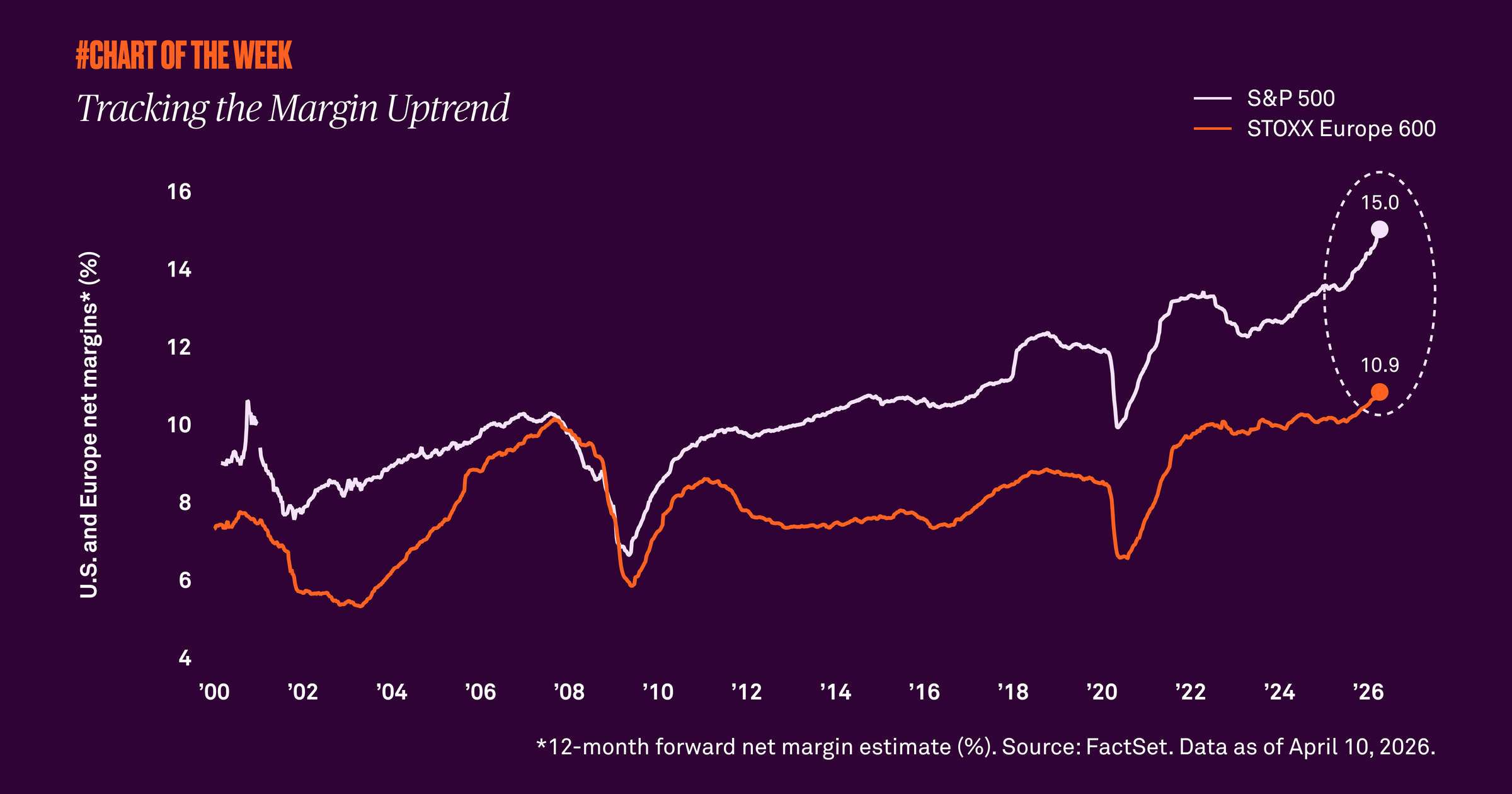

Margins remain one of the clearest indicators of corporate strength because they illustrate how much profit companies keep after absorbing the costs of doing business. The recent rise in future margin estimates is therefore an important support for equities.

What stands out now is the resilience of those margins. Despite last year’s tariff concerns and this year’s geopolitical uncertainty, margin expectations have continued to move higher rather than weaken. That suggests companies are still exercising pricing power, cost discipline and an ability to protect profitability in a more challenging environment.

Additionally, the U.S. continues to lead its peers. Forward S&P 500 profit margin estimates are near 15% versus roughly 11% in Europe, demonstrating the widest gap on record. That margin advantage helps support our positive view on U.S. equities, though first quarter earnings remain an important signal. Any meaningful weakness in guidance or downward margin revisions could pressure estimates, shift sentiment and increase volatility.  
RELATED CONTENT
In a real regime shift?
Chart of the Week | Macroeconomic

Higher inflation has been a dominant theme of the current decade. In addition to price shocks, it is being shaped by secular investment trends in infrastructure, defense spending, onshoring and the ongoing AI buildout. These structural changes reinforce the case for looking beyond traditional 60/40 portfolios to include real assets as a source of diversification and return potential in portfolios.

Getting real with real assets
Chart of the Week | Macroeconomic

Inflation appears to have transitioned from its pre-Covid average of 2% to a stickier point closer to 3%, and we do not expect a near-term return to prior levels. In this environment, we believe real assets, such as commodities, infrastructure and REITs, can provide inflation protection, diversification and return potential.

Not in a bubble
Chart of the Week | Macroeconomic

As the S&P 500 approaches all-time highs, there are renewed concerns among investors about elevated valuations. However, historically strong profitability and expected earnings growth appear to support current pricing. In addition, the current S&P 500 price-to-earnings (P/E) ratio is roughly equal to the average since Covid. As a result, we do not view U.S. equities as being in bubble territory and we remain constructive on the asset class.

Is the market rally broadening?
Chart of the Week | Macroeconomic

Stocks, as measured by the S&P 500, are up over 13% through early August. The solid gains have been fueled by a resilient economy, steady consumer spending, optimism around artificial intelligence and better-than-expected earnings growth. Still, some investors worry the advance may be too concentrated in technology and that AI-capex monetization may fall short of expectations. A closer look suggests that it is not just tech moving the market higher.

Gathering data
Disclaimer Not Available

This is a marketing communication