Please ensure Javascript is enabled for purposes of website accessibility Resilience Is a Historical Trend
at
de
institutional
institutional
false
true
Gathering data
Disclaimer Not Available

Resilience is a historical trend

Resilience is a historical trend

The S&P 500’s history shows that despite recessions, wars, inflation, and corrections, the market’s long-term trajectory has remained upward. As the U.S. marks 250 years of resilience, the lesson for investors is clear: wealth is built through patience, discipline and staying invested.
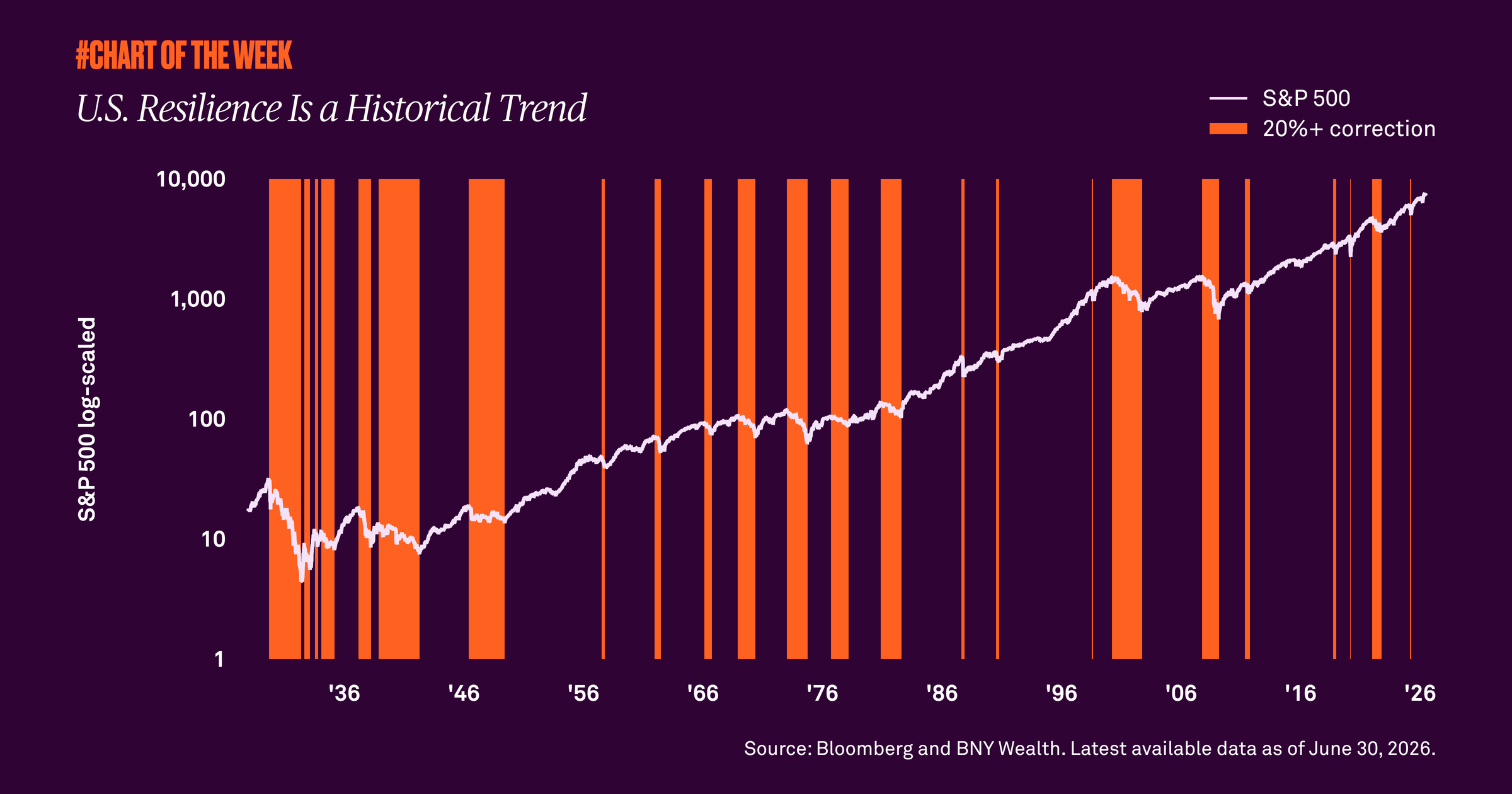

The S&P 500, in its current form, was introduced in 1957, building on Standard & Poor’s earlier 90-stock index, launched in 1926. Over the decades, it has endured recessions, wars, inflation, political division, corrections and bubbles — yet its long-term trajectory has remained upward. Its history is defined not by continuous gains, but by resilience: the capacity to absorb shocks and recover over time.

That lesson feels especially relevant as the U.S. marks its 250th anniversary. Like the market, the country’s history has never been smooth or free of conflict. Yet the broader American story is also one of endurance and long-term progress.

For investors, the message is simple: wealth building is a long-term mindset. Setbacks are inevitable, but history suggests that staying patient, disciplined and invested matters far more than trying to time every rise and fall of the market.
VERWANDTE THEMEN
Resilient through uncertainty
Chart of the Week | Makroökonomisch

U.S. policy uncertainty has remained elevated and consumer sentiment has weakened. Even so, the economy has stayed resilient, and because growth has held up better than sentiment and headlines suggest, we continue to forecast 2% U.S. growth in 2026, in line with trend.

Getting real in retail
Chart of the Week | Makroökonomisch

Despite persistent concerns that sticky inflation would erode purchasing power and drag consumer spending lower, the May retail sales data tells a different story. Spending is up not just in dollar terms, but in quantity, highlighting continued consumer resilience.

Higher inflation, contained expectations
Chart of the Week | Makroökonomisch

Inflation has jumped since the Strait of Hormuz closed, squeezing consumers through higher gas and utility bills and pressuring businesses with higher freight and operating costs. Yet, longer-term inflation expectations remain contained, suggesting this looks more like a temporary energy shock than a lasting inflation upswing.

Steady hiring, fewer layoffs
Chart of the Week | Makroökonomisch

May’s jobs report showed a labor market that is improving, with payroll growth exceeding expectations and layoffs down sharply from last year. Steady hiring and fewer layoffs should continue to support consumer spending and U.S. economic growth.

Gathering data
Disclaimer Not Available

Dies ist eine Marketingkommunikation