Key Takeaways
- Midterm elections are often referendums on the incumbent party with congressional power flipping.
- Despite strong economic growth and a stable job market, issues such as affordability, the buildout of data centers and the conflict in Iran are weighing on voters.
- The makeup of Congress will impact the policy agenda over the next two years, but earnings are the main driver of equity market returns.
- Let your long-term wealth objectives guide investment decisions rather than politics.
With roughly a month to go until the 2026 midterm elections, markets are once again trying to decipher what the electorate has in store this time around. Will the results impact the balance of power in Washington? What might they mean for the economy and markets? To address these questions, let’s consider the history of midterm elections; it can provide context around the potential market implications and suggest how to best navigate the environment if this year is similar to past ones.
Referendum on the President’s First Two Years in Office
Midterm elections are often seen as a referendum on the incumbent party, and this year is no exception. There is a very strong historical relationship between the president’s approval rating and the number of seats the president’s party loses in Congress. With Trump’s approval rating at 32%, near the weakest of his two terms in office as we head into the midterm elections, the chance of the Democrats winning both the House and the Senate is looking more plausible.
The Democrats need to gain three seats to reach the 218-seat majority in the House. For the Senate, Democrats would need a net gain of four seats to reach the simple majority of 51 seats. Thirty-three Senate seats are up for re-election in addition to two special elections for the Senate seats vacated by Marco Rubio (Republican, Florida) and JD Vance (Republican, Ohio).
What will the outcome mean?
A Democratic sweep, which is increasingly becoming the consensus expectation among polling experts, would give the party greater influence over the budget process, which they could use to advance priorities such as reversing Medicaid cuts, extending renewable energy tax credits, pursuing consumer affordability measures including possible action on credit cards, and potentially moving another infrastructure package. While some may speculate that Democrats could use the debt ceiling as leverage to seek tax policy changes, that outcome appears less likely. However, the ability to enact major legislation would remain limited, as President Trump would be very selective about which bills, if any, he signs.
In the case of a divided Congress, where the Democrats win the House and the Republicans maintain a majority in the Senate, there would likely be more gridlock, fewer major legislative changes and a greater reliance on executive agencies to implement policy. There is the possibility that a bill could gain bipartisan support and thus increase the chances that the president signs it. Even so, the issue of the debt ceiling could still require action. From a market perspective, a divided Congress may be favorable because it reduces the likelihood of sweeping policy shifts. However, fiscal-policy disputes can generate volatility.
A Source of Volatility
On average, midterm election years have historically tended to follow a similar pattern: choppy trading and weakness in the months leading up to the election, followed by a stronger and more sustained advance once the results are known. By contrast, 2026 has tracked much stronger than the historical playbook so far, with equities posting gains despite the backdrop of higher oil prices, elevated bond yields and political uncertainty. Still, with Treasury yields near cycle highs and control of power still up for grabs, the market could yet see volatility emerge before any post-election relief rally takes hold. This is something we are keeping in mind.
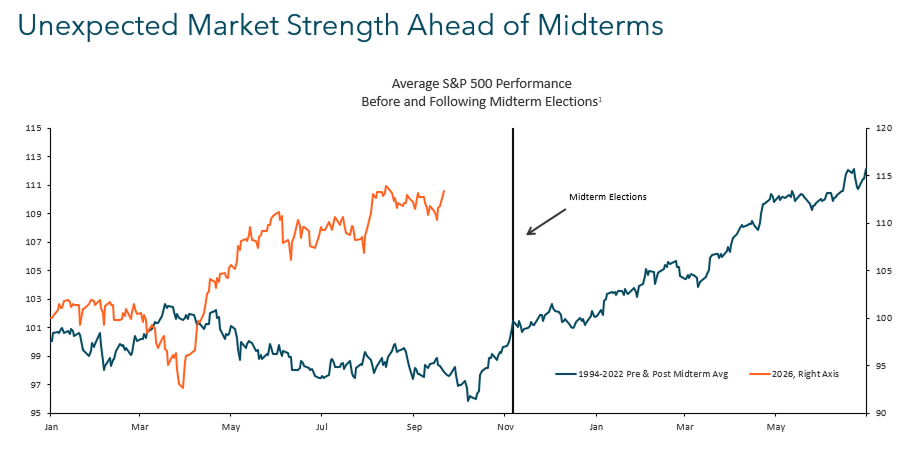
1Midterm election years: (1994, 1998, 2002, 2006, 2010, 2014, 2018, 2022)
Source: Strategas. As of September 21, 2026. Past performance is no guarantee of future results.
But once election results are in and most of the uncertainty clears up, markets can stabilize and gain momentum heading into year end, so the fourth quarter of midterm election years may be quite strong. And the good news doesn’t stop there. Since 1942, one-year equity returns following Election Day have averaged 14.8%.
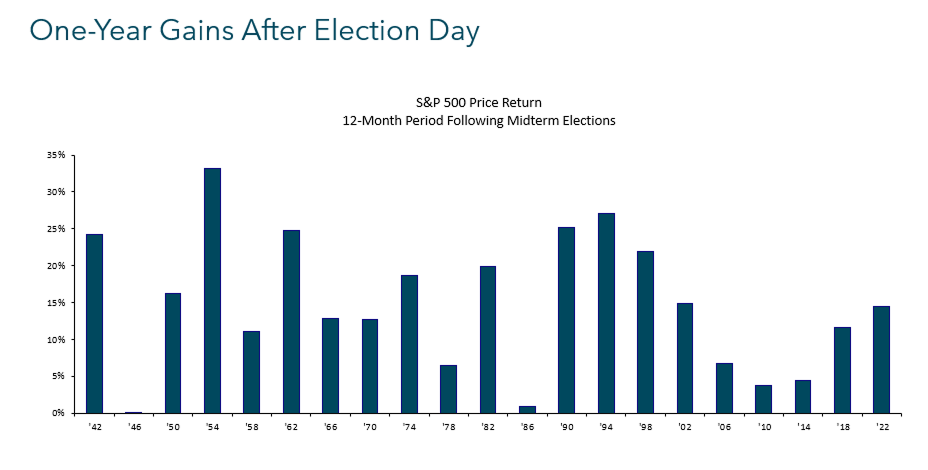
1Source: Strategas. S&P 500 data sourced from FactSet. Data as of September 21, 2026.
Past performance is no guarantee of future results.
Don’t Let Politics Drive Investment Decisions
As November nears, equity market volatility may increase. Although investors have additional uncertainties to contend with, such as higher energy prices, persistent inflation and a more hawkish Federal Reserve, the underlying economy may manage to weather these headwinds given continued consumer resilience and an above-trend earnings growth cycle.
For investors, the message is clear: midterm election results have typically had a limited impact on the long-term performance of the broader market. No matter which party is in control, staying focused on a long-term plan and maintaining a well-diversified portfolio have generally been a sound approach. We are here to guide you as the election season progresses and the outcomes become known, making tactical asset allocation adjustments to help protect and grow your wealth.
The information provided is for illustrative/educational purposes only and is not intended to constitute legal, tax, investment or financial advice. Election outcomes are uncertain, and actual results may differ materially from current expectations, polling, or assumptions. The views expressed are as of the date indicated and are subject to change without notice. Polling and other third-party data may be revised and may not accurately predict actual results. Market reactions to political developments are inherently uncertain, and historical patterns may not repeat.
BNY Wealth conducts business through various operating subsidiaries of The Bank of New York Mellon Corporation. BNY is the corporate brand of The Bank of New York Mellon Corporation and may be used to reference the corporation as a whole and/or its various subsidiaries generally.