
How do Trump Accounts work? And what are some other strategies for gifting to children?
What is the best way to transfer money to the next generation? There are multiple answers, depending on your circumstances and goals: Are you hoping to mitigate estate taxes? How large is the gift you’d like to make? How old are your children? Are they capable of managing the assets themselves, both legally and in terms of maturity?
Choosing the right strategy can feel daunting. Fortunately, there are many transfer strategies, including the recently introduced New Child Savings Accounts, commonly called “Trump Accounts.” You may be wondering how these accounts work, what the rules are and whether you should be opening one for eligible children, either alongside or instead of a different gifting strategy.
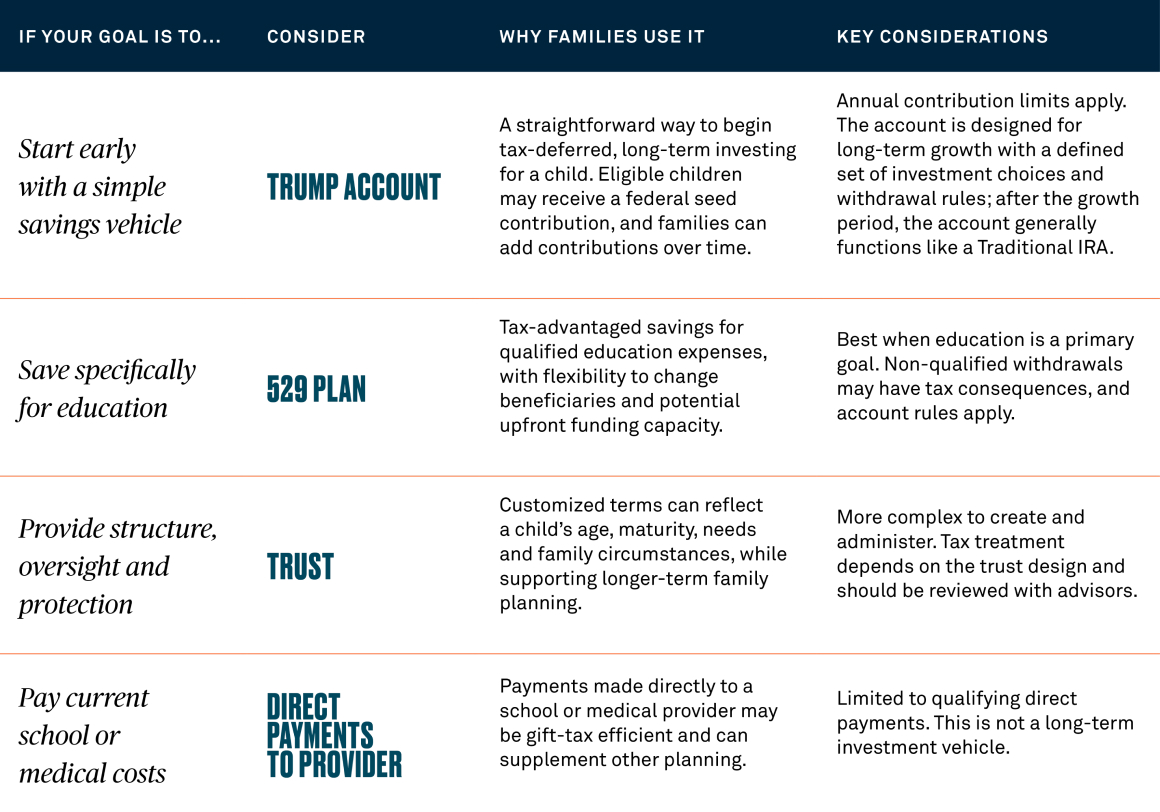
Below, we’ve outlined a few popular strategies suitable for transferring wealth to members of the next generation. Learn the mechanics, tax considerations, and potential advantages of each strategy.
Work With Your Advisor
You don’t need to be a tax expert to understand the basics, but you should involve your tax and legal advisors to help you facilitate your gifts. Even the seemingly straightforward method of a direct transfer of assets can be surprisingly complicated and may require the filing of gift-tax returns. This guide will help you distinguish between the various gifting strategies available to you. Your wealth team can help you explore more sophisticated wealth transfer techniques.
Trump Accounts (New Child Savings Account):
The newest wealth-transfer strategy for children and grandchildren is the Trump Account, which launched nationally in July 2026. Trump Accounts can be opened for any U.S. child under 18 with a valid Social Security Number. Parents or legal guardians can open and manage the accounts on behalf of their children.
U.S. Citizen children born between January 1, 2025 and December 31, 2028 are eligible for a one-time contribution of $1,000 from the federal government. Parents/guardians who claim this child as a dependent can claim their child’s seed deposit at any point from the child’s birth until December 31 of the year in which the child turns 17. Children born outside of the date range are also eligible to open and contribute to Trump accounts but will not receive the federal funding.
Families, friends, and employers can contribute up to a combined annual limit of $5,000 (adjusted for inflation) per child; contributions from employers are limited to $2,500 per year. 1
Governments and nonprofits can contribute to Trump accounts for beneficiaries living in a given state or geographic area or born in a given year.
Investment options are currently being added and expanded, but IRS guidance explains that the funds in Trump Accounts must be invested in certain mutual funds or exchange-traded funds that track the S&P 500 or another index of primarily American equities. The intent is that funds will be invested in a diversified investment vehicle designed to maximize long-term growth while minimizing risk.2
Parents or guardians function as custodians of the account during the “growth period,” from inception until December 31 of the year a child turns 17 but no distributions can be made during that period except in the event of the beneficiary’s death.
After the growth period, the account becomes a Traditional IRA under the beneficiary’s control. The funds can be used penalty-free for qualified expenses like education or a first-time home purchase but otherwise are subject to typical IRA penalties if withdrawn before reaching age 59½. With the exception of original individual contributions, withdrawn funds are subject to ordinary income-tax treatment.
Contributions made by parents or grandparents are not tax-deductible and will not be taxed upon withdrawal. Investments grow tax-deferred but any earnings are generally taxed as ordinary income when withdrawn. In addition, contributions made by employers, nonprofit organizations, and governmental agencies (including the original $1,000 seed deposit from the federal government), and the returns on those contributions, are treated as ordinary income upon withdrawal. Per recent IRS guidance, contributions may qualify for the annual gift tax exclusion amount, depending on the donor’s other tax circumstances.
To open a Trump Account, complete IRS Form 4547 on the IRS website. Then, if you have not already done so, download the Trump Accounts app from trumpaccounts.gov and create a login to receive notice once your election is processed. After processing, you can activate the account in the app and begin contributing as of July 4, 2026.
Outright Gifts
For some families, Trump accounts may serve as an entry point for wealth accumulation, but greater planning opportunities may lie in combining these accounts with existing gifting strategies suited to a family’s specific goals. If your children are adults, you might consider outright gifts.
An outright gift is a direct transfer of cash or assets to a recipient with no restrictions, meaning the beneficiary becomes the full legal owner immediately. In addition to its simplicity, an outright gift has the potential added benefit of removing the asset’s future appreciation from the donor’s estate. Outright gifts offer parents and children flexibility in terms of timing, intent and use. However, this lack of restriction usually makes this kind of gift more appropriate for adult children than minors.
Outright gifts demand careful consideration of tax implications.
As of 2026, the Internal Revenue Code provides each taxpayer the ability to transfer up to $19,000* annually gift-tax free to any number of recipients; married couples can transfer up to $38,000* per recipient. Your tax and legal advisor can prepare documentation as necessary and may recommend filing a gift tax return to reflect these annual exclusion gifts.
You may choose to make gifts in excess of the annual exclusion. However, to the extent a gift exceeds $19,000 annually, the donor’s lifetime gift exemption is reduced. For example, a gift of $1,019,000 reduces the donor’s lifetime exemption by $1,000,000. As of 2026, the federal estate tax exemption is $15,000,000 and the gift we just described would reduce it to $14,000,000.
If you don’t anticipate having a taxable estate, then exceeding the annual exclusion becomes less of a concern. That said, even for estates in excess of $15M, large lifetime taxable gifts can still make sense but are typically better structured as transfers to trusts (outlined in more detail below) for tax optimization at each generation. This is achieved by applying the donor’s generation-skipping transfer tax exemption.
Outright gifts, whether within or over the annual exclusion amounts, create an immediate transfer of assets from you to your recipient and are therefore most appropriate for gifts to mature, financially responsible adults.
*as of 2026
UTMA and UGMA Accounts
While outright gifts are typically not appropriate or logistically feasible for minor children, the Uniform Transfers to Minors Act (“UTMA”) or Uniform Gifts to Minors Act (“UGMA”) provides a structure for direct gifts to supervised accounts for minors.
An UTMA/UGMA account is a vehicle that can be opened on a child’s behalf without the involvement of attorneys or accountants and is supervised by a custodian. The account can be funded with annual exclusion gifts or with larger taxable gifts. Once the account is established, the custodian controls investments and has broad power to make distributions for the minor. This supervision and control lasts until the child reaches the age of majority (18 or 21, depending on the state).
While this arrangement’s simplicity is appealing, beware of the potential for significant account growth. Even ignoring investment returns, a hypothetical $19,000 contribution x 18 years = $342,000. Many parents have panicked at the thought of their newly-minted “adult” child coming into control of an account of that size, and options for prolonging the custodial control are limited and complicated.
Like outright transfers, gifts to UTMA/UGMA accounts can remove assets and their growth from the donor’s account. Kiddie tax rules generally ensure that investment returns beyond a low threshold are taxed at the parents’ income tax rates.
Gifts to Trusts
If the idea of your children having full, unrestricted control of gifted assets leaves you uneasy, you may consider making a gift to a trust for their benefit. This gifting strategy can create an appealing level of tax efficiency, supervision and asset protection.
Gifting to a trust for a child means transferring assets into a legal arrangement where a trustee manages the assets for the child according to the trust’s terms. This can provide more control over how the assets are invested, used, or spent, rather than leaving those choices to the child. Depending on your goals, you may decide to create one trust for the benefit of all of your children or a separate trust for each one.
Notably, families have a wide array of choices when it comes to designing a trust. A primary consideration is the duration of the trust: Should the trust last only until the child reaches the age of majority or maturity? Should it remain in place for the child’s entire life and terminate only on that beneficiary’s passing? Or should it be a dynasty trust, designed to endure for multiple generations? Families will also need to consider to what extent the beneficiary can enjoy the assets held in trust. Some trusts provide a withdrawal power, some allow the beneficiary to demand distributions for certain reasons – typically health, education, maintenance, and support – and some leave distribution decisions solely in the hands of an independent trustee. These choices, along with other technical considerations, will inform the tax consequences of establishing, funding, and maintaining the trust.
A trust’s tax treatment will depend upon its terms.
Longer-term trusts
Families wishing to pass wealth along to their children or grandchildren and to protect it for many years may consider trusts that last for extended periods, even up to a lifetime -- or longer. Gifts to dynasty trusts – those intended to last multiple generations – may be protected from estate taxes at the beneficiaries’ own passing by application of the donor’s generation-skipping transfer tax exemption. This strategy provides a beneficial alternative to outright gifts to children and grandchildren where such gifts may be exposed to taxation at the beneficiary’s death.
Whether a gift to the trust has a gift-tax impact on the donor depends, again, on the size of the gift and on the trust’s terms. While the annual-exclusion gifts described above typically require the beneficiary’s immediate access in order to avoid gift-tax treatment, trusts can be drafted to include “Crummey provisions,” an estate planning tool which allows beneficiaries a brief, vanishing withdrawal window sufficient to qualify the gift for annual-exclusion treatment, meaning the donor’s lifetime gifting capacity is not decreased. And, where advisable, donors may choose to make taxable gifts – whether they are merely in excess of the annual exclusion amount or whether the trust does not include Crummey provisions – to trusts for their children or grandchildren, strategically utilizing some or all of their lifetime exemption (or even, in some cases, exceeding it and paying a gift tax). With the help of your advisors, you can design a trust to provide ongoing asset protection, supervision, and tax savings for your children and, if you so choose, subsequent generations.
2503(c) Trusts
A particular trust established under Internal Revenue Code Section 2503(c) typically referred to by that code section provides another potentially gift-tax-free way to transfer money to a trust for a child. These trusts do not need to include the Crummey withdrawal provisions and instead qualify for annual exclusion giving by including certain prescribed terms, including a specific withdrawal window at age 21; assets not withdrawn may continue in trust once the right of withdrawal has passed but are considered to be includible in the beneficiary’s own taxable estate at death. These trusts offer a measure of asset protection but do not provide estate tax protection at the beneficiary’s passing. Accordingly, they are typically considered a good vehicle for annual exclusion gifts but an inefficient use of taxable gifts. Your attorney and advisors can help you determine whether there is a trust strategy suited to your gifting plans.
529 Education Savings Plans
The popular 529 Education Savings Plan is a tax-advantaged savings plan designed to encourage saving for future education costs.
These plans must be funded with cash and, while the annual exclusion rules do apply, a special rule allows 529 plans to be front-loaded with five years of annual exclusion gifts —or up to $190,0003 — from a married couple at once (provided they make no other annual exclusion gifts to that beneficiary during the 5-year period).
Earnings on funds in the 529 plan are not subject to federal income tax if used for qualified educational expenses and may be exempt from state income tax as well. Some states allow a state income tax deduction for contributions. Excess funds not needed for the beneficiary’s education can be transferred to an account for qualifying family members. In addition, unused funds up to $35,000 may be rolled over into a Roth IRA for the beneficiary, provided that certain parameters are met.
Direct Education and Medical Payments
Finally, payments made directly to educational institutions or healthcare providers on behalf of a child, grandchild or other loved one are generally excluded for gift-tax purposes and can be made in addition to annual exclusion gifts. This strategy is simple and straightforward and can provide significant financial support while reducing the risks associated with outright gifts.
Conclusion: The Next Generation of Wealth
When it comes to your wealth, among the most important concerns is how to share it with your family. Trump Accounts have provided an accessible entry point for every eligible family within the United States to help launch the financial future for a generation just being born. The other strategies outlined here offer solutions for a wide range of needs and situations that can help further the goals of families and their children, building wealth for generations to come.
Learn more about Trump Accounts and other strategies for gifting to children. Contact us for more information.
1 Bipartisan Policy Center. (n.d.). What to know about Trump accounts. https://bipartisanpolicy.org/explainer/what-to-know-about-trump-accounts/
2 Internal Revenue Service. (n.d.). Treasury, IRS issue guidance on Trump accounts established under the working families tax cuts; notice announces upcoming regulations. https://www.irs.gov/newsroom/treasury-irs-issue-guidance-on-trump-accounts-established-under-the-working-families-tax-cuts-notice-announces-upcoming-regulations
3 Saving for College. 10 rules for Superfunding a 529 plan.