
While there are good reasons to keep some savings in cash or cash-equivalent investments, today's rate environment presents several other attractive options for investors. Whether you want to maintain liquidity without taking on additional risk, seek higher income or focus on tax efficiency, the fixed income market offers compelling opportunities.
An Attractive Entry Point
This year, the bond market has been shaped by several factors, including persistent inflation concerns, geopolitical tensions, uncertainty about monetary policy and the heavy U.S. debt burden. The result has been a fair amount of interest rate volatility, pushing bond yields near the highs of the past decade. This is key because the initial yield at which you invest is typically a good proxy for expected long-term returns.
Short-Taxable Investments: Customizable Credit Risk and Liquidity
The short end of the Treasury yield curve has been influenced by persistent inflation and shifting Federal Reserve rate expectations. Since the war with Iran began in late February, the two-year Treasury note yield has increased roughly 75 basis points along with rising expectations for rate hikes. More recently, the weaker July jobs report and softer inflation data may have reduced pressure on the Fed to deliver rate hikes.
However, with the two-year Treasury note yield still sitting around 4.2%, the bond market is suggesting that rate hikes are still likely. In our view, the two-year Treasury note looks mispriced, which is creating opportunities in the one- to two-year segment of the Treasury yield curve. For investors seeking low credit risk and flexibility, building a portfolio of short-duration government securities, including Treasury bills, notes and other government debt instruments, may make sense. Even if yields rise again, maturing securities can be reinvested at higher rates.
Municipal Bonds: Attractive Tax-Equivalent Yields
For investors in higher tax brackets or those with a longer investment horizon, intermediate- and long-term high-quality municipal bonds look interesting. Yields in the 10- to 15-year part of the curve are in the 3.5% to 4% range, which translates into roughly 6.3% on a tax-equivalent basis. For individuals in a high-tax state such as New York, Massachusetts or California, that’s over 7% on a tax-equivalent basis for those in the top tax bracket.
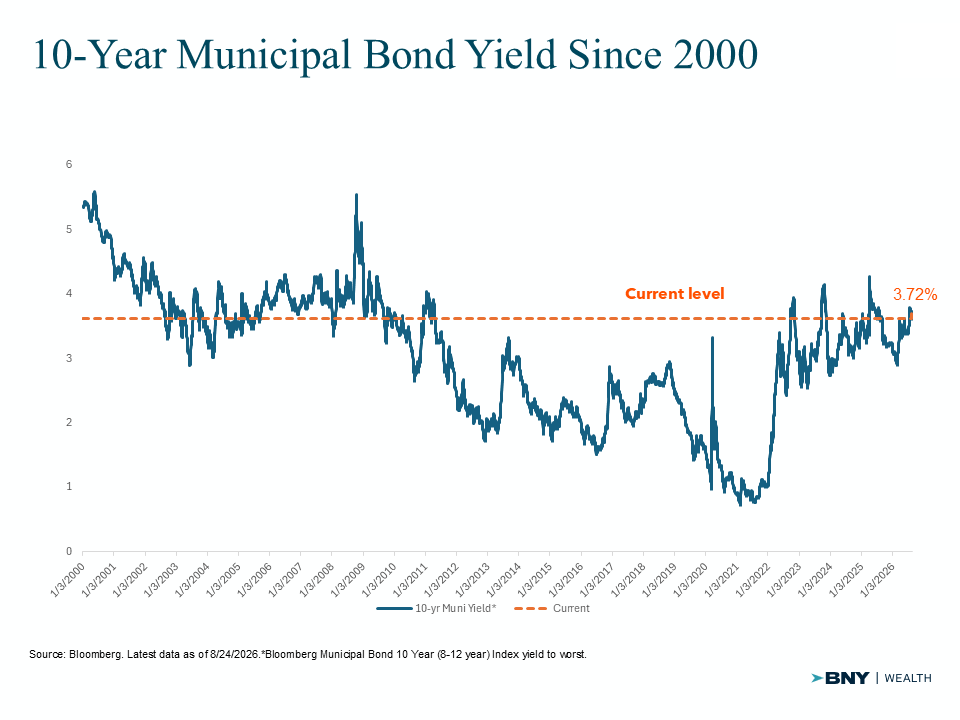
Municipal bond market fundamentals remain strong, and demand has been solid despite robust new issuance. We continue to see opportunities in AA-rated bonds or higher, particularly essential-service revenue bonds and general obligation bonds in maturities between 10 and 20 years. This remains an attractive opportunity to lock in tax-free yields.
Short-Term Corporate Bonds: Higher Yield with Strong Fundamentals
Another opportunity to consider is high-quality, short- to intermediate-term investment-grade corporate bonds. These securities offer an additional 0.5% to 0.75% in yield over a two-year Treasury, depending on duration and rating, while still carrying relatively low duration risk. Corporate fundamentals remain strong, and although credit spreads are tight, they reflect a backdrop of resilient economic growth, solid profit margins and strong demand. These can be a good fit for investors seeking moderate risk and greater income.
Don’t Miss This Opportunity to Put Cash to Work
Although a money market fund or certificate of deposit still offers attractive yields, the longer investors stay in cash, the greater the risk of missing out on today’s higher bond yields.
In our view, quality fixed income can serve as both a source of income and portfolio diversification. We offer a range of actively-managed fixed income solutions that can be customized to your financial objectives, including preferences around risk tolerance, income needs and tax considerations, while offering the potential to outperform cash over the long run.
If you are sitting with excess cash, it’s time to consider putting it to work by choosing from a variety of short-to intermediate-term bond options.