KEY POINTS
- The Fed’s 25bp hike marks a shift from hawkish rhetoric to action with policymakers indicating further tightening ahead.
- We support the Fed’s decision and expect two more 25bp hikes over the next 12 months.
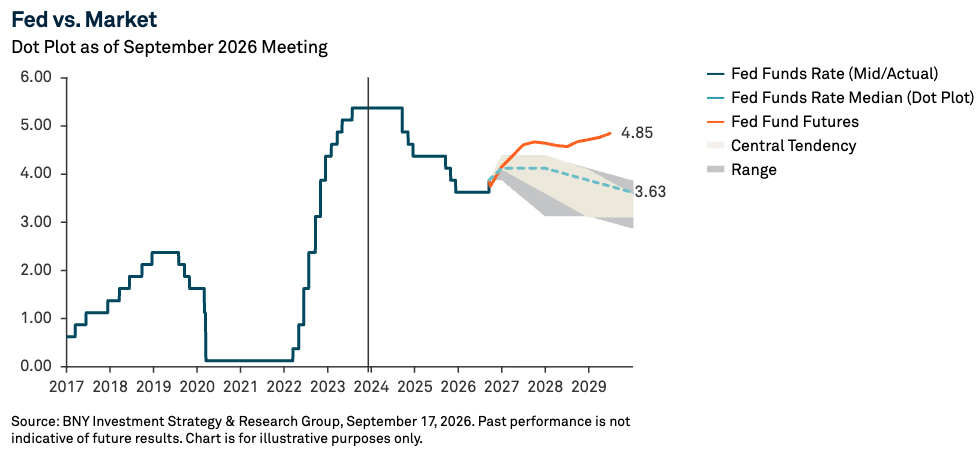
- We believe market pricing appears overextended and expect the Fed to hike more than the dots suggest, but less than markets imply.
The U.S. Federal Reserve’s (Fed) 25 basis point (bp) rate hike on September 16 marks the beginning of its effort to bring inflation back toward its 2% target. Under Chair Warsh, the Fed’s actions are now aligning with its hawkish rhetoric.
The rate hike was widely anticipated and in line with market expectations.
However, the Federal Open Market Committee took a restrictive stance: The median projections (dot plots) suggest one more hike by the end of this year. The decision reflected a “solid pace” economic expansion despite considerable geopolitical uncertainty. This assessment was also supported by firmer projections of real gross domestic product (GDP) growth, lower unemployment and a slightly higher, although stickier, path of core inflation to reach the Fed’s target.
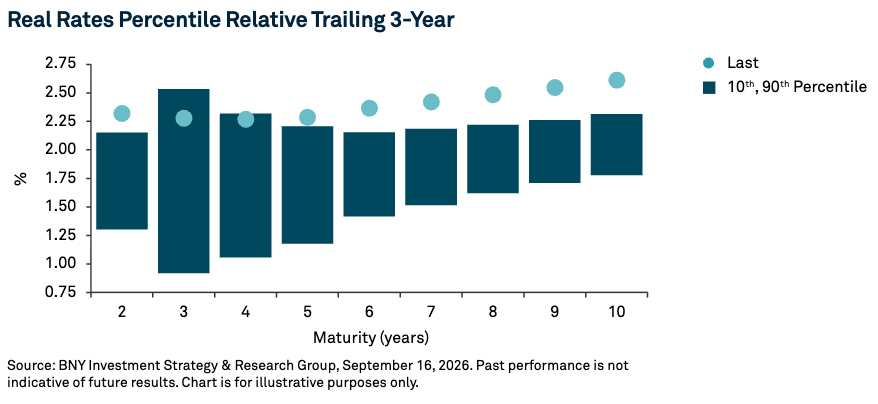
In our view, the hike was becoming overdue. Inflation risk was beginning to rise, driving the need for a tougher monetary policy response. In fact, market pricing of inflation has risen and expectations for a much higher terminal federal funds rate have also lifted real yields, contributing to much of the recent widening of nominal bond yields across the U.S. Treasury yield curve.
The Fed’s projections implicitly acknowledge this point of higher-for-longer real rates. The latest Summary of Economic Projections (SEP) now forecasts core Personal Consumption Expenditures (PCE) price index inflation at 2.2% and the fed funds rate at 3.9% in 2028. These projections suggest a higher real policy rate is needed to bring inflation back down to its 2% target. By contrast, the June 2026 SEP projected core inflation at 2.1% and the fed funds rate at 3.4%. In other words, the medium-term required real policy rate just rose to 1.7% from 1.3%.
More Hikes on the Horizon
We believe the Fed may need to hike at least once more than the dot plots indicate, but less than current market pricing, which seems overstretched given lagging pipeline pressures from earlier energy and tariff shocks on core inflation. Moreover, the rising cost of semiconductors and information processing equipment will likely also take a toll in a few months’ time.
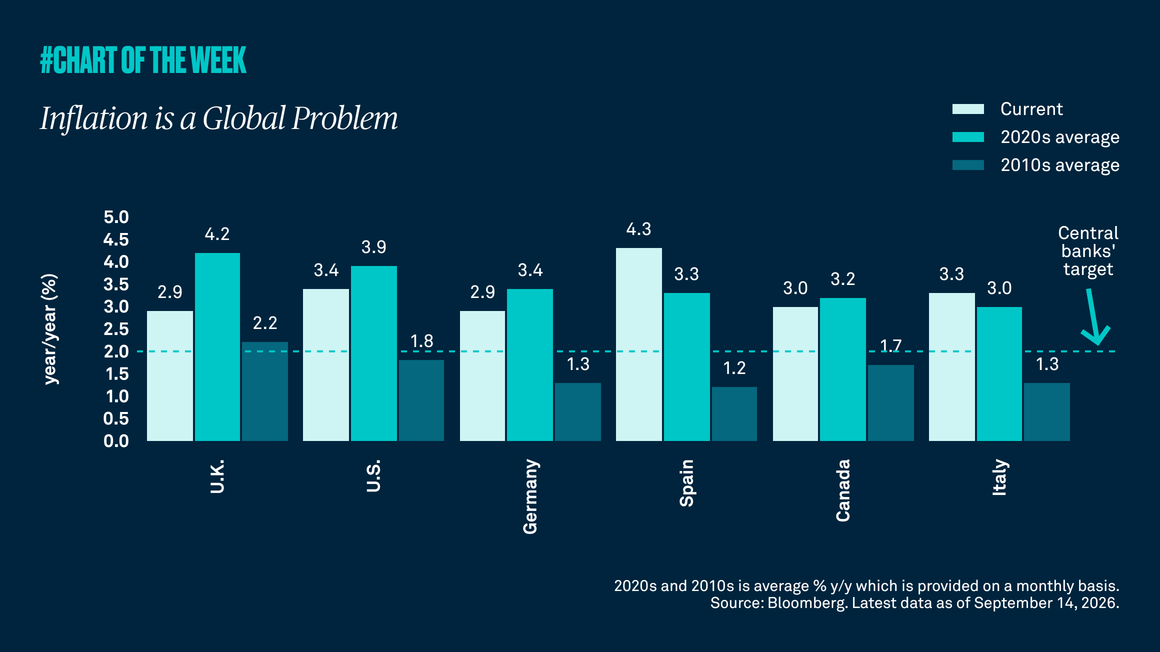
However, we disagree with market expectations for four 25-basis-point hikes over the next 12 months. With federal tax refunds trailing and headline inflation above 3%, consumer real wages are stalling. These trends imply overall consumption may quickly come under more pressure than what is currently priced in. Additionally, any slowdown in AI capital expenditures (capex) is a risk that may also slow the economy more than what GDP Nowcasts and Purchasing Managers’ Index (PMI) metrics currently imply.
A Closer Look at Real Rates
We agree with the Fed’s decision, aligning its rhetoric with specific actions to reduce elevated inflation. Even though the policy response may need to be strengthened more than what the Fed has intimated so far, we think real rates appear slightly overstretched, potentially creating opportunities to be more supportive of U.S. sovereign bonds.
Market pricing of Fed policy appears overextended.
Real rates across the Treasury Inflation-Protected Securities (TIPS) curve have cheapened, potentially raising opportunities in U.S. fixed income.
Appendix
Core personal consumption expenditures (PCE) price index is a measure of the prices paid by consumers for goods and services in the U.S., excluding food and energy. The federal funds rate is the interest rate banks charge each other for overnight loans of their reserve balances held at the Federal Reserve. Fed fund futures are financial contracts traded on the Chicago Mercantile Exchange (CME) that track the effective federal funds rate, which is the overnight interest rate banks charge each other for loans. The Purchasing Managers’ Index (PMI) is a monthly economic indicator that measures the health of the manufacturing and services sectors by surveying supply chain executives. Treasury Inflation-Protected Securities (TIPS) adjust their principal value with inflation to protect your purchasing power over time.
Risks
Bonds are subject generally to interest-rate, credit, liquidity, call and market risks, to varying degrees. Generally, all other factors being equal, bond prices are inversely related to interest-rate changes and rate increases can cause price declines.
Important Information
BNY Investments is the brand name for the investment management business of BNY and its investment firm affiliates worldwide. BNY is the corporate brand of The Bank of New York Mellon Corporation and may be used to reference the corporation as a whole or its various subsidiaries generally.
The information contained herein reflects general views and is provided for informational purposes only. This material is not intended as investment advice nor is it a recommendation to adopt any investment strategy.
Opinions and views expressed are subject to change without notice.
Past performance is no guarantee of future results.
Issuing entities
This material is only for distribution in those countries and to those recipients listed, subject to the noted conditions and limitations: • United States: by BNY Mellon Securities Corporation (BNYSC), 240 Greenwich Street, New York, NY 10286. BNYSC, a registered broker-dealer and FINRA member, has entered into agreements to offer securities in the U.S. on behalf of certain BNY Investments firms. • Europe (excluding Switzerland): BNY Mellon Fund Management (Luxembourg) S.A., 2-4 Rue EugèneRuppertL-2453 Luxembourg. • UK, Africa and Latin America (ex-Brazil): BNY Mellon Investment Management EMEA Limited, BNY Mellon Centre, 160 Queen Victoria Street, London EC4V 4LA. Registered in England No. 1118580. Authorised and regulated by the Financial Conduct Authority. • South Africa: BNY Mellon Investment Management EMEA Limited is an authorised financial services provider. • Switzerland: BNY Mellon Investments Switzerland GmbH, Bärengasse 29, CH-8001 Zürich, Switzerland. • Middle East: DIFC branch of The Bank of New York Mellon. Regulated by the Dubai Financial Services Authority. • South East Asia and South Asia: BNY Mellon Investment Management Singapore Pte. Limited Co. Reg. 201230427E. Regulated by the Monetary Authority of Singapore. • Hong Kong: BNY Mellon Investment Management Hong Kong Limited. Regulated by the Hong Kong Securities and Futures Commission. • Japan: BNY Mellon Investment Management Japan Limited. BNY Mellon Investment Management Japan Limited is a Financial Instruments Business Operator with license no 406 (Kinsho) at the Commissioner of Kanto Local Finance Bureau and is a Member of the Investment Trusts Association, Japan and Japan Investment Advisers Association and Type II Financial Instruments Firms Association. • Brazil: ARX Investimentos Ltda., Av. Borges de Medeiros, 633, 4th floor, Rio de Janeiro, RJ, Brazil, CEP 22430-041. Authorized and regulated by the Brazilian Securities and Exchange Commission (CVM). • Canada: BNY Mellon Asset Management Canada Ltd. is registered in all provinces and territories of Canada as a Portfolio Manager and Exempt Market Dealer, and as a Commodity Trading Manager in Ontario. All issuing entities are subsidiaries of The Bank of New York Mellon Corporation.
No part of this material may be reproduced in any form, or referred to in any other publication, without express written permission. All information contained herein is proprietary and is protected under copyright law.
NOT FDIC INSURED | NO BANK GUARANTEE | MAY LOSE VALUE
© 2026 THE BANK OF NEW YORK MELLON CORPORATION
MARK-1003276-2026-09-17
GU-943 - 1 April 2027