Please ensure Javascript is enabled for purposes of website accessibility In a real regime shift?
nl
en
institutional
institutional
false
true
Gathering data
Disclaimer Not Available

In a real regime shift?

In a real regime shift?

Higher inflation has been a dominant theme of the current decade. In addition to price shocks, it is being shaped by secular investment trends in infrastructure, defense spending, onshoring and the ongoing AI buildout. These structural changes reinforce the case for looking beyond traditional 60/40 portfolios to include real assets as a source of diversification and return potential in portfolios.
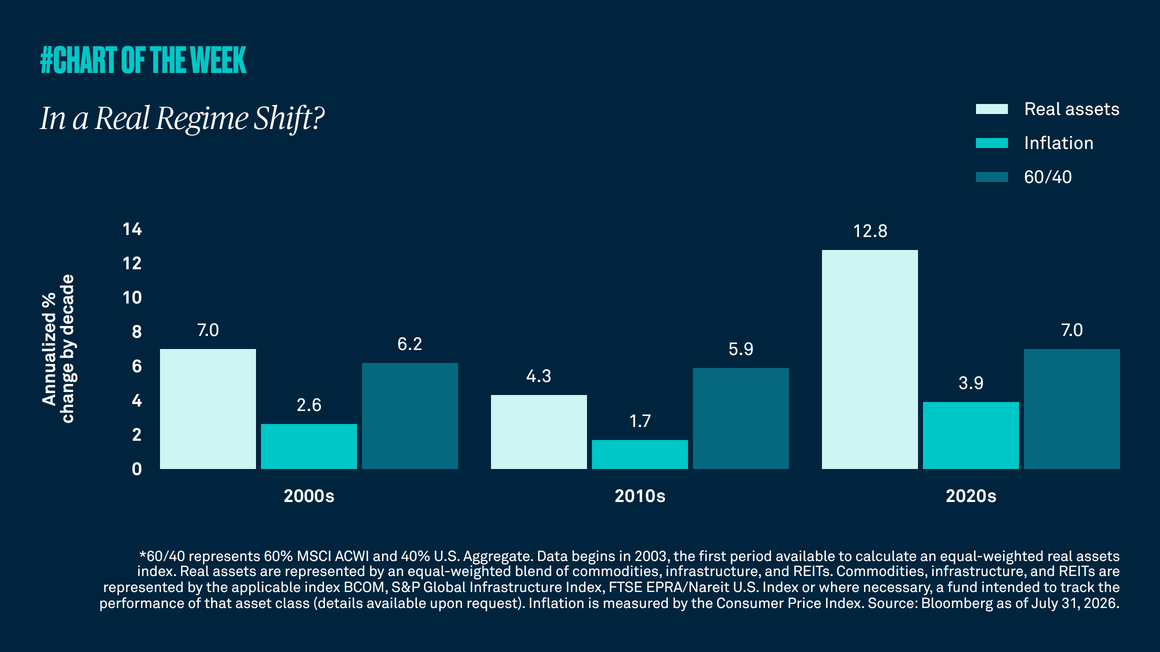

For much of the 2000s, inflation was broadly contained, averaging around 2.6% in the first decade and falling below 2.0% during the 2010s following the global financial crisis. Since the pandemic, however, inflation has shifted into a meaningfully higher range, with annualized inflation running at roughly 4% this decade — more than double the pace of the prior decade. In our view, various factors including event-driven spikes, such as COVID and energy-driven supply shocks, as well as deglobalization, suggest that inflation is likely to remain structurally higher than it was in the years preceding COVID.

As inflation has moved higher, real assets have meaningfully outperformed. Real assets have generated annualized returns of 12.8% this decade, compared with approximately 7% for a traditional 60/40 portfolio, while returns for real assets are roughly three times the level achieved in the 2010s. We believe this relative outperformance reflects more than a short-term cyclical adjustment and instead points to a long-term trend.

Importantly, the case for real assets is not driven by inflation alone. We also see support from a durable capital expenditure cycle reinforced by several powerful secular trends, including infrastructure investment, increased defense spending, onshoring across industries and the continued buildout of artificial intelligence-related capacity.

Given these factors, it’s important for investors to review their portfolio mix and consider including real assets as a way to enhance diversification, improve return potential and position for a structurally higher inflation environment.
RELATED CONTENT
Getting real with real assets
Chart of the Week | Macroeconomic

Inflation appears to have transitioned from its pre-Covid average of 2% to a stickier point closer to 3%, and we do not expect a near-term return to prior levels. In this environment, we believe real assets, such as commodities, infrastructure and REITs, can provide inflation protection, diversification and return potential.

Not in a bubble
Chart of the Week | Macroeconomic

As the S&P 500 approaches all-time highs, there are renewed concerns among investors about elevated valuations. However, historically strong profitability and expected earnings growth appear to support current pricing. In addition, the current S&P 500 price-to-earnings (P/E) ratio is roughly equal to the average since Covid. As a result, we do not view U.S. equities as being in bubble territory and we remain constructive on the asset class.

Is the market rally broadening?
Chart of the Week | Macroeconomic

Stocks, as measured by the S&P 500, are up over 13% through early August. The solid gains have been fueled by a resilient economy, steady consumer spending, optimism around artificial intelligence and better-than-expected earnings growth. Still, some investors worry the advance may be too concentrated in technology and that AI-capex monetization may fall short of expectations. A closer look suggests that it is not just tech moving the market higher.

Fed friction?
Chart of the Week | Macroeconomic

Markets are navigating tensions between a Fed that offers less guidance and an inflation backdrop that remains sticky. Added uncertainty from Middle East tensions and energy-price swings is further shaping sentiment, with recent moves in Treasury yields suggesting the market wants the Fed to hike. However, with yield volatility expected to linger in the near term, we see today’s elevated Treasury yields as an especially compelling opportunity in fixed income.

Gathering data
Disclaimer Not Available

This is a marketing communication