WHAT’S NEXT FOR POLICY?
- Fiscal deadlines: Less scope for major legislation; funding and debt-limit negotiations could trade concessions for added social spending, limiting fiscal expansion while raising shutdown and debt-ceiling risks.
- AI capital expenditure (CAPEX) regulation: Federal artificial intelligence (AI) or data-center legislation faces veto hurdles. Texas alone holds roughly 25% of planned U.S. capacity and could bring moratoria, tighter permitting, and changes to tax incentives, delaying investment important to GDP growth. AI regulation will also grow as an issue heading into 2028.
- Senate and appointments: Confirmation power over Federal Reserve (Fed) governors, Supreme Court justices, and cabinet officials gives Democrats leverage, risking scrutiny, delays, or vacancies. This can be especially consequential for markets if it impedes reshaping the Fed’s Board.
Democrats Take Control of the House and Senate
Democrats secured both chambers of Congress in the U.S. midterm elections, ending unified Republican control. This shift points to a more divided government heading into 2027-2028.
The result constrains the administration’s legislative agenda while giving Democrats greater leverage over fiscal policy, oversight, and appointments, though the administration retains authority over sanctions, tariffs, and geopolitical policy.
What Are the Market Implications?
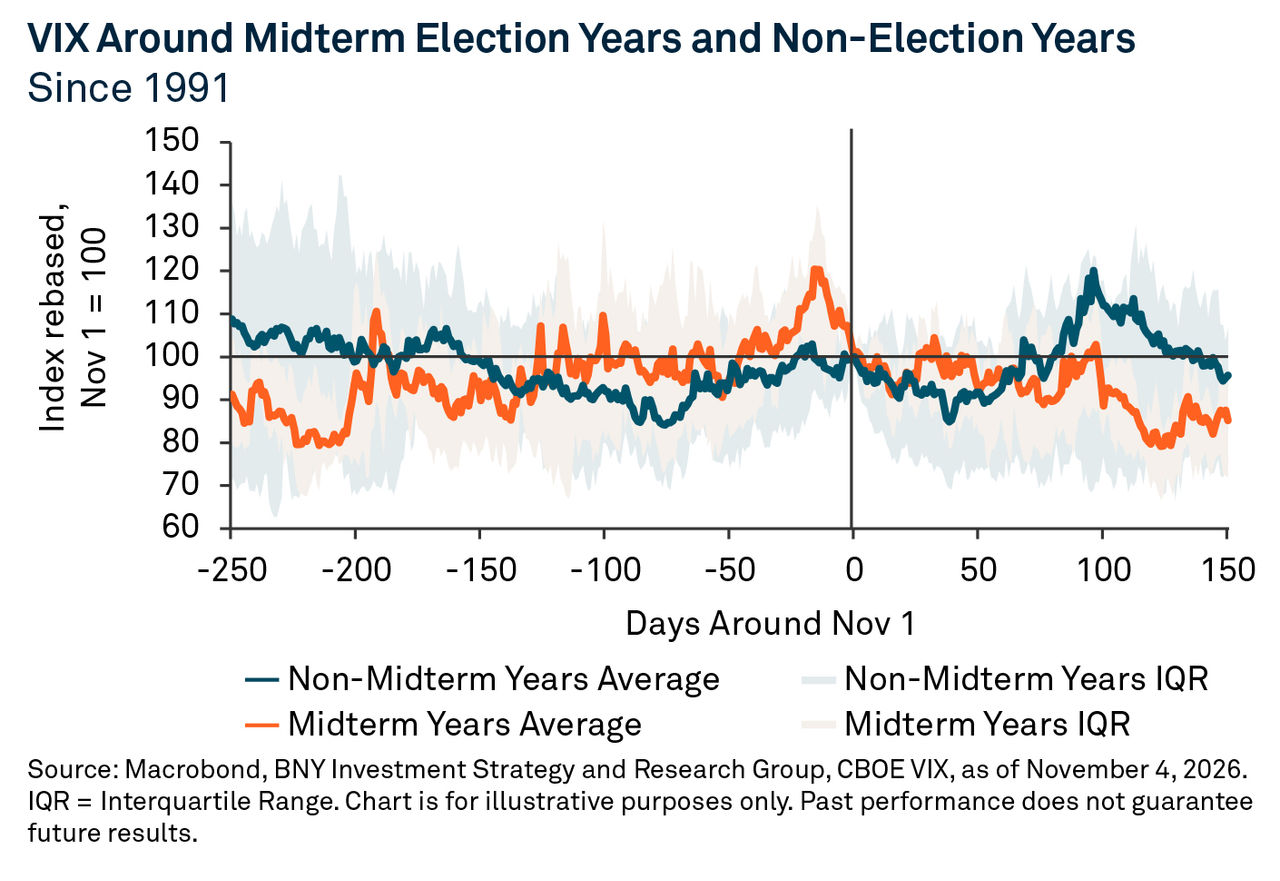
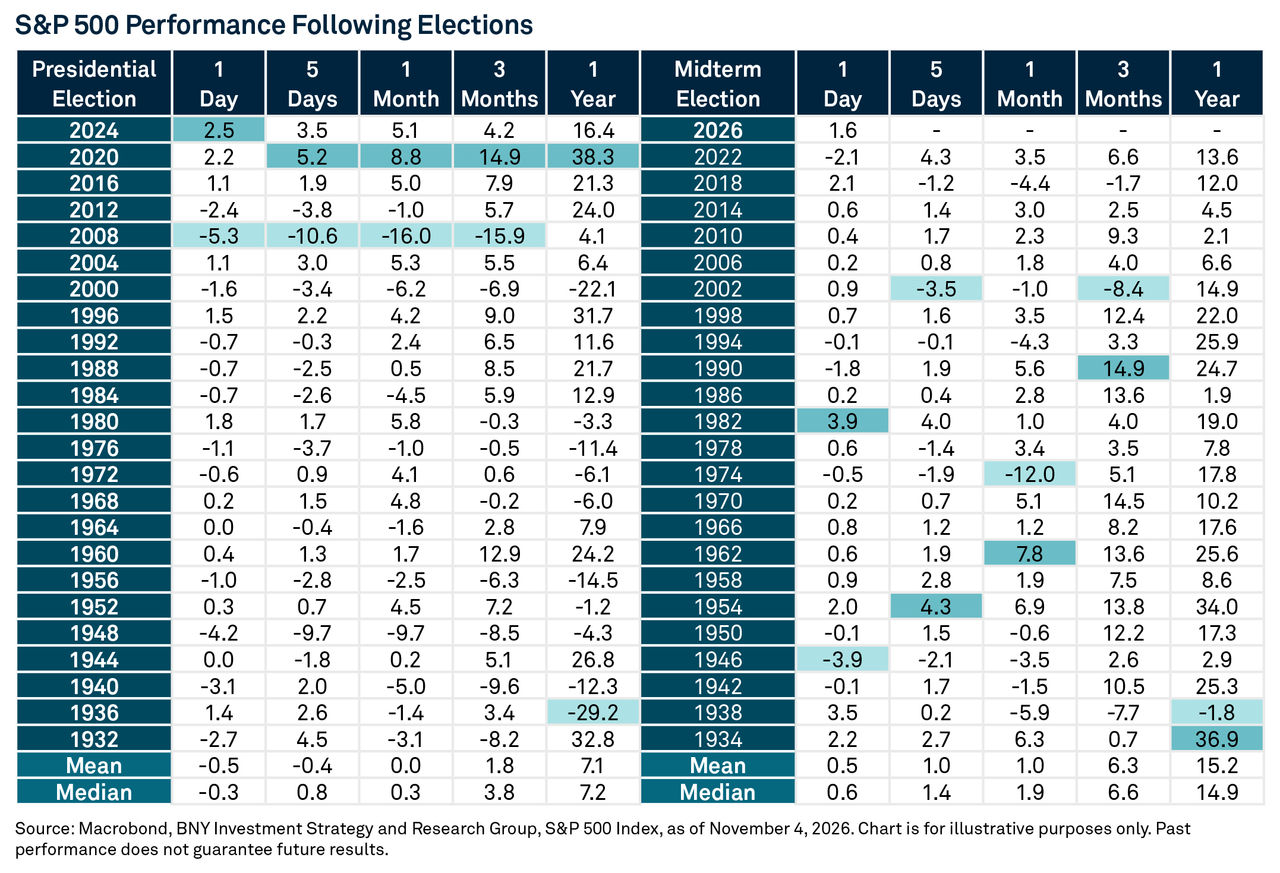
Elections bring a degree of uncertainty as they reshape expectations around fiscal policy, regulation, and the broader economic outlook. Equity markets have historically reflected this scenario, with implied volatility peaking heading into election day. The days and weeks after the election can remain volatile as markets adjust positions and reassess expectations, but as clarity builds, volatility tends to subside. The CBOE Volatility Index (VIX) has historically fallen over 10%, on average, in the six months after midterm elections.
Historically, Fading Volatility Has Been Supportive of Risk Asset Performance
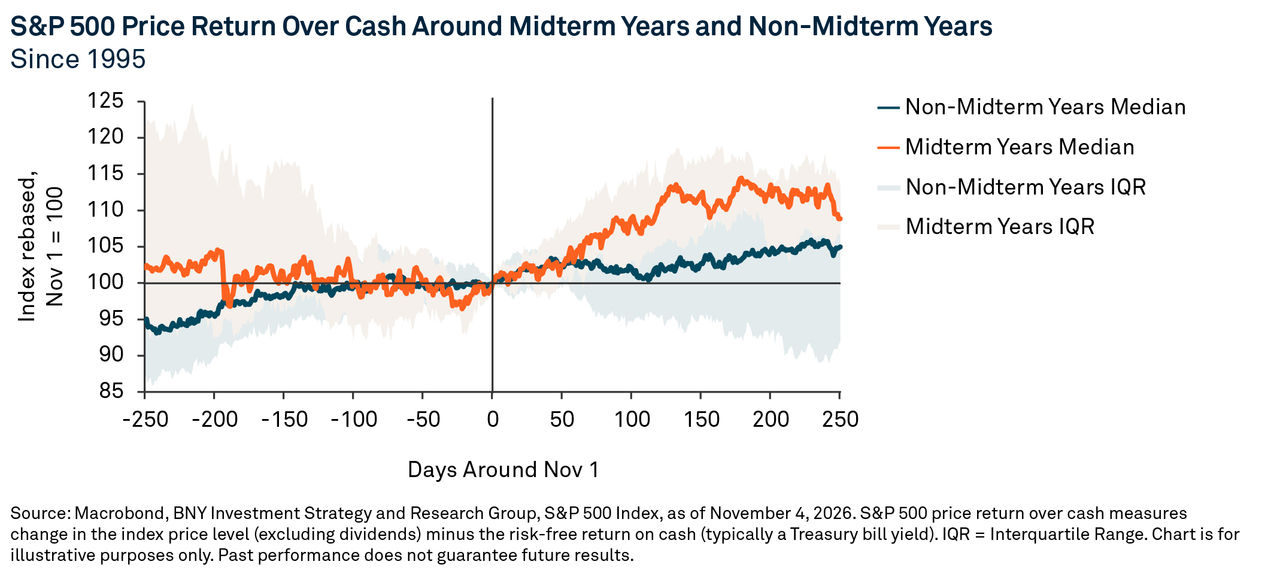
Since the mid-1950s, the S&P 500 has had a median excess return (over cash) of about 9% at 12 months following the election date. The strongest phase typically occurs in the first six months, with a roughly 12% median excess return, consistent with fading volatility. Recent House control flips have been more muted with a median equity market gain of around 7% over the subsequent 12 months, with 92% of those returns occurring in the first six months.
The Macro Backdrop Matters
Our models point to firm expansion territory, where growth remains solid over the tactical horizon, but risks increase. We view macro data staying robust and positive, but given the amount of good news priced in, we could be entering a period where upside surprises are less frequent.
AI Overinvestment Concerns Are a Key Focus
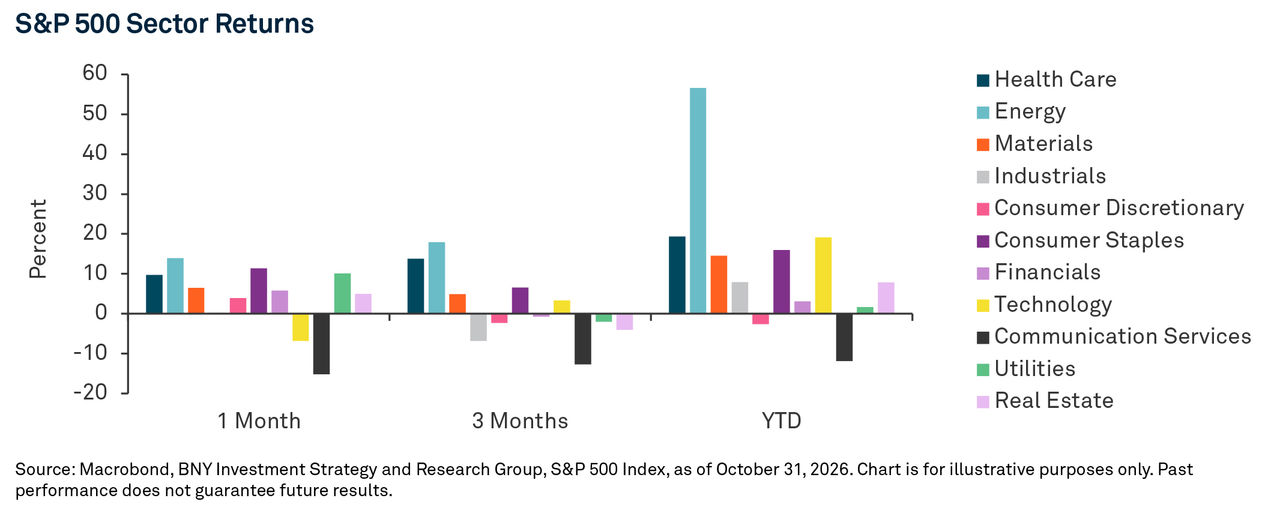
Two recent signals stand out. First, after inflation came in higher than expected, the yield curve flattened as short-term rates rose on expectations of a more hawkish Fed while long-term rates reflected growth concerns. Second, tech stocks sold off even as Brent crude fell over 7% on November 2. Concentration is also a risk: The S&P 500 is more concentrated than in past periods, with a narrow group of mega-cap companies driving a large share of returns.
Positioning for Volatility
In our view, pure beta exposure is likely a risky strategy this cycle. We favor value over growth and defensive sectors. The midterms are unlikely to change the narrative around AI overinvestment, and concerns will likely drive rotation within equity markets, as seen during the recent tech sell-offs.
Macro Outlook
Elections have historically produced different patterns in market returns, but many of these effects tend to fade over time. With the election behind us, fundamentals should increasingly take the lead, with the macro backdrop, AI investment risks, and Iran remaining key drivers.
AI capital expenditure (CAPEX) regulation is the set of rules governing investment in AI infrastructure, including data centers and computing hardware.
S&P 500® Index is a widely accepted, unmanaged index of U.S. stock market performance. CBOE Volatility Index (VIX) is a real-time market index that measures the stock market’s expectation of 30-day forward-looking volatility, derived from the prices of S&P 500 Index options. An investor cannot invest directly in any index.
Important information
BNY Investments is the brand name for the investment management business of BNY and its investment firm affiliates worldwide. BNY is the corporate brand of The Bank of New York Mellon Corporation and may be used to reference the corporation as a whole or its various subsidiaries generally.
The information contained herein reflects general views and is provided for informational purposes only. This material is not intended as investment advice noris it a recommendation to adopt any investment strategy.
Opinions and views expressed are subject to change without notice.
Past performance is no guarantee of future results.
Issuing entities
This material is only for distribution in those countries and to those recipients listed, subject to the noted conditions and limitations: • United States: by BNY Mellon Securities Corporation (BNYSC), 240 Greenwich Street, New York, NY 10286. BNYSC, a registered broker-dealer and FINRA member, has entered into agreements to offer securities in the U.S. on behalf of certain BNY Investments firms. • Europe (excluding Switzerland): BNY Mellon Fund Management (Luxembourg) S.A., 2-4 Rue EugèneRuppertL-2453 Luxembourg. • UK, Africa and Latin America (ex-Brazil): BNY Mellon Investment Management EMEA Limited, BNY Mellon Centre, 160 Queen Victoria Street, London EC4V 4LA. Registered in England No. 1118580. Authorised and regulated by the Financial Conduct Authority. • South Africa: BNY Mellon Investment Management EMEA Limited is an authorised financial services provider. • Switzerland: BNY Mellon Investments Switzerland GmbH, Bärengasse 29, CH-8001 Zürich, Switzerland. • Middle East: DIFC branch of The Bank of New York Mellon. Regulated by the Dubai Financial Services Authority. • South East Asia and South Asia: BNY Mellon Investment Management Singapore Pte. Limited Co. Reg. 201230427E. Regulated by the Monetary Authority of Singapore. • Hong Kong: BNY Mellon Investment Management Hong Kong Limited. Regulated by the Hong Kong Securities and Futures Commission. • Japan: BNY Mellon Investment Management Japan Limited. BNY Mellon Investment Management Japan Limited is a Financial Instruments Business Operator with license no 406 (Kinsho) at the Commissioner of Kanto Local Finance Bureau and is a Member of the Investment Trusts Association, Japan and Japan Investment Advisers Association and Type II Financial Instruments Firms Association. • Brazil: ARX Investimentos Ltda., Av. Borges de Medeiros, 633, 4th floor, Rio de Janeiro, RJ, Brazil, CEP 22430-041. Authorized and regulated by the Brazilian Securities and Exchange Commission (CVM). • Canada: BNY Mellon Asset Management Canada Ltd. is registered in all provinces and territories of Canada as a Portfolio Manager and Exempt Market Dealer, and as a Commodity Trading Manager in Ontario. All issuing entities are subsidiaries of The Bank of New York Mellon Corporation.
No part of this material may be reproduced in any form, or referred to in any other publication, without express written permission. All information contained herein is proprietary and is protected under copyright law.
NOT FDIC INSURED | NO BANK GUARANTEE | MAY LOSE VALUE
© 2026 THE BANK OF NEW YORK MELLON CORPORATION
MARK-1035219-2026-11-05
GU-986 - 4 November 2027