
Please ensure Javascript is enabled for purposes of website accessibility Is the Job Market Stabilizing?
fi
en
intermediary
intermediary
false
true
Gathering data
Disclaimer Not Available

Is the Job Market Stabilizing?

Is the Job Market Stabilizing?

After sluggish job growth in 2025, investors are looking for signs that the labor market may be stabilizing. With consumer spending driving 70% of economic activity, an improving labor market is essential to sustaining economic growth. 
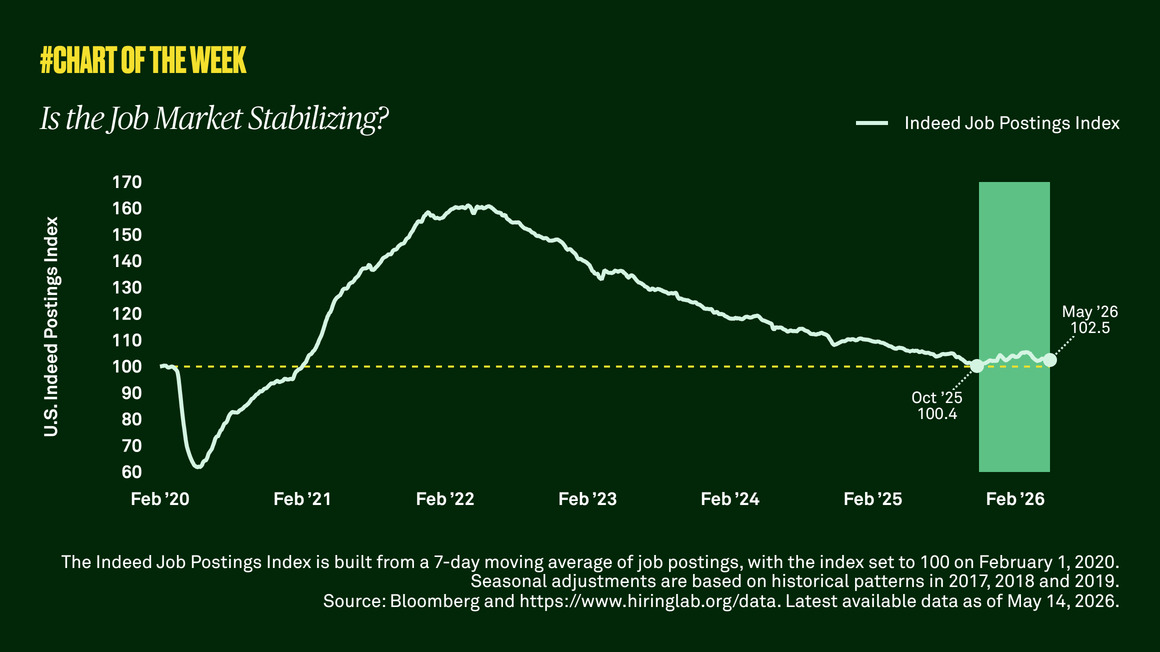

Since April 2022, job availability, as measured by the Indeed Job Postings Index, has trended lower, softening confidence in the labor market. With consumer spending accounting for 70% of gross domestic product (GDP), lower confidence in the ability to find jobs could prompt consumers to pull back spending — and weigh on economic growth.

Recently, however, the Indeed Job Postings Index has shown signs of stabilizing, along with other job market indicators. The Index has been in an uptrend since last October and job growth year to date stands at 304,000, compared to the 116,000 jobs for all of 2025. Initial weekly jobless claims — a timelier measure of labor market health — have averaged 204,000 over the last four weeks, the lowest in four years. Continuing jobless claims have also fallen from their peak of 1.96 million in July of 2025 to 1.77 million – the lowest in over two years. And, despite recent headlines, layoffs year to date through April are the lowest since 2022.

While job growth may be resetting to a lower monthly average because of aging demographics, reduced immigration and improved productivity, stabilization of the labor market may be another positive sign for the consumer and the broader economy.

RELATED CONTENT
What happens on bad days?
Chart of the Week | Macroeconomic

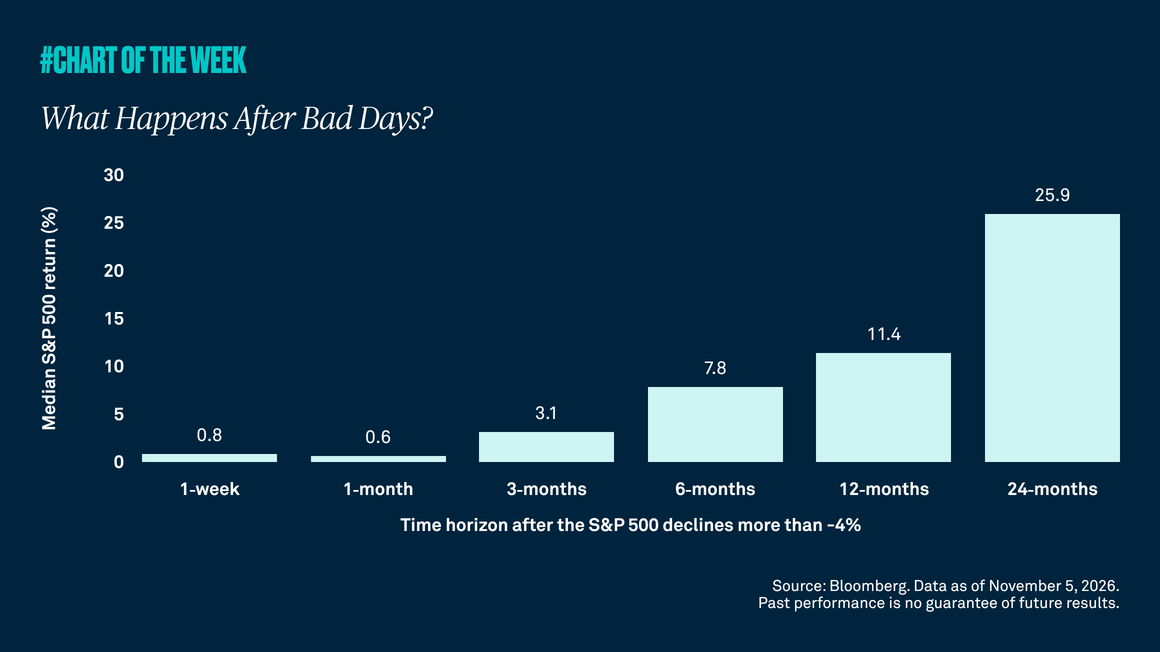
The recent one-day equity selloff reflected weaker sentiment amid election uncertainty and concerns that slower artificial intelligence spending could weigh on growth and earnings. Still, pullbacks of this magnitude have often been followed by solid returns, and we remain constructive given the economy’s resilience and AI’s long-term potential.

A decade of delivery: 10 reasons global short-dated high yield bonds still stand out
Article | Fixed Income

Higher starting yields and improving credit quality are helping reinforce the case for global short-dated high yield bonds.

A decade of delivery: 10 reasons global short-dated high yield bonds still stand out
Article | Fixed Income

Higher starting yields and improving credit quality are helping reinforce the case for global short-dated high yield bonds.

Gathering data
Disclaimer Not Available

This is a marketing communication