Please ensure Javascript is enabled for purposes of website accessibility Behind the Numbers: Q4 GDP
fi
en
intermediary
intermediary
false
true
Gathering data
Disclaimer Not Available

Behind the numbers: Q4 GDP

Behind the numbers: Q4 GDP

Gross domestic product undershot expectations last quarter, but the shortfall appears driven more by the temporary government shutdown than broad-based weakness. Consumer demand remains resilient, and with supportive fiscal policy, easing financial conditions and a steady labor market, the outlook points to a modest acceleration in economic activity this year. 
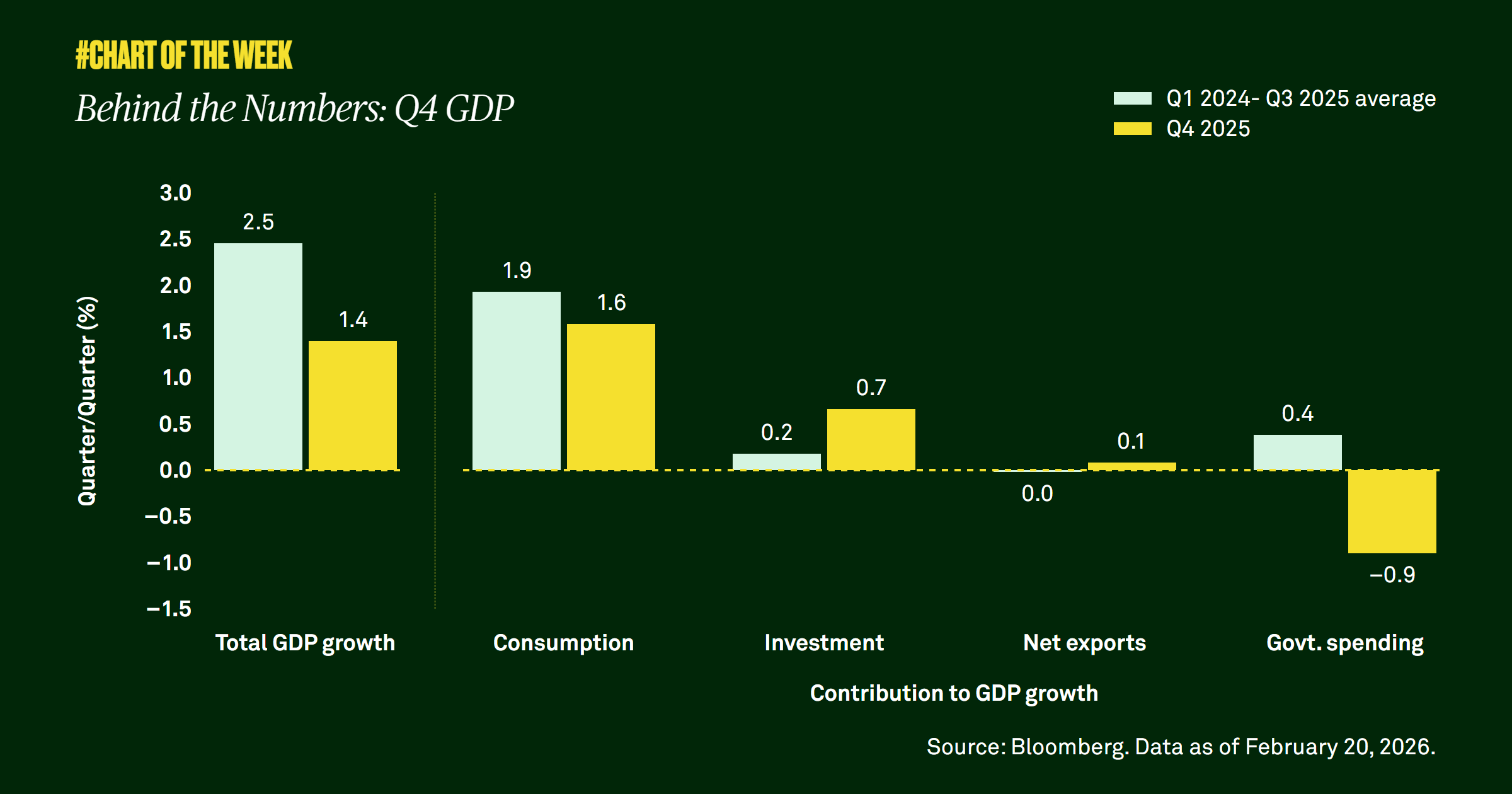

Last week’s fourth quarter gross domestic product (GDP) report came in at annualized pace of 1.4%, disappointing many Wall Street analysts who had anticipated 2.8%. For some investors, the news renewed concerns about an economic slowdown.

Growth was indeed softer than the 3% or more recorded in the previous two quarters, but the drivers of the miss are clear. The biggest drag was government spending at −0.9%, an unusually weak contribution that suggests the fourth quarter could have ended near 2.3% — above trend — absent the 43‑day government shutdown.

Consumption, the largest driver of GDP with a 70% share, slowed slightly to 1.6%, yet it remains resilient and in line with the average since 2024. We believe fiscal stimulus, lower interest rates and a steady job market will support household balance sheets and spending going forward.

Taken together, the evidence suggests the government shutdown — rather than a broad slowdown — drove the shortfall. Consensus GDP is 2.5% this year, and our target of 2.3% closely matches, reflecting our confidence in the economy amid a steady job market and sustained consumer spending.
RELATED CONTENT
A broader foundation for earnings growth
Chart of the week | Macroeconomic

Although companies benefiting most directly from AI-related capital spending are the main drivers of higher earnings, strength is no longer confined to that group. Earnings across the broader market remain solid and are expected to grow more than 10% this year and next, suggesting the risk of concentrated market leadership may not be founded.

Is the Job Market Stabilizing?
Chart of the week | Macroeconomic

After sluggish job growth in 2025, investors are looking for signs that the labor market may be stabilizing. With consumer spending driving 70% of economic activity, an improving labor market is essential to sustaining economic growth.

Will Markets Remain Resilient?
Chart of the week | Macroeconomic

Global equities have risen an annualized 11% since 2020 despite repeated shocks, as resilient growth and earnings have helped markets recover from periods of volatility. While the U.S.-Iran conflict poses near-term inflation and growth risks, markets remain constructive as earnings expectations continue to improve.

Earnings breadth still improving
Chart of the week | Macroeconomic

Rising earnings estimates continue to support equities despite geopolitical and macroeconomic uncertainty. With profit growth broadening across S&P 500 industries, resilient corporate earnings underpin our constructive outlook for the stock market.

Gathering data
Disclaimer Not Available

This is a marketing communication