Please ensure Javascript is enabled for purposes of website accessibility A Broader Foundation for Earnings Growth
fi
en
institutional
institutional
false
true
Gathering data
Disclaimer Not Available

A broader foundation for earnings growth

A broader foundation for earnings growth

Although companies benefiting most directly from AI-related capital spending are the main drivers of higher earnings, strength is no longer confined to that group. Earnings across the broader market remain solid and are expected to grow more than 10% this year and next, suggesting the risk of concentrated market leadership may not be founded.
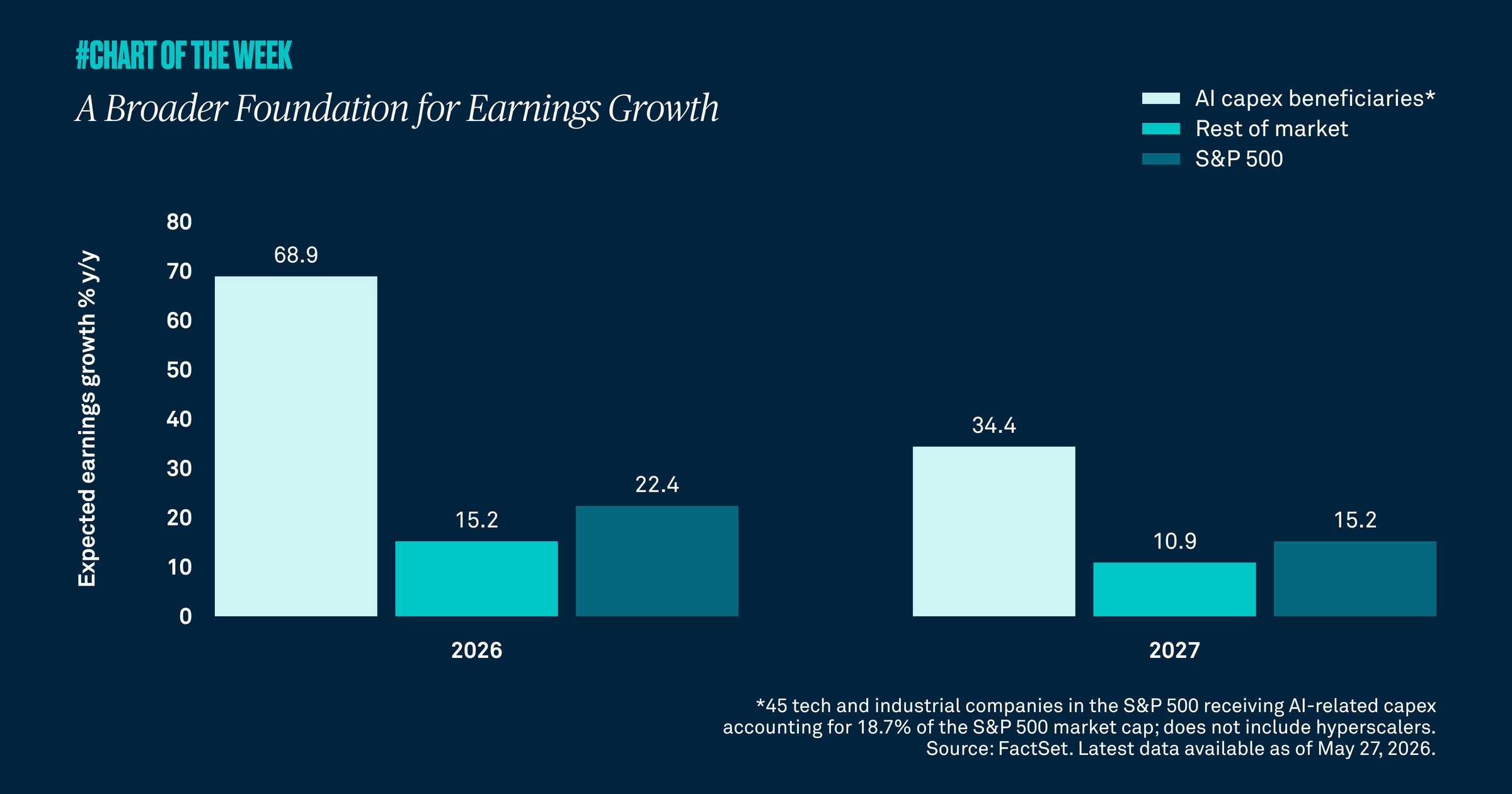

First-quarter earnings were better than expected, with attention now shifting to full-year expectations. Consensus forecasts now call for S&P 500 earnings growth of 22% in 2026 and 15% in 2027. That optimism is partially rooted in companies most directly benefiting from AI-related capital spending. This group is expected to deliver earnings growth of about 70% this year and 34% next year, which raises the issue of whether a narrow set of stocks is responsible for the acceleration in earnings growth and much of the S&P 500’s year-to-date advance.

There is some truth there; however, that question does not capture the full picture. First-quarter results have come in stronger than expected, with S&P 500 earnings growth at about 29% and 85% of companies beating estimates. More importantly, earnings growth outside the top AI capital expenditure beneficiaries remains solid. That broader segment of the market is still expected to grow earnings by 15% this year and 11% next year — both above the roughly 10% average annualized growth rate for overall S&P 500 earnings since 2010.

While continued AI capex is likely in the near term, we view a market driven by broader earnings as more sustainable. Volatility could pick up near term given higher inflation and yields along with uncertainty surrounding the new Federal Reserve chair. Still, improving earnings with breadth keep us constructive on the future outlook.
RELATED CONTENT
Getting real with real assets
Chart of the Week | Macroeconomic

Inflation appears to have transitioned from its pre-Covid average of 2% to a stickier point closer to 3%, and we do not expect a near-term return to prior levels. In this environment, we believe real assets, such as commodities, infrastructure and REITs, can provide inflation protection, diversification and return potential.

Not in a bubble
Chart of the Week | Macroeconomic

As the S&P 500 approaches all-time highs, there are renewed concerns among investors about elevated valuations. However, historically strong profitability and expected earnings growth appear to support current pricing. In addition, the current S&P 500 price-to-earnings (P/E) ratio is roughly equal to the average since Covid. As a result, we do not view U.S. equities as being in bubble territory and we remain constructive on the asset class.

Is the market rally broadening?
Chart of the Week | Macroeconomic

Stocks, as measured by the S&P 500, are up over 13% through early August. The solid gains have been fueled by a resilient economy, steady consumer spending, optimism around artificial intelligence and better-than-expected earnings growth. Still, some investors worry the advance may be too concentrated in technology and that AI-capex monetization may fall short of expectations. A closer look suggests that it is not just tech moving the market higher.

Fed friction?
Chart of the Week | Macroeconomic

Markets are navigating tensions between a Fed that offers less guidance and an inflation backdrop that remains sticky. Added uncertainty from Middle East tensions and energy-price swings is further shaping sentiment, with recent moves in Treasury yields suggesting the market wants the Fed to hike. However, with yield volatility expected to linger in the near term, we see today’s elevated Treasury yields as an especially compelling opportunity in fixed income.

Gathering data
Disclaimer Not Available

This is a marketing communication