Please ensure Javascript is enabled for purposes of website accessibility Resilient Retail Sales
at
de
intermediary
intermediary
false
true
Gathering data
Disclaimer Not Available

Resilient retail sales

Resilient retail sales

This year has been characterized by policy uncertainty and fears about the potential impact of tariffs on inflation. While many expected the consumer would crack amid weaker sentiment, it hasn’t happened yet. Retail sales remain resilient, supported by a job market that remains good enough to support spending.
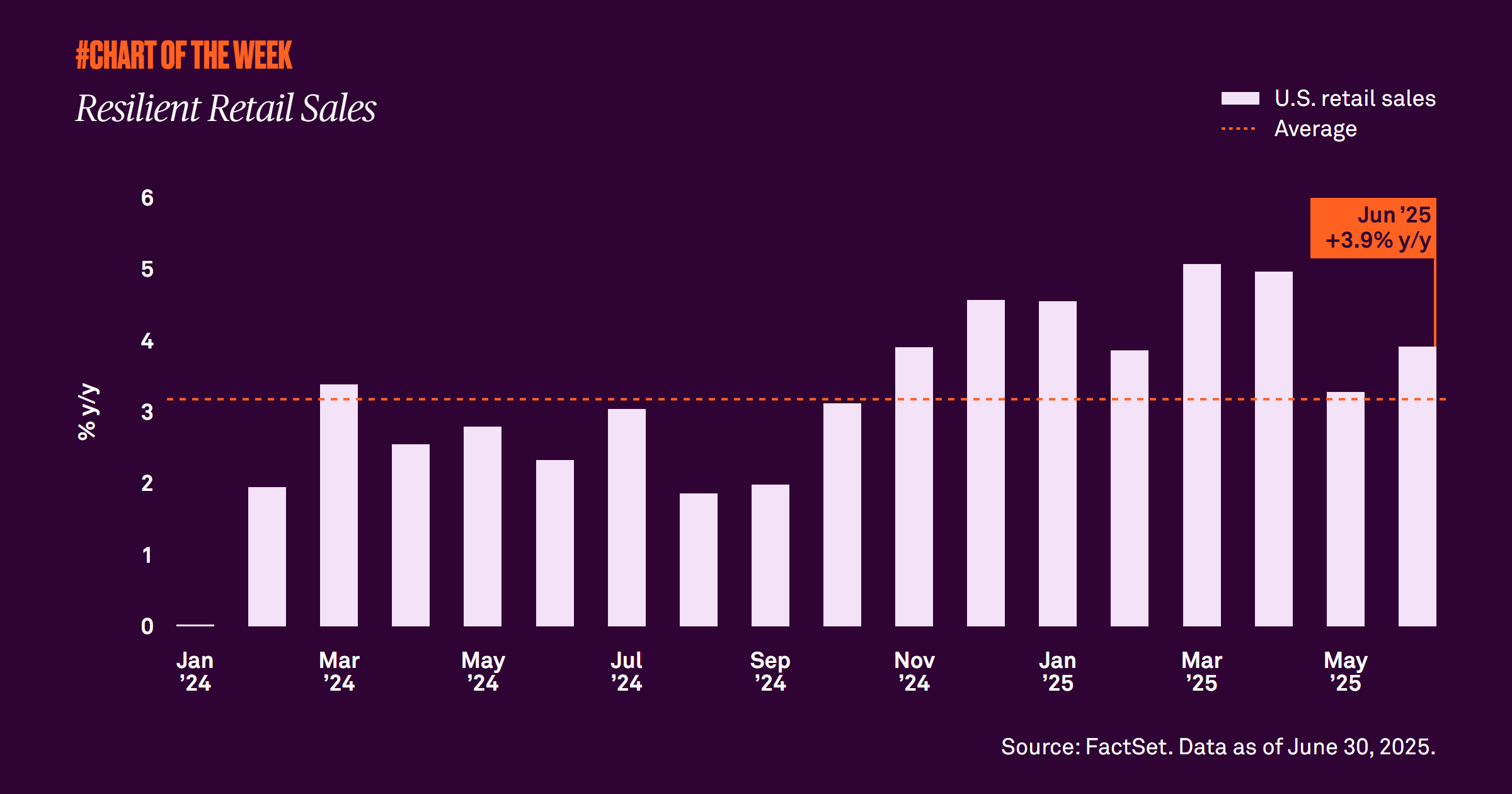


Although policy uncertainty around tariffs has kept investors worried about a potential slowdown, economic growth has remained resilient. The main driver has been continued consumer spending, which accounts for 70% of gross domestic product.

In June, retail sales, a proxy for consumption, grew 3.9% year over year, beating May’s 3.3% and surpassing the 3.2% average established since 2024. When we look at the underlying components, we find that consumers are still purchasing big-ticket items such as home appliances and furniture, and they are still dining out. Many investors have speculated that the consumer would crack amid the policy uncertainty and weakened sentiment, but so far spending has held up. A key reason has been the job market.

Though the job market has slowed somewhat, as evidenced by monthly payrolls, jobless claims have reversed their upward trajectory and have reached new lows over the past three months. In addition, the unemployment rate has held steady. The wealth effect, driven by rising equity and housing prices, has also supported spending.

Faced with a resilient consumer, we expect spending to support economic growth in the vicinity of 1% this year. 
VERWANDTE THEMEN
Job market hanging in there
Chart of the week | Makroökonomisch

Recent jobless claims data point to a resilient U.S. labor market, with both initial and continuing claims remaining low and signaling that unemployment is still contained. Although job growth has softened and remains subdued, March’s job growth of 178,000, the highest since 2024, is encouraging. Our constructive outlook still holds despite continued uncertainty related to the war in the Middle East.

cotw-30-03-2026-thumbnail-580x326px
Chart of the week | Makroökonomisch

Markets are reacting to the Middle East conflict with sharp moves across asset classes, signaling broad risk repricing and shifting safe haven behavior. While volatility is elevated, fundamentals like earnings growth continue to support our constructive outlook.

Signals from spreads
Chart of the week | Makroökonomisch

Credit spreads have risen yet remain historically low, reinforcing our view that the oil shock is likely temporary — not a driver of long-term growth concerns.

Dollar strength: what does it mean for markets?
Chart of the week | Makroökonomisch

Geopolitical tensions have lifted oil prices, sent U.S. stocks slightly lower and driven flows into the safety of the U.S. dollar, which has strengthened versus peers. While a weaker dollar previously supported international equity outperformance, dollar stabilization now suggests that tailwind is fading, underscoring the importance of diversification across regions and asset classes.

Gathering data
Disclaimer Not Available

Dies ist eine Marketingkommunikation