Please ensure Javascript is enabled for purposes of website accessibility Resilience Is a Historical Trend
at
de
intermediary
intermediary
false
true
Gathering data
Disclaimer Not Available

Resilience is a historical trend

Resilience is a historical trend

The S&P 500’s history shows that despite recessions, wars, inflation, and corrections, the market’s long-term trajectory has remained upward. As the U.S. marks 250 years of resilience, the lesson for investors is clear: wealth is built through patience, discipline and staying invested.
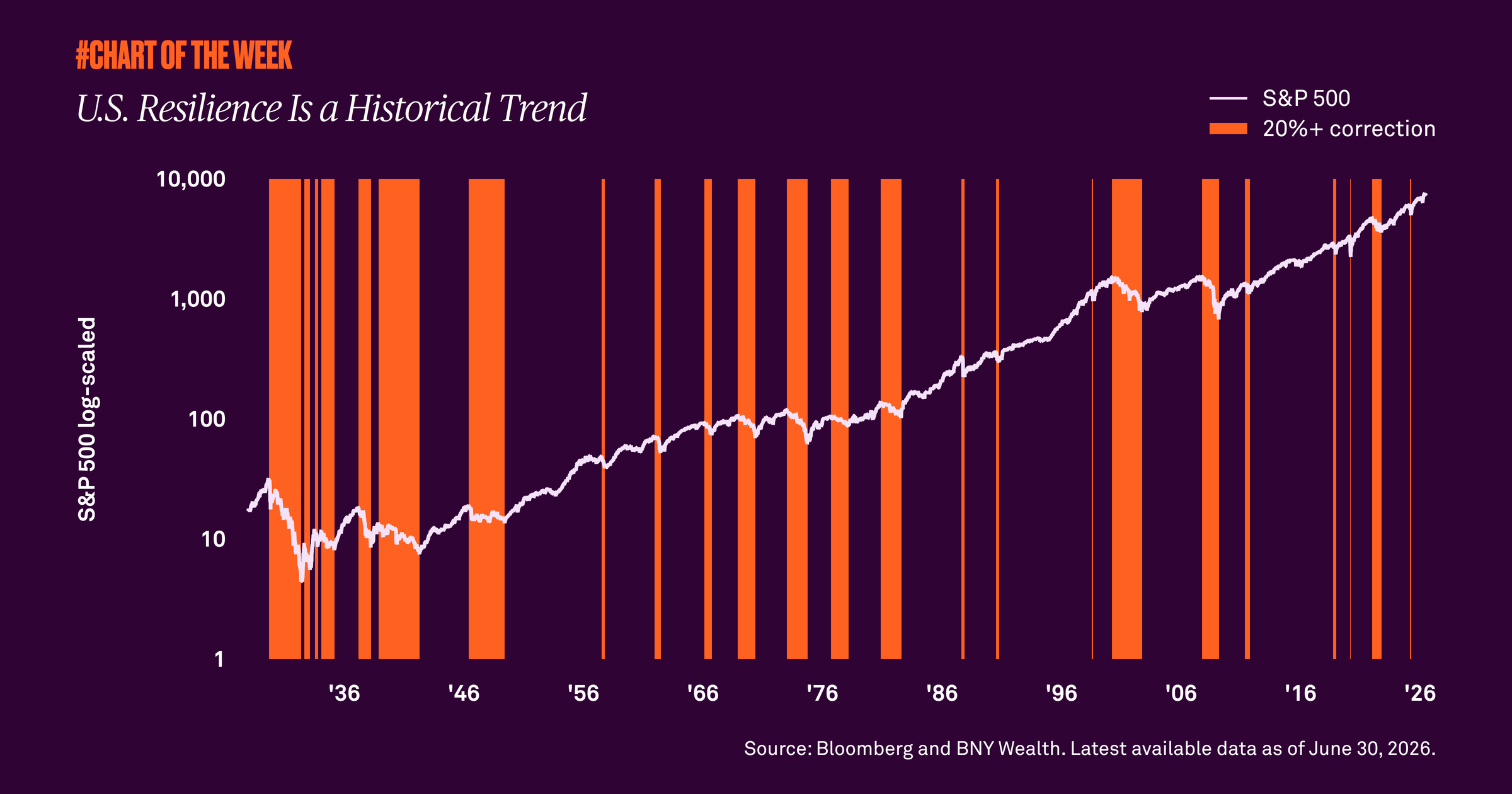

The S&P 500, in its current form, was introduced in 1957, building on Standard & Poor’s earlier 90-stock index, launched in 1926. Over the decades, it has endured recessions, wars, inflation, political division, corrections and bubbles — yet its long-term trajectory has remained upward. Its history is defined not by continuous gains, but by resilience: the capacity to absorb shocks and recover over time.

That lesson feels especially relevant as the U.S. marks its 250th anniversary. Like the market, the country’s history has never been smooth or free of conflict. Yet the broader American story is also one of endurance and long-term progress.

For investors, the message is simple: wealth building is a long-term mindset. Setbacks are inevitable, but history suggests that staying patient, disciplined and invested matters far more than trying to time every rise and fall of the market.
VERWANDTE THEMEN
Is the market rally broadening?
Chart of the Week | Makroökonomisch

Stocks, as measured by the S&P 500, are up over 13% through early August. The solid gains have been fueled by a resilient economy, steady consumer spending, optimism around artificial intelligence and better-than-expected earnings growth. Still, some investors worry the advance may be too concentrated in technology and that AI-capex monetization may fall short of expectations. A closer look suggests that it is not just tech moving the market higher.

Fed friction?
Chart of the Week | Makroökonomisch

Markets are navigating tensions between a Fed that offers less guidance and an inflation backdrop that remains sticky. Added uncertainty from Middle East tensions and energy-price swings is further shaping sentiment, with recent moves in Treasury yields suggesting the market wants the Fed to hike. However, with yield volatility expected to linger in the near term, we see today’s elevated Treasury yields as an especially compelling opportunity in fixed income.

Sizing up small caps
Chart of the Week | Makroökonomisch

Small caps have outperformed this year despite the threat of higher interest rates, suggesting the rally is being driven by more than just diversification away from large cap tech stocks. Improving earnings expectations and a resilient U.S. economy support our view that small caps have further upside from here.

cotw_27_07_2026_580x326
Chart of the Week | Makroökonomisch

The war in Iran has increased volatility across fixed income markets, pushing municipal bond yields higher as investors reassess inflation risk, energy costs and the path of Federal Reserve policy. Even so, historically elevated municipal bond yields present a compelling opportunity for tax-sensitive investors.

Gathering data
Disclaimer Not Available

Dies ist eine Marketingkommunikation