
Fallen angels, or bonds downgraded from investment grade to high yield, have quietly outperformed comparable fixed income markets across most near- and longer-term time horizons. With downgrades potentially picking up, now may be the time to take another look at the asset class.
Fallen Angels Have Performed Historically Well Against Other Credit Markets
Fallen angels’ track record is compelling across many periods, with only one notable weak spot: their five-year performance versus U.S. high yield, which was a result of the 2022 rising rate environment.
A Compelling Track Record
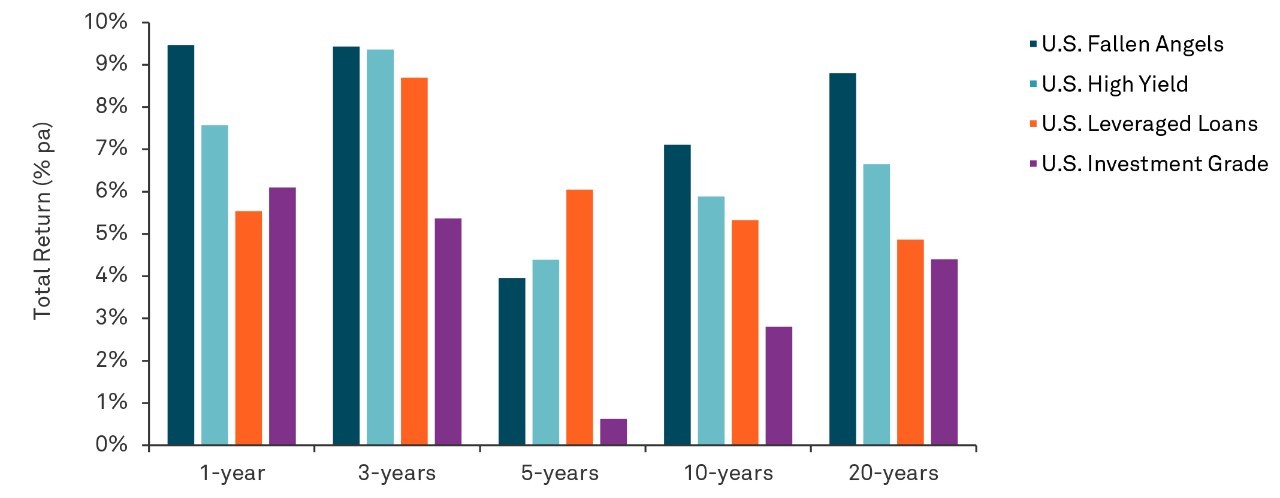
Source: Insight, Bloomberg, May 2026 (Fallen angels: Bloomberg U.S. High Yield Fallen Angel 3% Capped Index, High yield: Bloomberg Corporate U.S. High Yield Index, Investment grade: Bloomberg U.S. Corporate Index, Leveraged loans: Morningstar LSTA U.S. Leveraged Loan 100 Index). See index definitions in Appendix. Past performance is not indicative of future results. Chart is for illustrative purposes only.
The composition of fallen angel returns has historically mirrored high yield corporates more than investment grade companies. Like high yield, fallen angels have seen greater contributions from credit spread (or “excess” returns versus Treasuries), potentially offering diversification benefits against investment grade bonds. These returns are largely driven by fallen angels’ typically wider credit spreads relative to investment grade bonds.
Credit Spreads, Not Interest Rates, Have Driven Strong Fallen Angel Performance Versus High Yield
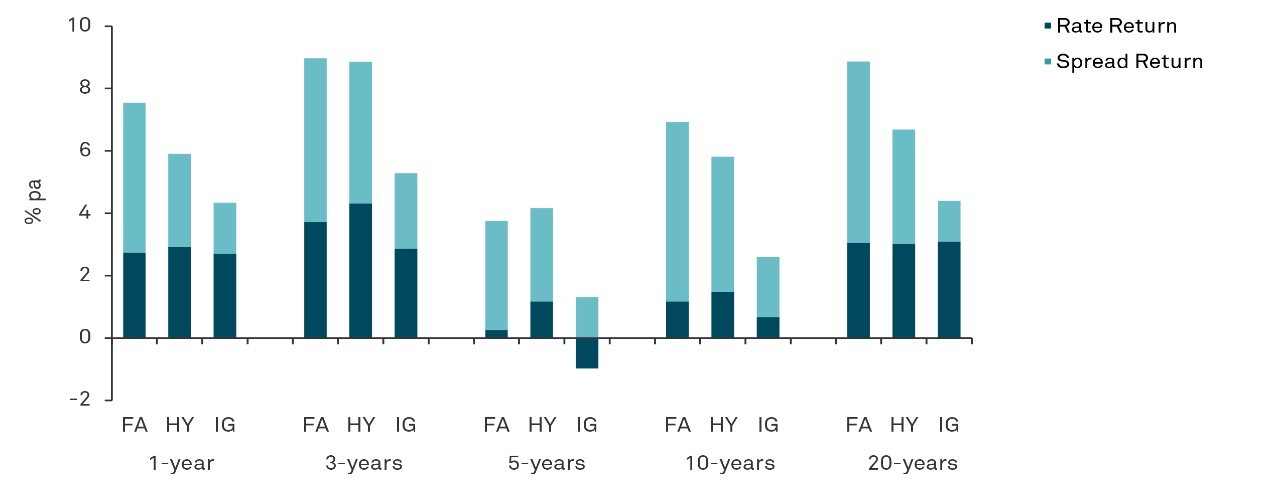
Source: Insight, Bloomberg, May 2026 (Fallen angels: Bloomberg U.S. High Yield Fallen Angel 3% Capped Index, High yield: Bloomberg Corporate U.S. High Yield Index, Investment grade: Bloomberg U.S. Corporate Index). See index definitions in Appendix. Past performance is not indicative of future results. Chart is for illustrative purposes only. FA = Fallen Angels; HY = High Yield; IG = Investment Grade.
Source:Insight, Bloomberg, May 2026 (Fallen angels: Bloomberg U.S. High Yield Fallen Angel 3% Capped Index, High yield: Bloomberg Corporate U.S. High Yield Index, Investment grade: Bloomberg U.S. Corporate Index). See index definitions in Appendix. Past performance is not indicative of future results. Chart is for illustrative purposes only. FA = Fallen Angels; HY = High Yield; IG = Investment Grade.
Can a Wave of Downgrades Improve Near-Term Fallen Angel Returns Further?
When a bond is downgraded from investment grade to high yield, it gets removed from investment grade indices, forcing passive funds and many active managers to sell simultaneously. Many funds are unable to hold any bond below investment grade, creating “forced sellers.” This may lead to overselling, creating potentially compelling entry points for other investors.
Our research indicates that sector downgrade waves historically coincided with higher fallen angel returns, and we believe business development companies (BDCs) are a sector to watch for future downgrade candidates.1 BDCs have had a difficult year, partly due to concerns around software exposure and most of the market holds BBB ratings (the lowest investment grade rating) and many trade in line with high yield companies.
Waves of Downgrades Have Historically Coincided with Higher Fallen Angel Returns
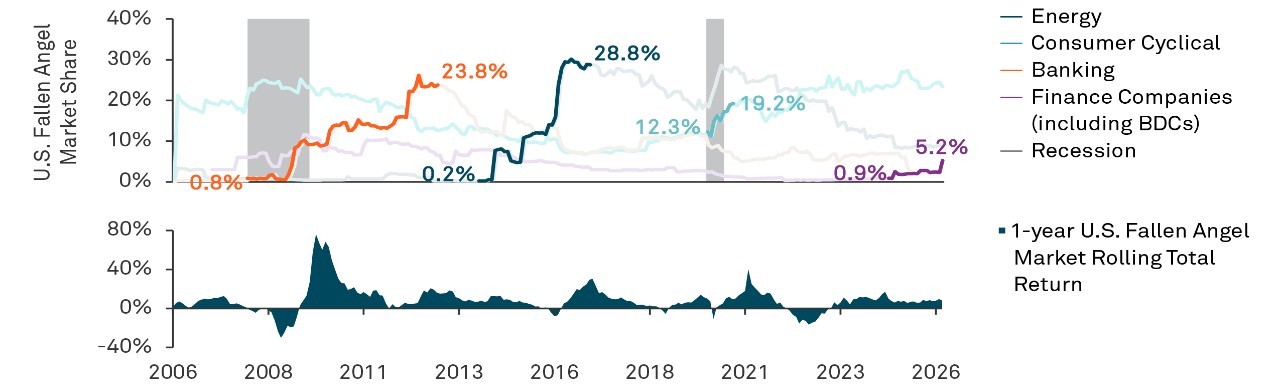
Source:Insight, Bloomberg, April 2026 (Fallen Angels: Bloomberg U.S. High Yield Fallen Angel Index). Past performance is not indicative of future results. Chart is for illustrative purposes only.
We see signs that downgrades may also pick up across other sectors. Fallen angel downgrades have been low since the pandemic, but $30 billion has entered fallen angel indices year-to-date, already making it the highest level since 2020.
Economic Conditions May Also Indicate a Potential Catalyst for Downgrades
Consumers, particularly in lower-income brackets, are increasingly dipping into savings to support consumption, leaving the personal savings rate at its lowest level since 2022.2 A declining savings rate signals that consumers are under financial pressure, which can weigh on corporate revenues and earnings, particularly for consumer-facing companies, and ultimately increase the likelihood of credit downgrades.
Trends are also moving toward higher mergers and acquisitions (M&A) activity. Goldman Sachs forecast M&A volumes of $3.8 trillion in 2026,3 driven by factors like deregulation and AI-related disruption and consolidation.
We are watching fundamentals, rating agency outlooks and pricing within BBB names in particular. We expect to see downgrades return to more historically normal levels of $40 billion to $50 billion per year.
Getting Ahead of Future Downgrade Waves May Be an Optimal Strategy
In our view, total returns over recent years offer potential evidence that the fallen angel market may provide value even absent a wave of downgrades. Importantly, we do not expect higher downgrades to coincide with higher defaults. We expect default rates in high yield and fallen angel markets to remain contained, as we believe the economic environment and corporate fundamentals should remain robust.
Endnotes
1. Insight Investment, BDCs as a Fallen Angels Opportunity, May 2026. Business development companies (BDCs) are publicly traded vehicles that finance small and mid-sized private companies, passing most income to shareholders as dividends.
2. U.S. Bureau of Economic Analysis, May 2026.
3. Source: Goldman Sachs, M&A Volume Expected to Surge This Year Despite Economic Uncertainty, April 2026.
Appendix
Credit spread is the difference in yield between a bond and a comparable “risk-free” government bond (typically a U.S. Treasury) of the same maturity. Credit spread return is the gain or loss resulting from the narrowing or widening of a bond’s credit spread. Interest rate return is the portion of a bond’s total return that results from changes in market interest rates. Fallen angels are bonds that were originally issued as investment grade but have since been downgraded to high yield (or “junk”) status by a major credit rating agency. Fallen angels have longer maturities, so when spreads tighten, their prices rise more than shortermaturity high yield bonds — amplifying returns.
Bloomberg U.S. High Yield Fallen Angel Index Tracks U.S. bonds originally issued as investment grade that have since been downgraded to high yield status. Bloomberg U.S. High Yield Fallen Angel 3% Capped Index Tracks U.S. bonds originally issued as investment grade that have since been downgraded to high yield status, but limits any single issuer to 3% of the index to reduce concentration in any one company. Bloomberg U.S. Corporate High Yield Index Tracks the broad US high yield corporate bond market, or bonds rated below investment grade (BB or lower). Bloomberg U.S. Corporate Index Tracks the U.S. investment grade corporate bond market, or bonds rated BBB or higher. Morningstar LSTA U.S. Leveraged Loan 100 Index Tracks the 100 largest leveraged loans in the U.S., or floating-rate loans made to below-investment grade companies. Investors cannot directly invest in any index.
“BLOOMBERG” and the Bloomberg indices listed herein (the “Indices”) are service marks of Bloomberg Finance L.P. and its affiliates, including Bloomberg Index Services Limited (“BISL”), the administrator of the Indices (collectively, “Bloomberg”) and have been licensed for use for certain purposes by the distributor hereof (the “Licensee”). Bloomberg is not affiliated with Licensee, and Bloomberg does not approve, endorse, review, or recommend the financial products named herein (the “Products”). Bloomberg does not guarantee the timeliness, accuracy, or completeness of any data or information relating to the Products.
Risks
Bonds are subject generally to interest-rate, credit, liquidity, call and market risks, to varying degrees. Generally, all other factors being equal, bond prices are inversely related to interest-rate changes and rate increases can cause price declines. Investment grade is a rating of fixed-income bonds, bills, and notes by credit rating agencies.
Bond ratings reflect the rating entity’s evaluation of the issuer’s ability to pay interest and repay principal on the bond on a timely basis. Bonds rated BBB/Baa or higher are considered investment grade, while bonds rated BB/Ba or lower are considered speculative as to the timely payment of interest and principal. Credit ratings reflect only those assigned by Nationally Recognized Statistical Rating Organizations (NRSRO) that have rated fund holdings. Split-rated bonds, if any, are reported in the higher rating category.
Important Information
This is a financial promotion and is not investment advice. Any views and opinions are those of the investment manager, unless otherwise noted. The value of investment can fall. Investors may not get back the amount invested. BNY, BNY Mellon and Bank of New York Mellon are the corporate brands of The Bank of New York Mellon Corporation and may also be used to reference the corporation as a whole and/or its various subsidiaries generally. BNY Investments encompass BNY Mellon’s affiliated investment management firms and global distribution companies. Any BNY entities mentioned are ultimately owned by The Bank of New York Mellon Corporation. In Hong Kong, the issuer of this document is BNY Mellon Investment Management Hong Kong Limited, which is registered with the Securities and Futures Commission (Central Entity Number: AQI762). In Singapore, this document is issued by BNY Mellon Investment Management Singapore Pte. Limited, Co. Reg. 201230427E. Regulated by the Monetary Authority of Singapore (MAS). This advertisement has not been reviewed by the Monetary Authority of Singapore.
MC769-22-09-2026 (6M)