Warsh’s hawk talk
iFlow > Short Thoughts
Published on Tuesdays, Short Thoughts offers perspectives on US funding markets, short-term Treasuries, bank reserves and deposits, and the Federal Reserve's policy and facilities.
iFlow > Short Thoughts
Published on Tuesdays, Short Thoughts offers perspectives on US funding markets, short-term Treasuries, bank reserves and deposits, and the Federal Reserve's policy and facilities.

John Velis
Time to Read: 4 minutes
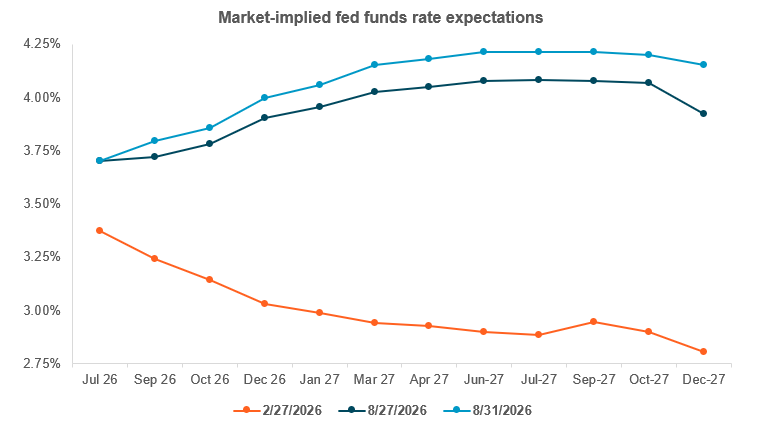
EXHIBIT #1: RATE HIKES EXPECTED
Source: BNY Markets, Bloomberg
Although he stopped short of explicit forward guidance in his Jackson Hole address, Fed Chair Kevin Warsh stepped as close to the line as possible in advocating a hike; the market is currently pricing an almost two-thirds probability for one at the FOMC’s September 16 meeting. With the August CPI expected the week before, we agree that a hike will take place unless the print shows a significant slowing in the pace of price increases. After that, the view is murkier, although the market sees at least an additional hike into early 2027 and more upside – although not a full hike – beyond that, with a total of about two-and-a-half currently priced. See Exhibit 1, which shows that expectations have clearly moved higher in the day since the speech.
The key here, as always, is inflation. While both PCE and CPI remain elevated, with even core indices running above 2%, inflation has been softening slowly. However, Warsh correctly pointed out that the central bank has missed its 2% target for 65 straight months. With other Committee members advocating a rate hike, and the CPI print expected to show core inflation above 2%, we don’t think Warsh can wait any longer and that he will advocate for a hike. We expect the Committee to vote affirmatively for the action, although we don’t discount a dissent or two, with a good chance those will come from one or two of the Governors, and not a regional bank president with a voting position. Recall, all three dissents in July came from Reserve Bank leaders.
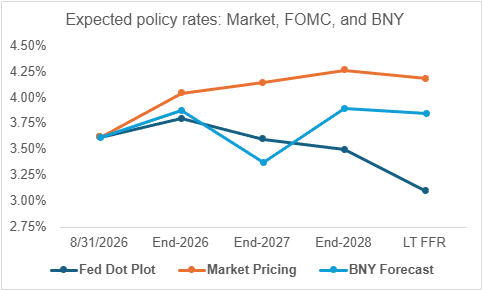
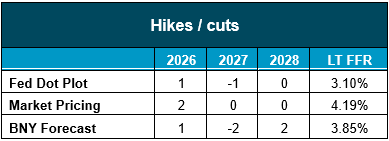
After September, we believe things will get a bit more complicated. How much higher do rates need to go before they become restrictive? And what happens if inflation continues to slow gradually toward 2% into the fall months? We note that market expectations several years out the curve top out at just above 4%. Overnight index swaps imply the peak Fed funds rate this cycle is about 4.2%, while the implied risk-free neutral policy rate from the New York Fed’s term structure model shows that at a 10y horizon, markets expect the short rate over the decade to average around 4% as well. A 25bp hike now brings the effective rate to 3.88%. If something close to 4% is the estimated neutral rate, we may not need much more than one hike to get close, especially if inflation continues to approach 2% for the rest of the year.
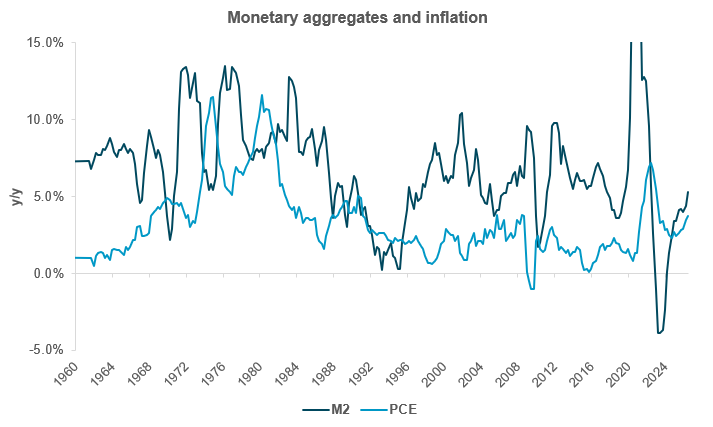
The Warsh Fed has been making more noise about the growth of the money supply since the change in leadership. It was one of the six points he made in his speech: “Money matters.” The old monetarist view of monetary policy is that control of monetary aggregates is a key step in bringing down inflation, but attention to the money supply has been scant in recent years. Money growth was also highlighted in the Fed’s semiannual report to Congress and in the July FOMC statement. This suggests that Warsh is keying on this variable, which has been growing at above 6% for some time now, after having plumbed the depths during and just after COVID. The current 6.7% annual growth in M2 (broad money) places it close to the steady-state level observed for most of the 1980s.
EXHIBIT #2: MONEY SUPPLY AND INFLATION – NOT A CLEAR RELATIONSHIP
Source: BNY Markets, Bureau of Economic Analysis, Federal Reserve Board of Governors
Central bankers have moved away from money supply as a policy determinant or inflation driver. We’ll explore this in depth in a later piece, but the empirical relationship between money growth and inflation is hard to identify looking back as far as the 90s (Exhibit 2). Money demand – a key transmission mechanism through which monetary policy is thought to have effects – is notoriously unstable and hard to measure, while money supply is difficult to control outside of the narrow M0 (base money) and M1 aggregates. Nevertheless, Warsh is clearly training his gaze on the money supply development as well, which bears watching and further commentary.
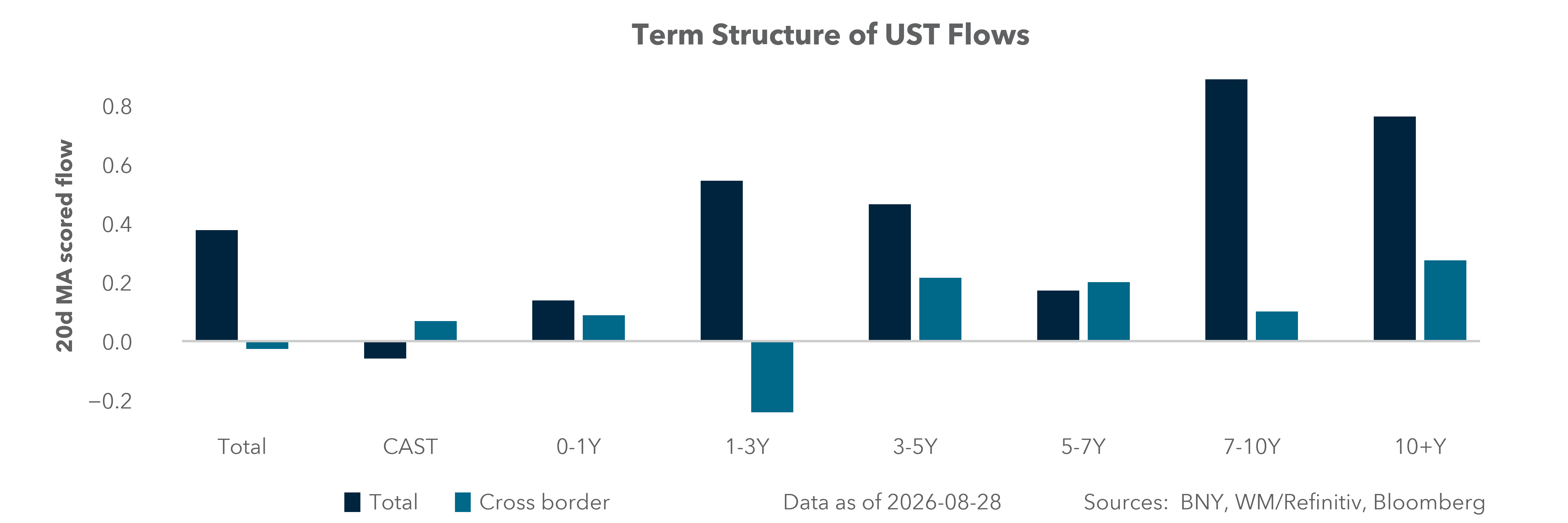
All in all, it was a hawkish speech, and the market reacted accordingly. The front end moved higher, with overnight and swaps rates through the 2y yield all pricing in some tightening to come. The long end has sold off, betraying the view of many (including ours) that a more hawkish Fed would help bring yields lower as credibility would be seen to be enhanced. And yet, both the 10y and 30y yields have moved much higher since Friday. This continues to reinforce for us the view that the long end of the curve is being led by something other than mere inflation expectations and policy conjectures. We think of fiscal concerns and doubts about institutional credibility as the culprits.
We’ve addressed our view that the September move will be a hike, a change from our position before Jackson Hole. Beyond September, we believe the usual suspects, inflation and jobs, will drive the rate expectations narrative. We still think inflation relief will continue to slowly reveal itself, and that the job market remains in a very low equilibrium. The latter has been dismissed by most Fed officials, including Warsh, as nothing to worry about, although recent monthly prints have been disappointing. Nevertheless, we think it would take several months of properly weak jobs data and ongoing gradual disinflation for the Fed to begin to get concerned about policy suddenly moving from nonrestrictive to restrictive.