September FOMC preview, rate rises start now
iFlow > Short Thoughts
Published on Tuesdays, Short Thoughts offers perspectives on US funding markets, short-term Treasuries, bank reserves and deposits, and the Federal Reserve's policy and facilities.
iFlow > Short Thoughts
Published on Tuesdays, Short Thoughts offers perspectives on US funding markets, short-term Treasuries, bank reserves and deposits, and the Federal Reserve's policy and facilities.

John Velis
Time to Read: 6 minutes
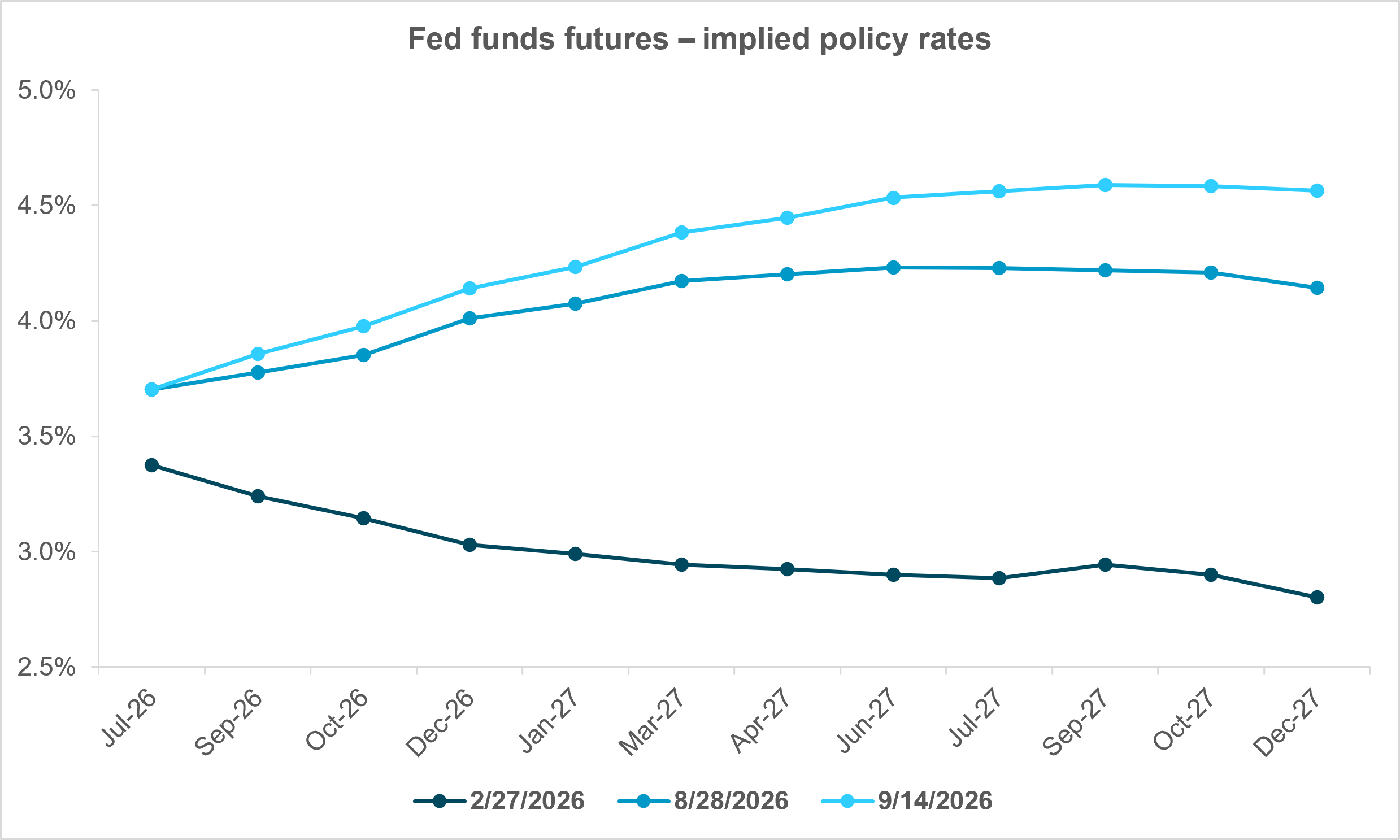
EXHIBIT #1: MARKET INCREASINGLY HAWKISH SINCE JACKSON HOLE
Source: BNY Markets, Bloomberg
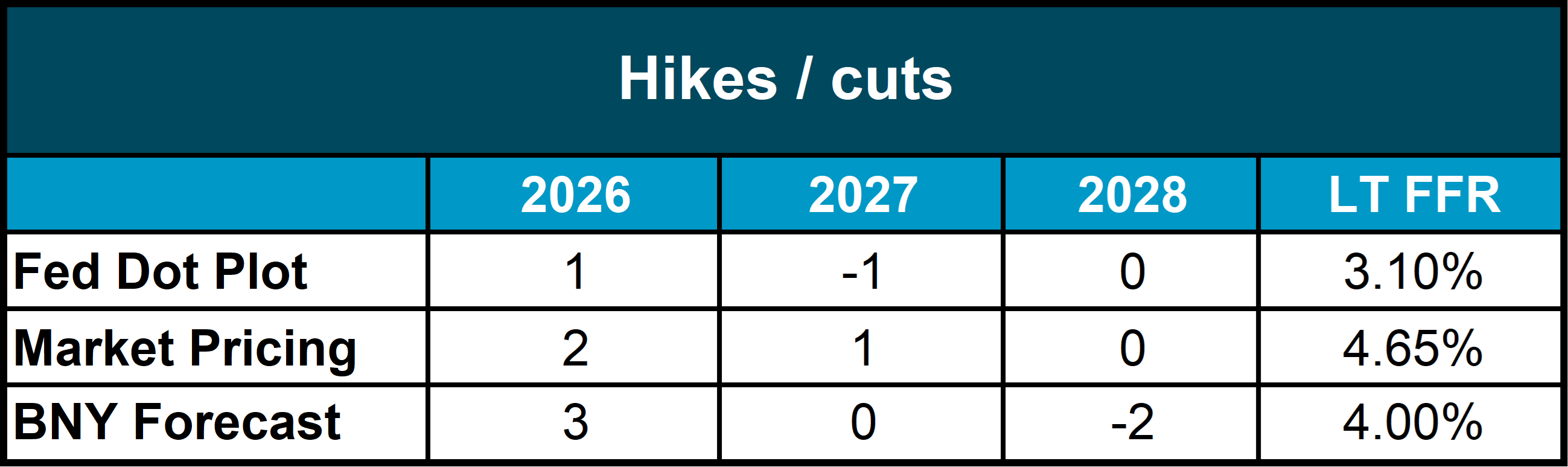
We expect the FOMC to enact a 25bp rate hike this Wednesday, in line with implied market probabilities, which currently price over a 90% likelihood of such action. The Fed’s expected move is also likely to feature one or more dissents in favor of a hold from less hawkish members of the Committee. At the July meeting when rates were held steady, three regional Fed presidents dissented in favor of a rate hike.
Exhibit 1 shows that the market has become even more hawkish in the last few weeks since Chair Kevin Warsh’s August 28 Jackson Hole speech. That speech, which we regarded as hawkish, stopped just short of explicit forward guidance and led us to change our call from no hikes this year. While we expect a hike this week, and probably one more this year, we think the path to even higher policy rates is strewn with potential impediments to significantly tighter policy.
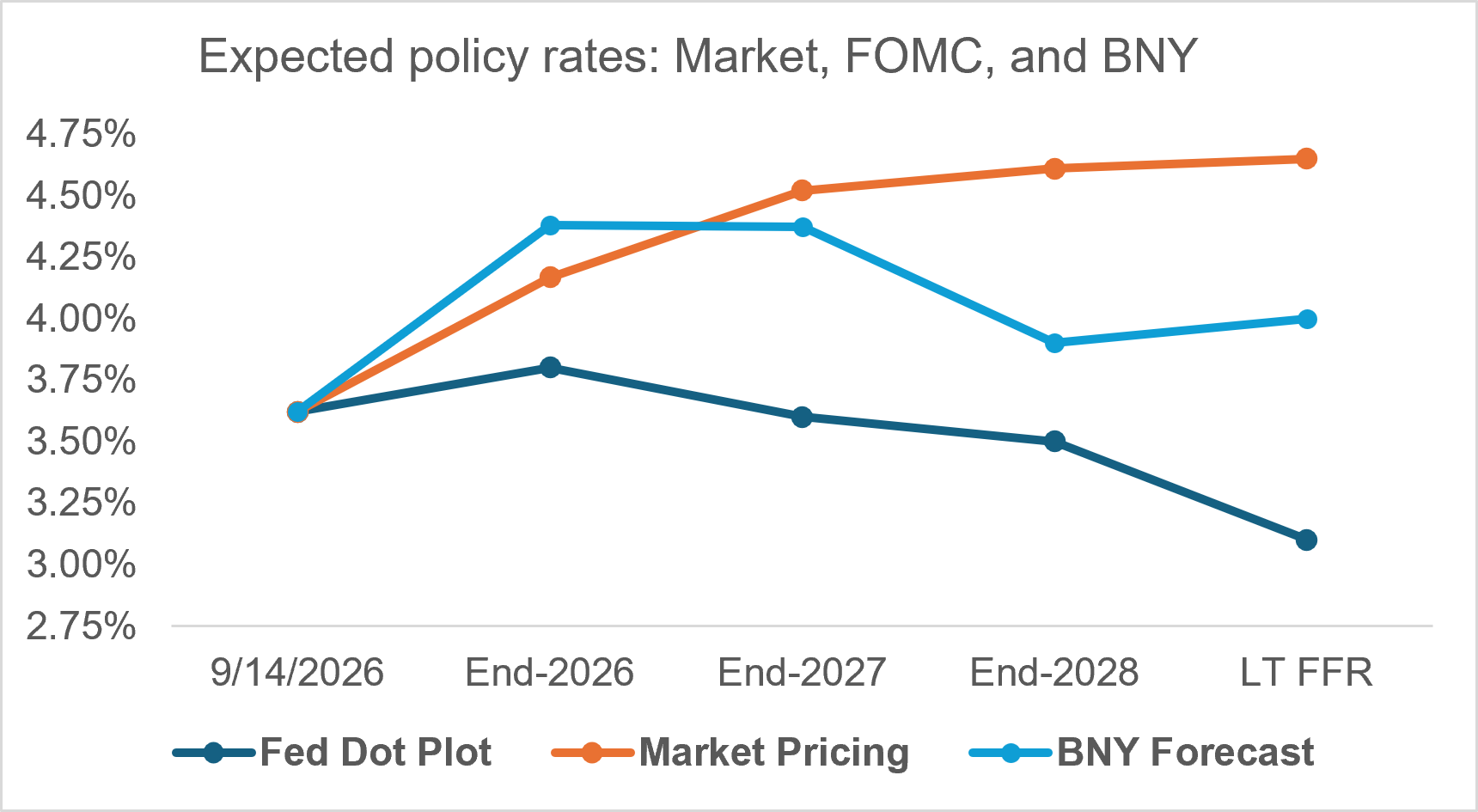
We acknowledge a murky outlook for 2027 and the possibility of one or more additional increases in the funds rate next year, although we differ from the market in our H2 2027 outlook. The market sees a total of nearly four rate hikes (approx. 100bp) through the end of next year. We think that by then the economy won’t be able to handle rates that high for very long, and the Fed will be contemplating dialing back its restrictiveness toward the second half of the year. Raising rates is probably the correct medicine for now, but it’s risky and carries costs to the real economy and to financial markets that might require a reversal later in the cycle.
We had thought – perhaps naively, and certainly incorrectly – that the conflict in the Middle East would have cooled by now. Lower oil prices would have pulled inflation expectations down with them, allowing a less hawkish bias at the Fed. If anything, the geopolitical situation is more fraught now than it was a few months ago, reflected in ever higher prices for crude and crucial distillates like diesel.
Monetary policy may not be well suited to offsetting the current supply shock, but there’s a need to keep inflationary expectations dampened. The global and U.S. economies have suffered a series of supply shocks since COVID – including the pandemic itself, the Russian invasion of Ukraine, “liberation day” tariffs, and a series of energy shocks as a result of the conflict in the Middle East. Even though long-term inflation expectations have stayed relatively steady, short-term expectations are ramping up again. Long-maturity real rates are significantly higher now, leading the entire back end higher with them, even though breakevens and longer horizon inflation swaps remain stable.
The rise in the nominal 10y and 30y yields is instead almost entirely due to rising real yields. This suggests that the market is expecting higher short-term rates for the next several years, even though inflation expectations are holding steady. Most likely, the expected higher policy rates that are driving real yields higher are precisely what’s keeping inflation expectations stable. In the market’s eyes, the Fed still enjoys credibility – higher rates now and into the future will keep inflation from getting out of control. At least that appears to be the message in the market.
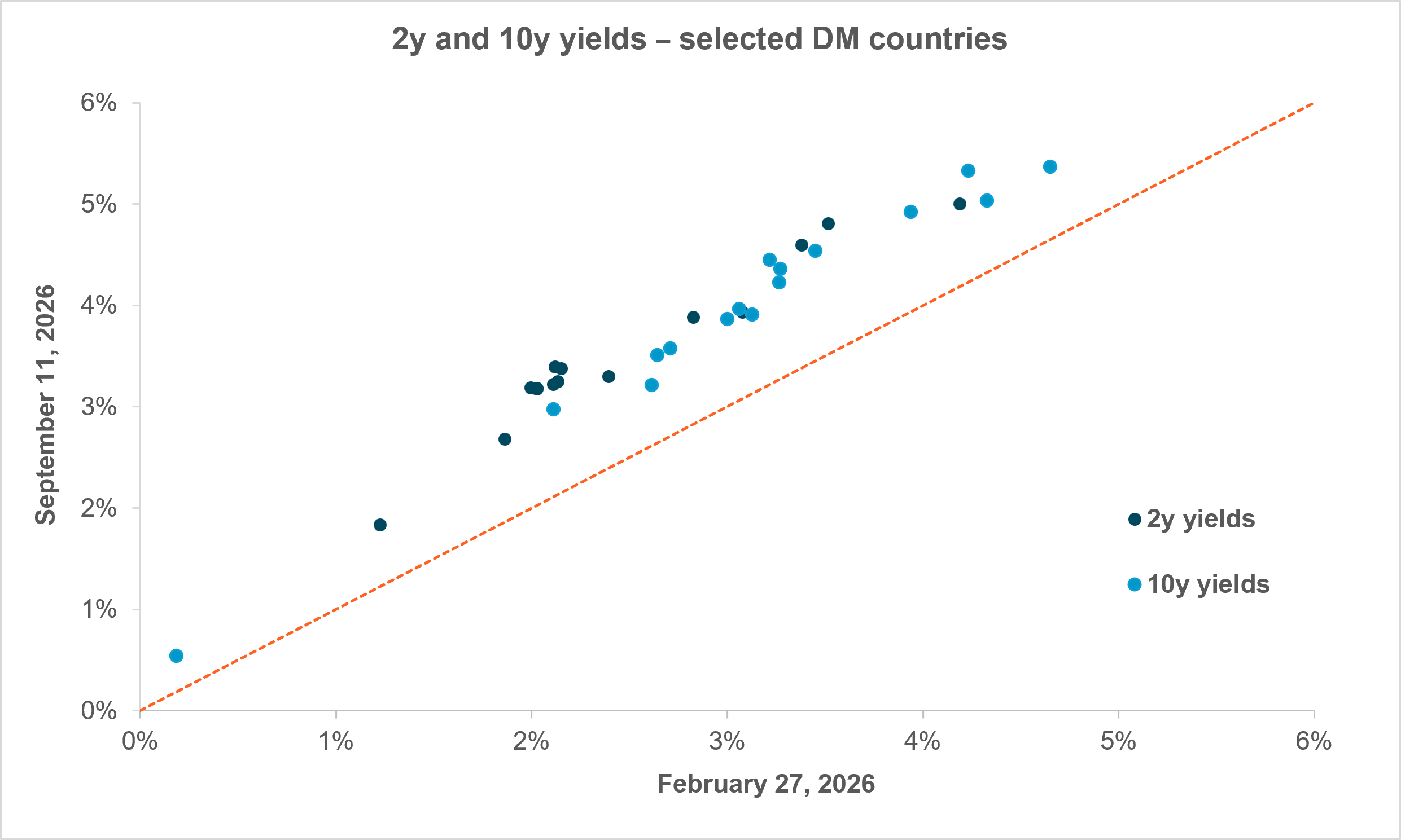
EXHIBIT #2: YIELDS HIGHER ACROSS THE DEVELOPED WORLD
Source: BNY Markets, Bloomberg
The almost inexorable rise in yields – real and nominal, short- and long-maturity – is a global phenomenon, but what’s driving it? Some slightly strenuous mathematics allow us to inquire how much of the rise in yields is due to real long-term rates (which reflect fiscal concerns, risk appetite, and higher expected short rates), as well as – recently – rising policy expectations around the world. Exhibit 2 shows how much higher both the 10y and 2y (nominal) yields are across 15 developed market economies since the U.S.-Iran conflict began in late February this year.
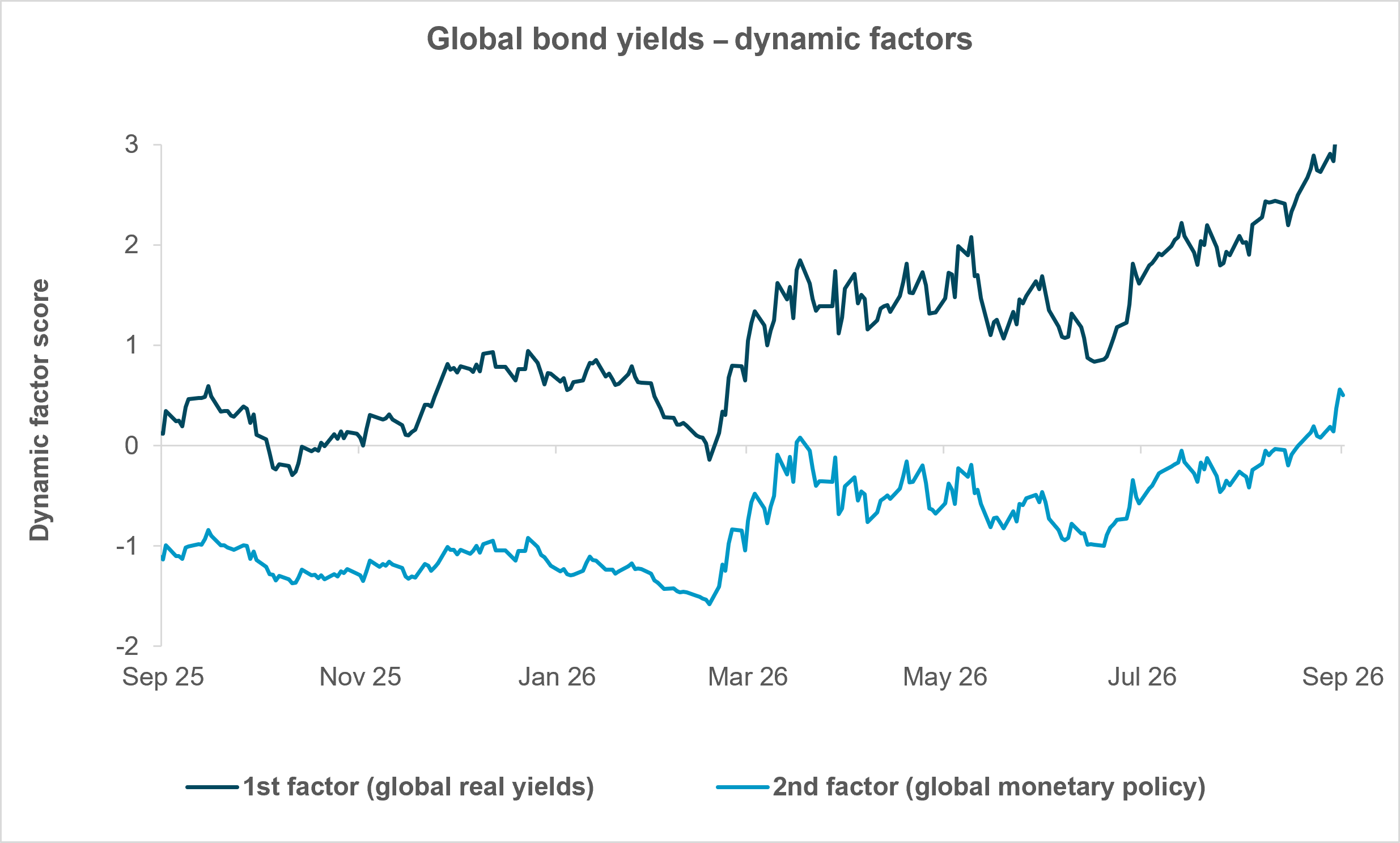
EXHIBIT #3: FACTORING GLOBAL YIELDS
Source: BNY Markets, Bloomberg
We used a technique known as dynamic factor modeling to extract common information contained across the global DM rates complex. Dynamic factors attempt to explain the co-movements of a set of time series – in this case 10y yields – across multiple markets. The technique presumes that all 15 markets in our study going back to the end of 2022 share some “latent” or behind-the-scenes factor or set of factors that explain their movements. We estimated five latent dynamic factors, which we interpreted as follows.
The first factor explains 55% of the common variance among the 15 10y yields in our sample and strongly suggests that there’s a common global factor associated with real rates driving yields higher across the globe. Note that in Exhibit 3, this factor shot higher right after the conflict erupted at the end of February. So did the second common factor, which explains an additional 30% of the joint variation in our sample. Together, the first two dynamic factors can be thought to be responsible for around 85% of the co-movements in global yields.
The first factor corresponds to higher real rates. It essentially confirms that this is a global phenomenon, something that we don’t think is likely to recede soon. We infer that the second factor is a monetary policy proxy, as the dynamics of that factor correspond to the average movement in the policy-sensitive 2y yields across the globe. Think of the first factor as a global risk factor – or a global pricing factor, while the second factor moves with changes in the perceived path of monetary policy across the world. Note that this second factor took an additional leg higher at the end of August, around the time of Chair Warsh’s hawkish Jackson Hole speech.
Dynamic factor modeling of the global rates and yield complex tells us two things: 1) the global risk appetite for long-dated bonds is deteriorating as time goes on, and 2) monetary policy expectations are getting more hawkish globally. As discussed above, for the U.S. at least, there’s a good chance that these hawkish expectations will be confirmed over Q4 this year, but may be somewhat overcooked and may stay that way for a few months, as markets begin to see more rate hikes, including from the U.S. However, there’s room for rate expectations to top out and even come in somewhat before too long. We’re not there yet, and we think the pressure on the front end (and therefore the long end as well from this monetary policy expectations factor) will stick around for a few months, after which it could recede. We’re currently strapped in for the journey if not the final destination, which could arrive well short of the policy rates currently priced in for the full global cycle.
We outlined our policy expectations above, for this coming meeting as well as the rest of the year and into 2027. Inflation is the policy priority for most FOMC members and will remain so for some time. Given the recent renewed climb higher in oil prices, we don’t think the inflation story will go away in a month or two, and the outlook is heavily reliant on geopolitical developments, about which we have very little visibility.
However, risks rise with policy rates for both the real economy and the financial markets, so we expect the Fed to move cautiously, and as is Chair Warsh’s wont, we aren’t likely to receive much of a commitment beyond Wednesday’s expected action. It’s true there will be a new Summary of Economic Projections, but we don’t think that the dots will be worth much post-meeting focus, given the Chair’s (and many of those in the markets) dim view of them.
Our concern and the source of our uncertainty about 2027 is the effect that rising policy rates will have on leverage throughout the system, as well as consumer financials. We do think that the nearly 100bp of hikes (equivalent to four hikes of the standard 25bp increment) currently priced in will be realized. We’re not ready to see shorter-maturity yields fall any time soon but think they may ultimately prove to be ahead of themselves.