Reforming the data stack
iFlow > Short Thoughts
Published on Tuesdays, Short Thoughts offers perspectives on US funding markets, short-term Treasuries, bank reserves and deposits, and the Federal Reserve's policy and facilities.
iFlow > Short Thoughts
Published on Tuesdays, Short Thoughts offers perspectives on US funding markets, short-term Treasuries, bank reserves and deposits, and the Federal Reserve's policy and facilities.

John Velis
Time to Read: 5 minutes
EXHIBIT #1: STATISTICAL AGENCY FUNDING ERODING IN REAL TERMS
Source: BNY Markets, Bloomberg, Bureau of Labor Statistics
The Fed’s Data Sources task force has a crucial and delicate mission, given that economic data are the lens through which policymakers and market participants view the economy. If the data inaccurately describe the economy’s evolution , misinformation can compromise or even misdirect policymaking across all matters of economic policy, not just monetary policy.
When announcing the five task forces at his first post-FOMC press conference in June, Fed Chair Kevin Warsh described the task force’s remit as follows: “Evaluate new information sources and consider methodological changes to improve data gathering, with the aim of giving policymakers more accurate, relevant, contemporaneous, and, perhaps most important, actionable information on the state of our economy.” The word “improve” suggests there are inadequacies in the government’s current stack of economic statistics. It’s instructive to revisit Warsh’s initial press conference transcript to understand his reasoning for a comprehensive look at the statistics the Fed relies upon to inform policy.
Among his critiques, Warsh says the Fed relies too much on outdated, backward-looking data, arguing that current statistics are often slow, revised later, and less useful in real time. Furthermore, he says the data framework doesn’t fully reflect the modern economy. He wants the Fed to use better official data, private-sector signals, and AI-enabled methods.
We, like many economists, don’t disagree with these criticisms. Although U.S. governmental statistics are considered the gold standard around the world, that gold is becoming somewhat tarnished, not just for methodological and structural reasons. Budgets and resourcing for the main federal statistical agencies have been squeezed for over a decade.
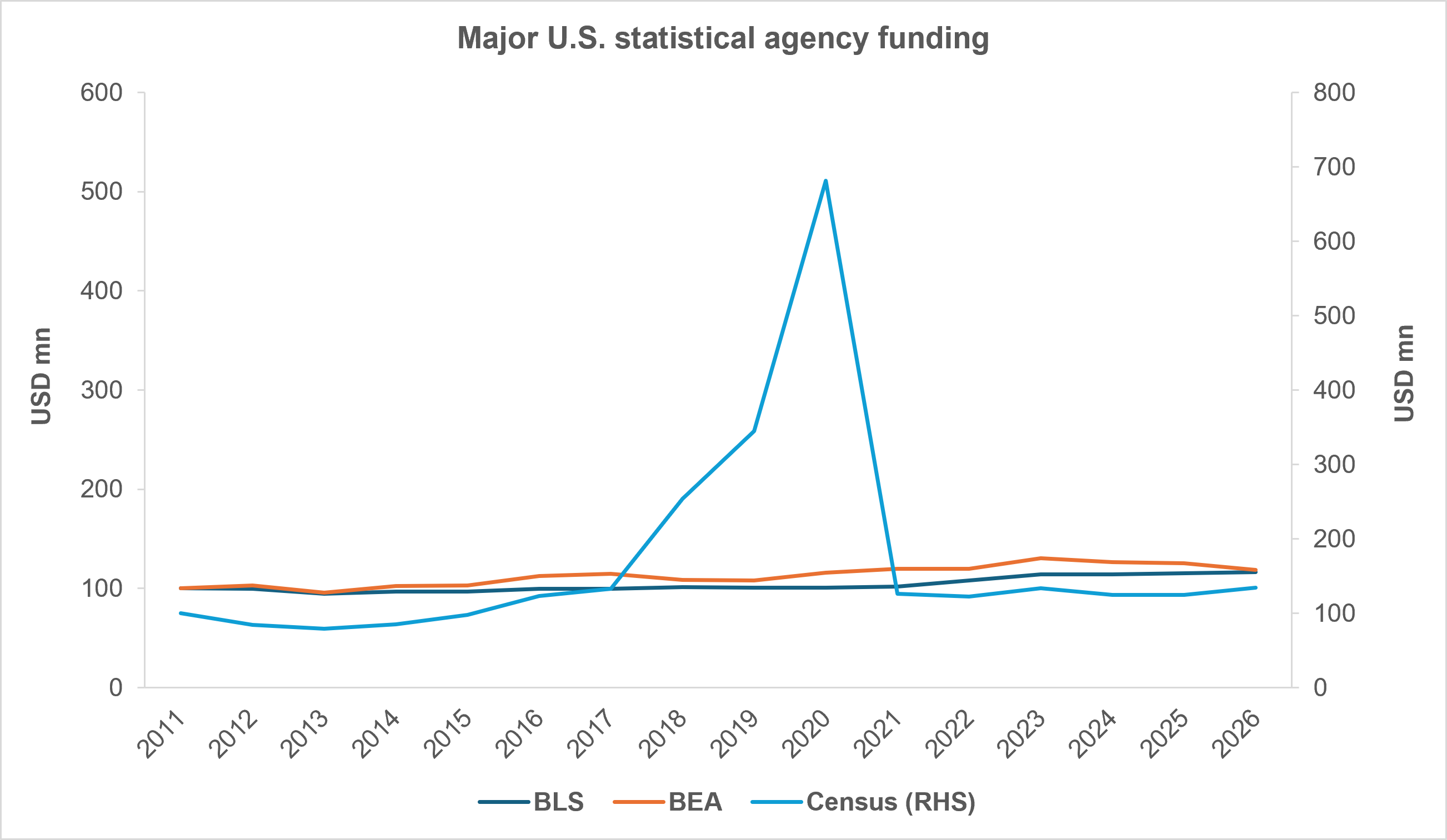
Exhibit 1 shows nominal funding levels for the Bureau of Labor Statistics (BLS), Bureau of Economic Analysis (BEA) and the Census Bureau since 2011. Over the past 15 years, appropriations for these agencies have been flat to modestly rising in nominal terms, but much weaker in real terms once inflation and operating costs are considered. BLS and BEA show a slow nominal increase but persistent purchasing-power erosion, while Census displays a highly cyclical profile driven by the decennial census, masking tighter funding for ongoing surveys. The practical effect is a gradual squeeze on federal statistical capacity, with implications for survey quality, geographic detail, staffing and modernization.
EXHIBIT #2: BLS SURVEY RESPONSE RATES IN SHARP DECLINE
Source: BNY Markets, COSSA, The Census Project, BLS, BEA
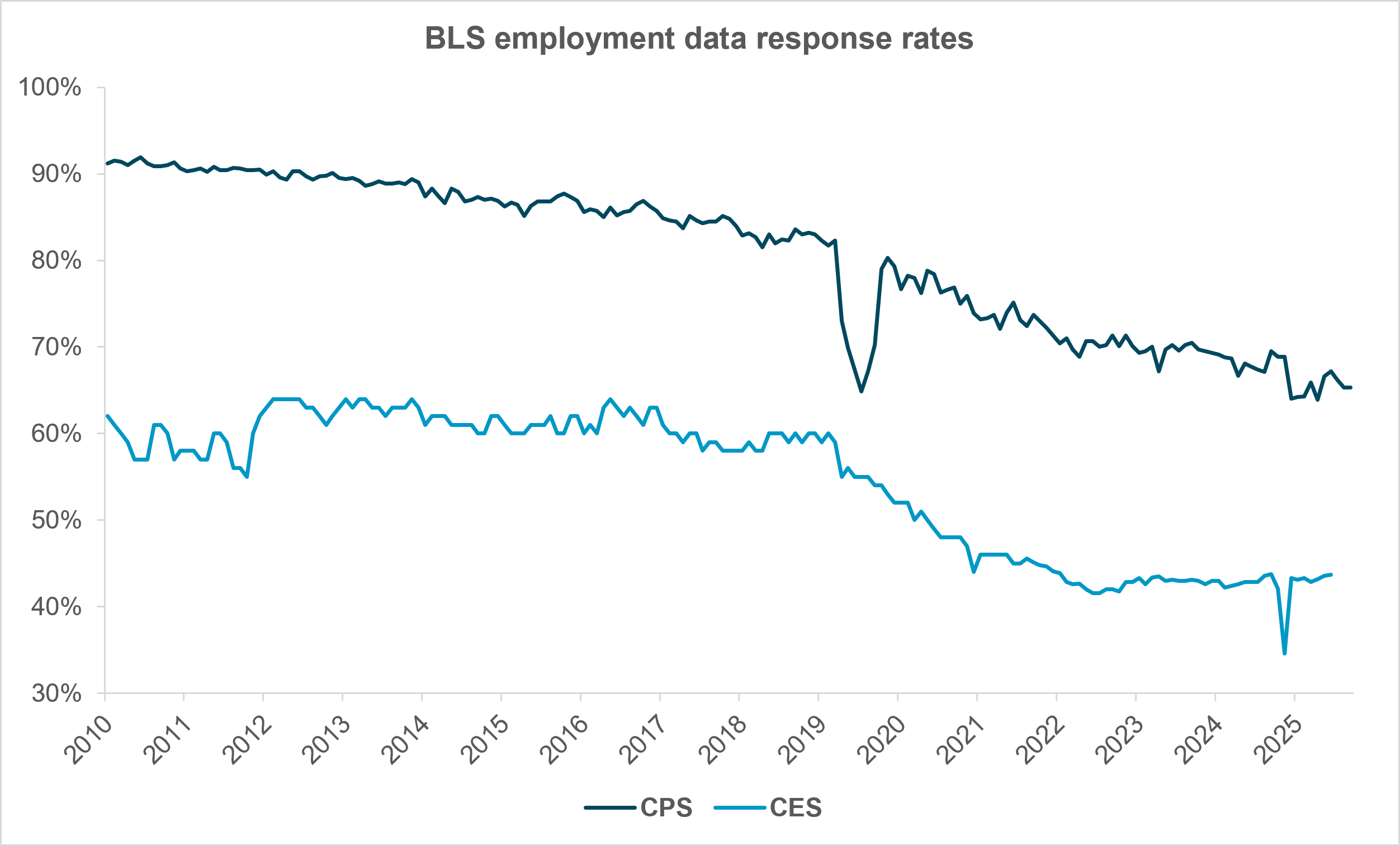
Warsh has also pointed out that survey response rates have been falling in recent years, imperiling the quality of aggregated responses. Exhibit 2 shows response rates (which plummeted in 2020 due to the pandemic) for two elements of the monthly jobs report, one of the most widely watched and important data sources the market and policymakers consume. Response rates for the Current Population Survey, from which household data are calculated, have fallen from 90% before Covid to just above 60%, while those for the Current Employment Statistics program (nonfarm payrolls) have plummeted from 70% to just above 40%. Such dwindling sample sizes could paint inaccurate pictures of reality.
It was notable that Warsh affirmed that the Fed’s inflation goal is 2% for the PCE deflator and, in his words at Jackson Hole, “is a firm fixed target.” This is a slight departure from other appearances where he suggested alternative inflation indicators could be considered.
There are also anachronistic quirks that lead to meaningful distortions. For example, portfolio management prices are measured in PCE in a way that rises when the stock market rises, since fees are tied to assets under management. In effect, this leads to “phantom inflation” in PCE where stock market gains are treated like price inflation in financial services even if wealth managers haven’t updated their fee schedules. While this specific peculiarity is being addressed in the BEA’s September update, the example highlights a shortcoming to existing data sources.
Clearly, there is room for improvement. But the Data Sources task force – led by Raj Chetty and Kevin Murphy from Harvard University and the University of Chicago, respectively, and former Walmart CEO Doug McMillen – has in some ways a tricky needle to thread. Doubtlessly, the inclusion of McMillen from the private sector is a nod toward Warsh’s suggestion that private data could be additive to the portfolio of government-produced data. However, private data may also have issues. And while public sector data-source methodology may be imperfect, it’s at least consistent and purpose-built for the task at hand. In contrast, many private sector data sources are compiled to enable executives to make specific, discrete decisions; they might be collected in an ad-hoc or inconsistent manner or altered, scaled back or stopped altogether as corporate priorities change.
Integrity and credibility, as well as transparency on methods and sources, are crucial for any data source used by the Fed and the markets. Can we trust the data were built free from conflicts of interest? What if private data are also flawed in some way? Who is responsible for addressing those flaws? These are some of the many questions the task force has to ponder.
Furthermore, is the Fed going to formally enter the data business? The task force’s mission statement identifies new information sources and potential methodological changes. Although the Federal Reserve System – both the Board and the individual Reserve Banks – does produce its own data, its performance is benchmarked against official government data and calculated from the same. Will the Fed suggest or require new methods? This potentially sets the Fed up for a measurement credibility problem altogether different from those currently present due to the flaws discussed above. It’s not optimal for the Fed to use its own tailor-made measuring stick to track its performance.
Criticisms of the economic data produced by the government and suggestions for specific ways to improve them are welcome and appropriate. But credibility – in objectivity as much as data quality – is essential. As we await the task force’s findings, we grapple with these questions alongside the flaws in the data.
After an exceptionally strong jobs print on Friday, even Governor Christopher Waller’s somewhat equivocal comments on Thursday don’t seem to be enough to change our view that a rate hike is imminent. However, the CPI print is due later this week. Waller had provided some hope that a hike might still be avoided even if the CPI comes in below lofty expectations – as Warsh said at Jackson Hole, the Fed shouldn’t rely on “isolated data points,” adding “Trends matter most.” If the CPI does come in softer, it could be dismissed as one of those isolated data points.
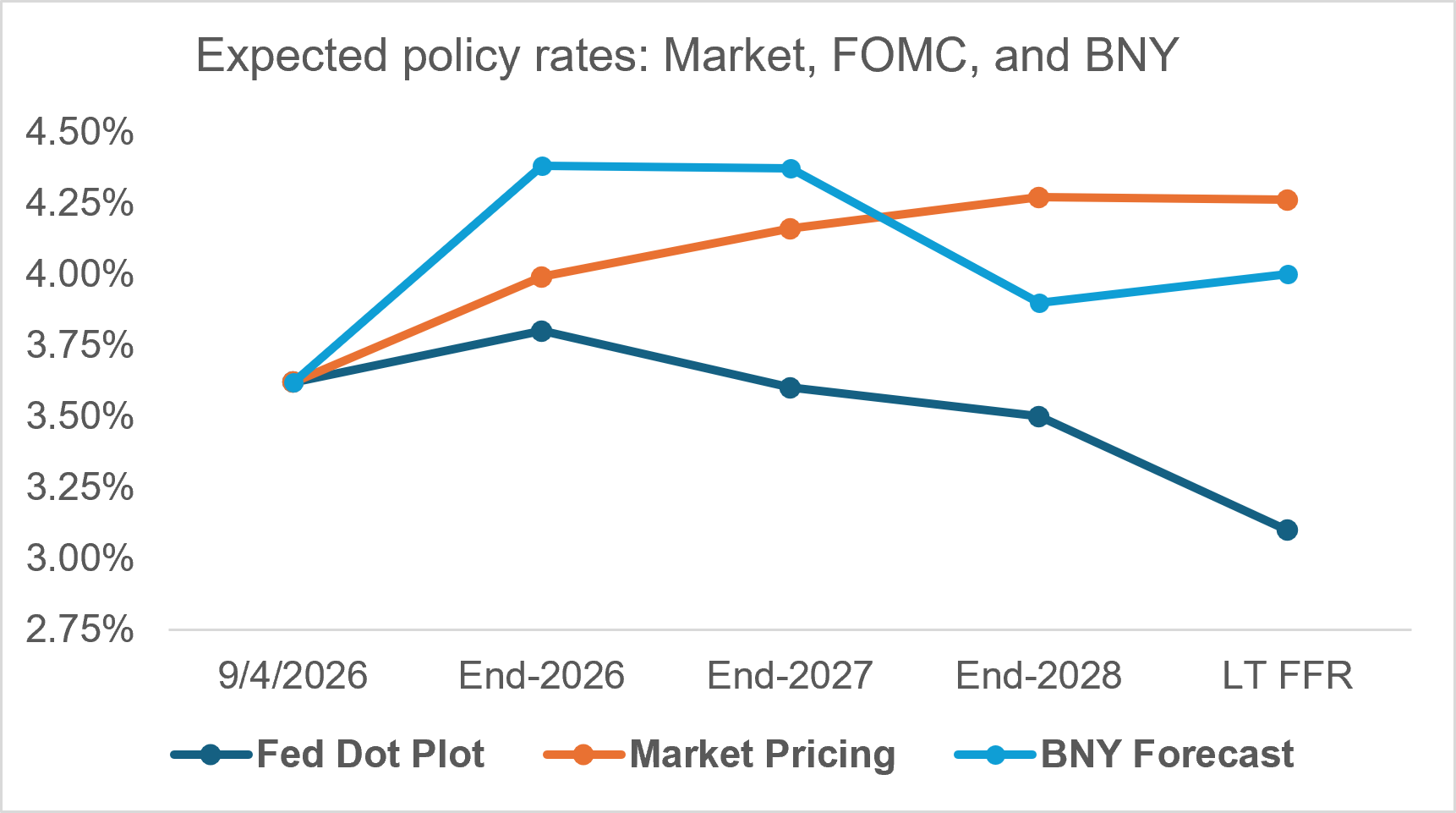
After dropping somewhat last Thursday on the basis of Waller’s remarks, the expectation for a September hike is back to over 60%. We would be surprised to not get one. As we said last week, it gets murky after that. The expected equilibrium neutral rate, observed across a variety of instruments, is still just above 4%. We’re some 40bp–50bp below that. Two hikes would get us there, but then we ask: do rates need to be restrictive, above and beyond 4%? It could well be the case.
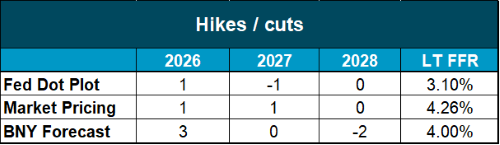
Our scenario now is that the Fed will raise rates two or three times in the next several months, although three consecutive hikes for the remainder of the year may wind up extending into 2027. By the second half of the year, we see rates coming down, as inflation starts to do the same – base effects alone will help here – and the economy looks to slow with tighter conditions.