Money markets calm, Fed credibility intact
iFlow > Short Thoughts
Published on Tuesdays, Short Thoughts offers perspectives on US funding markets, short-term Treasuries, bank reserves and deposits, and the Federal Reserve's policy and facilities.
iFlow > Short Thoughts
Published on Tuesdays, Short Thoughts offers perspectives on US funding markets, short-term Treasuries, bank reserves and deposits, and the Federal Reserve's policy and facilities.

John Velis
Time to Read: 4 minutes
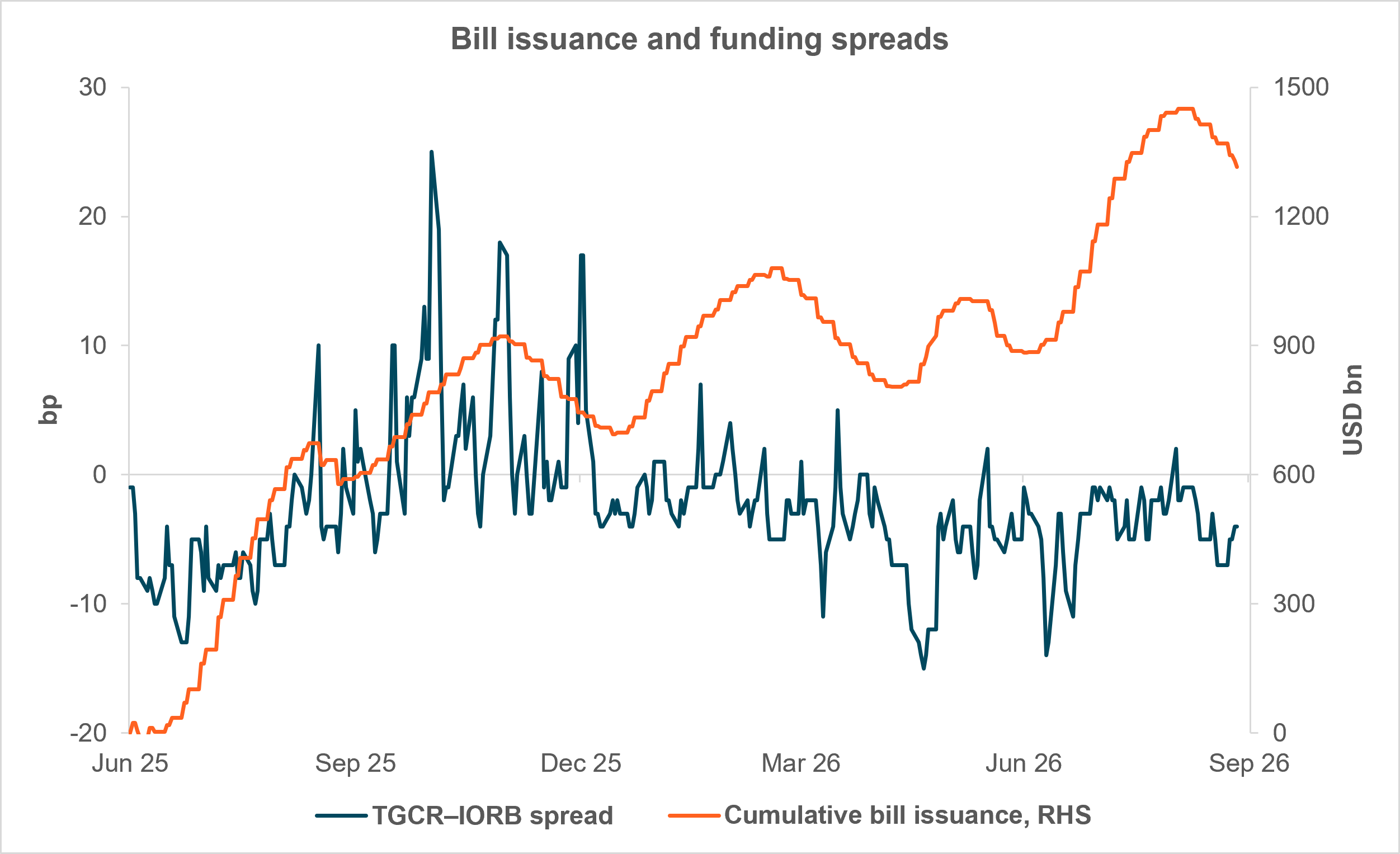
EXHIBIT #1: DESPITE HEAVY T-BILL ISSUANCE, FUNDING SPREADS REMAIN CALM
Source: BNY Markets, U.S. Treasury Department, Bloomberg
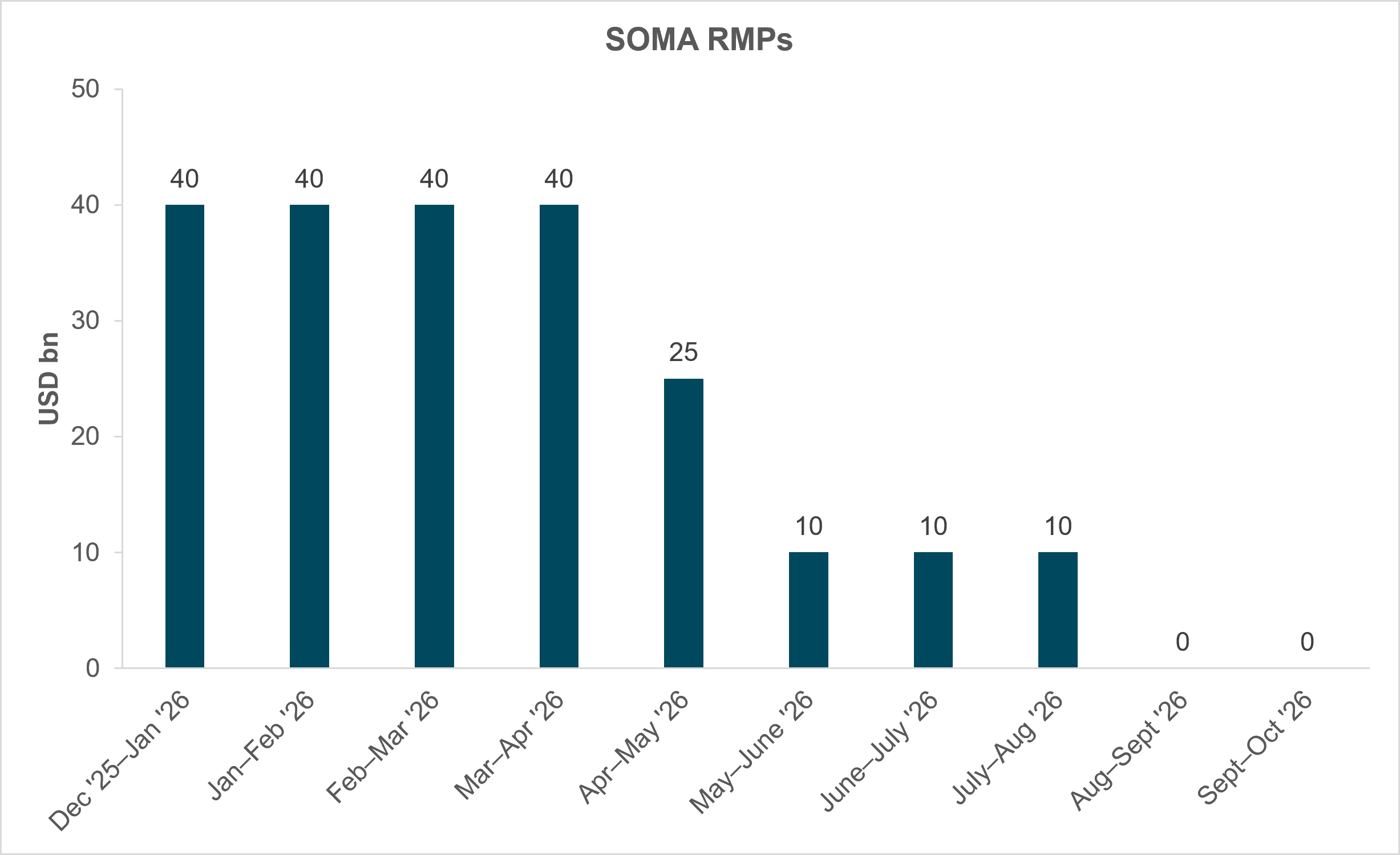
EXHIBIT #2: RMPS FLEXIBLE, DECLINING
Source: BNY Markets, Federal Reserve Bank of New York
Funding markets have been mostly calm since the Federal Reserve commenced reserve management purchases (RMPs), even though late summer bill issuance ramped up significantly and the last two monthly periods actually featured no new RMPs. Much of this calm in money markets is thanks to a relatively high level of reserves in the system, consistently near $3tn for most of 2026, except on the April tax filing date and at the very beginning of the year.
Exhibit 1 shows cumulative T-bill issuance since the middle of 2025 after the debt ceiling was lifted alongside the passage of the Republican tax and spending bill. Despite net issuance that totaled over $700bn between the beginning of the year and early September, funding rates have stayed mostly benign. Exhibit 2 shows the initial four RMP injections of $40bn through April 2026 (including Tax Day), falling to $25bn, then $10bn, and now two straight periods of no additional RMP funds being spent.
System Open Market Account (SOMA) Manager Roberto Perli provided an update last week at the New York Fed’s Annual U.S. Treasury Market Conference, where he reiterated that “RMPs are never on a preset course … We have adjusted RMP amounts several times in response to evolving conditions, and we stand ready to adjust them again in the future to fulfill the FOMC’s policy to keep reserves within the ample range.” This quote sums up the state of affairs nicely: the Fed is committed – for now – to maintaining an ample reserve regime. RMPs are an important feature of that commitment, and their flexible application reflects the Fed’s view that funding market conditions are currently in good stead. Going forward, we expect bill issuance to ramp up into Q4, and RMPs to continue to be a key element in keeping funding markets functioning smoothly. The Fed has sufficient room to restart RMPs when needed.
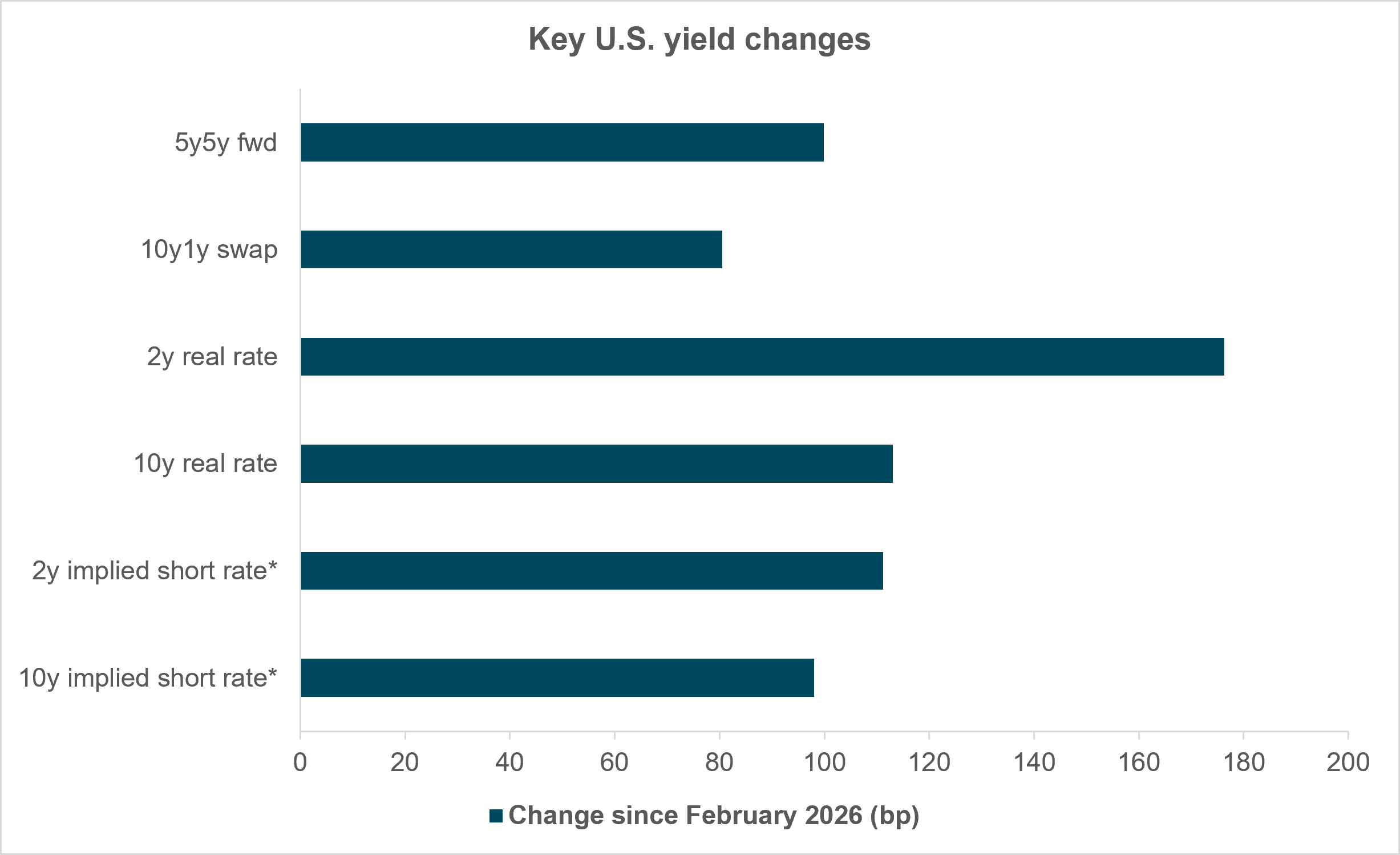
EXHIBIT #3: REAL RATES HIGHER ACROSS ALMOST ALL MEASURES
Source: BNY Markets, Bloomberg
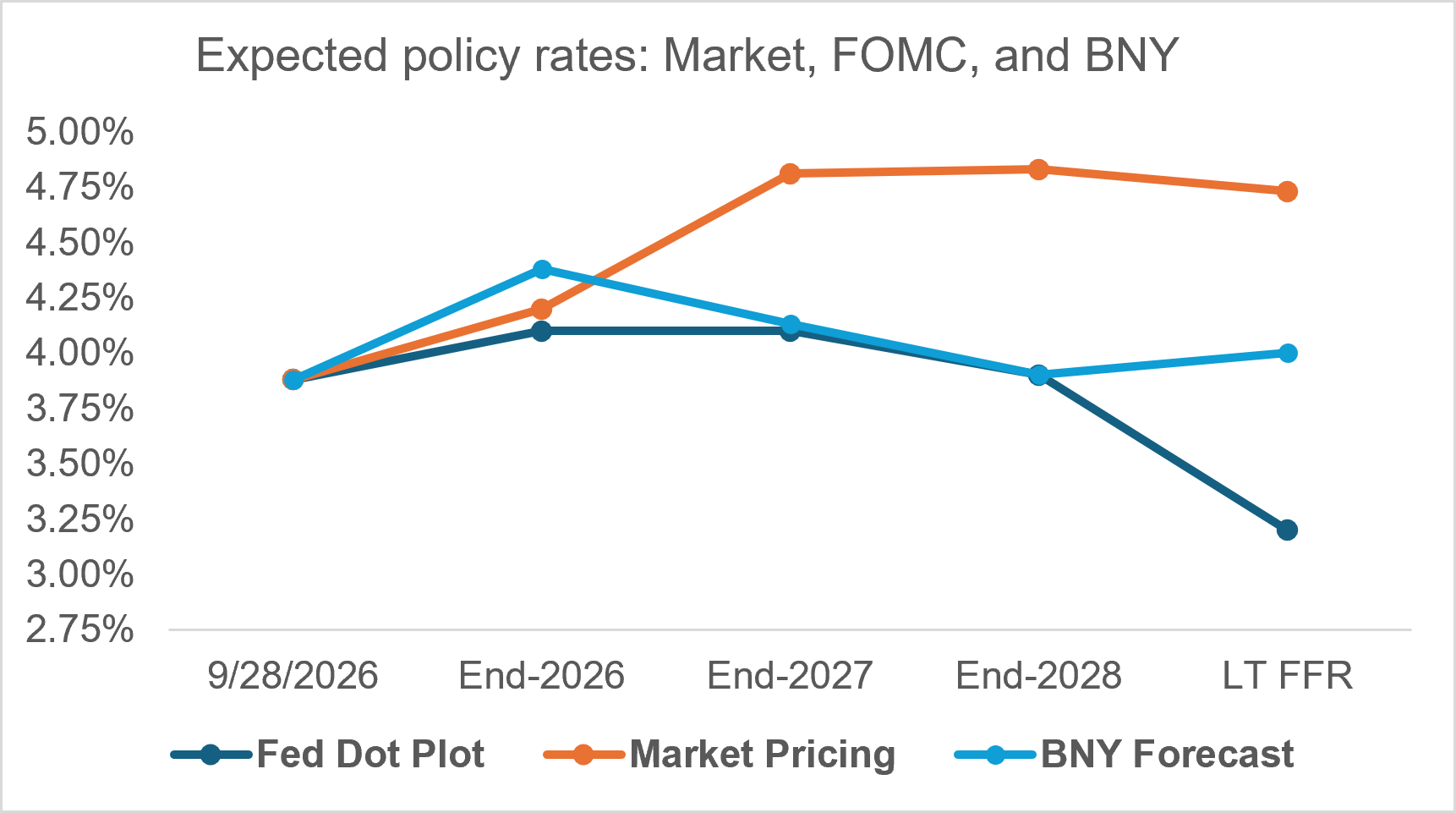
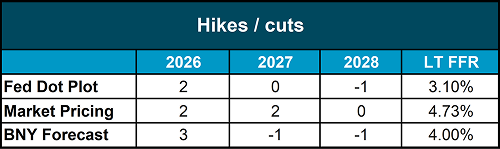
With the market expecting upwards of an additional 75bp in policy tightening through this cycle, bond yields across the curve continue to move higher. Last week we argued that there has been almost no increase in market-based measures of inflation expectations, despite the volatility in oil prices. We posited that instead of long-term inflation driving yields higher, it was ironically perceptions of central bank credibility – markets are expecting the Fed (and other central banks) to raise rates in response to rising inflation. This drives longer-term yields higher, even as breakevens and inflation swaps stay in their recent ranges.
Indeed, in Exhibit 3, we show a variety of longer-term (and a few shorter-) rates and how they’ve moved since the U.S.–Iran war began. We examine the 10y and 2y real yields, the 10y1y forward swap, and the 5y5y swap. We also plot the implied (from the New York Fed’s term premium model) expected average short rate over the next two years and ten years. All have risen between 80 and 113bp, with the exception of the real 2y yield, which is up by over 170bp. This latter move reflects the current policy cycle, where rates are expected to go higher than the longer-term average will turn out to be in a decade’s time. For example, the 10y nominal yield is up just over 120bp since February 27, while the real (ex-expected inflation) yield is up around 113bp, indicating much of the rise has little to do with inflation expectations, but much to do with policy expectations over the next decade.
The relatively outsized move in the 2y yield has flattened the 2y10y yield slope significantly, raising concerns about an eventual curve inversion. That’s often seen as a recession signal, though well down the road from here, and a difficult time for risk assets.
Other factors behind higher yields center on robust growth and rising capex due to the AI and technology investment cycle – again a fact that would be reflected in real yields. Fiscal concerns in the U.S. aren’t insignificant but given that the term premium calculated for long-horizon yields is still well contained at around 70bp, this doesn’t seem to be playing an outsized role in the yield increases thus far.
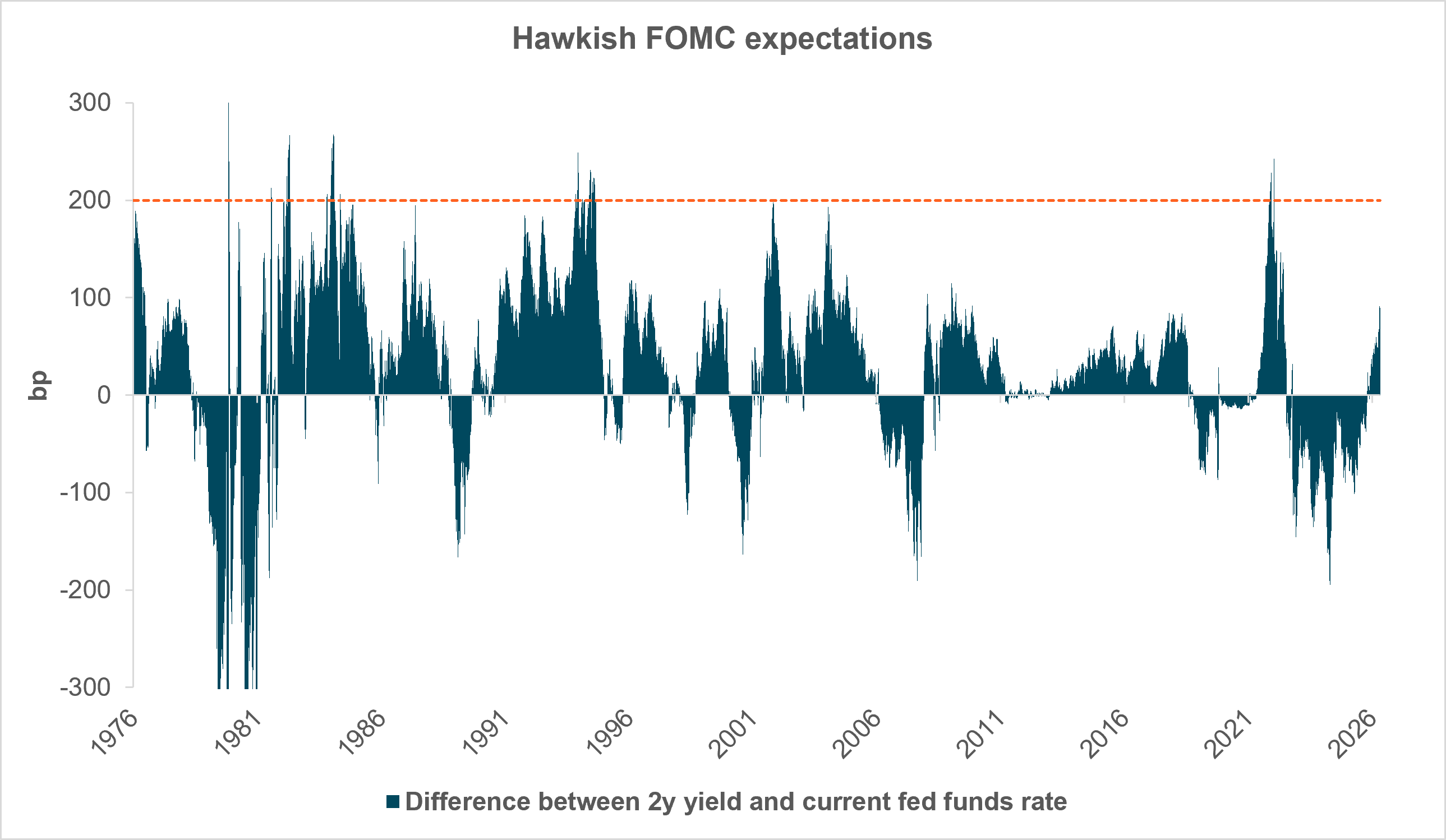
EXHIBIT #4: “PEAK HAWKISHNESS” STILL FAR AWAY
Source: BNY Markets, Bloomberg
Market probabilities for a rate hike on October 28 are currently running around 67%. This week will be key in pushing those measures either higher or lower, given the September PCE (personal consumption expenditures) inflation print due Wednesday and the jobs market report on Friday. The odds are that by the end of the week we’ll see higher probabilities for the October reading, as we don’t see much reason for the data to disappoint to the weak side.
We have argued above that the rise in long-end yields is less about inflation expectations and fiscal concerns and more about Fed credibility vis-à-vis inflation. “Peak hawkishness” can be estimated by the difference between the 2y yield and the current federal funds target. The former prices expected monetary policy through the cycle, so the difference between it and the latter implies the number of hikes the market expects relative to where the funds rate is currently. As Exhibit 4 shows, for nearly every hiking cycle in the last 50 years, peak hawkishness corresponds to around a 200bp difference between the two variables. At just under 100bp currently, it could mean there is more to price into 2y yields, potentially risking an inversion of the 2y10y slope.