Fed’s hiking cycle might miss the point
iFlow > Short Thoughts
Published on Tuesdays, Short Thoughts offers perspectives on US funding markets, short-term Treasuries, bank reserves and deposits, and the Federal Reserve's policy and facilities.
iFlow > Short Thoughts
Published on Tuesdays, Short Thoughts offers perspectives on US funding markets, short-term Treasuries, bank reserves and deposits, and the Federal Reserve's policy and facilities.

John Velis
Time to Read: 5 minutes
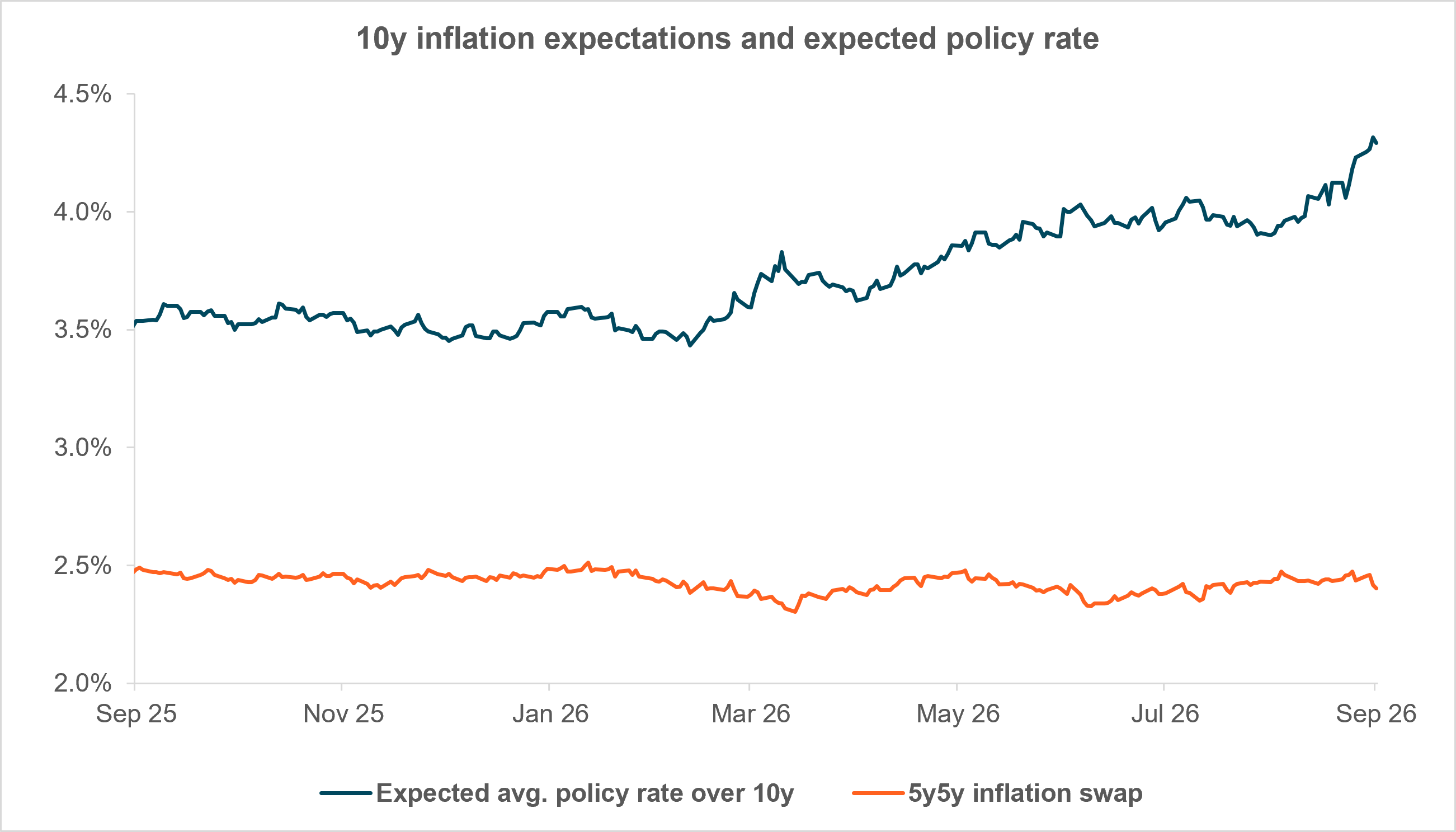
EXHIBIT #1: RATE, NOT INFLATION, EXPECTATIONS ARE RISING
Source: BNY Markets, Bloomberg, Federal Reserve Bank of New York, The Conference Board, University of Michigan
The FOMC’s expected rate hike last week has led to a flatter curve, driving the 2y yield up nearly 4.75%, even as the 10y yield remains steady around 5%. To us, this signals that the move was as much about preserving credibility against inflation as about pushing inflation down. This view rests on our analysis of what’s driving both the long end and current inflation. In short, the long end of the U.S. Treasury curve hasn’t moved higher due to inflation expectations but to higher expected policy rates, and the current inflation drivers aren’t very rate sensitive.
Let’s start with the back end of the curve. Exhibit 1 shows the 5y5y inflation swap (orange) and the expected policy rate over the next ten years (blue). We conclude from this that while inflation expectations have stayed remarkably stable during the past year, the expected policy rate has moved significantly and steadily higher since the end of February and the start of the Middle East conflict.
We infer from these observations that policy credibility hasn’t eroded throughout post-COVID inflation, tariffs, and war-related energy price increases. Neither the inflation expectations shown in the graph, nor a raft of other (both market- and survey-based) measures have moved materially higher since the conflict began. What has moved higher is the expected policy rate. Markets have been pricing in hikes to offset the supply shock – signaling that prices aren’t expected to be permanently affected. With policy rates at around 4.25% and seen to be rising further, markets expect the long-term price effect to be contained.
Certainly, the energy shock has driven headline inflation higher, with the August CPI up 3.4% and the July PCE deflator at 3.7%. The most recent core inflation readings were 2.4% and 3.3%, respectively. Recall, the Fed’s target – recently reaffirmed by Chair Kevin Warsh more than once – is 2% on PCE. Even with longer-term inflation expectations anchored for now, the concern is that a series of supply shocks since 2020 (COVID, the outbreak of the Russian–Ukrainian war, tariffs, and now the Middle East conflict) could upend those expectations, creating a dangerous spiral. Hence the need to act to ensure those expectations stay anchored.
The rise in the nominal 10y and 30y yields is instead almost entirely due to rising real yields. This suggests that the market is expecting higher short-term rates for the next several years, even though inflation expectations are holding steady. Most likely, the expected higher policy rates that are driving real yields higher are precisely what’s keeping inflation expectations stable. In the market’s eyes, the Fed still enjoys credibility – higher rates now and into the future will keep inflation from getting out of control. At least that appears to be the message in the market.
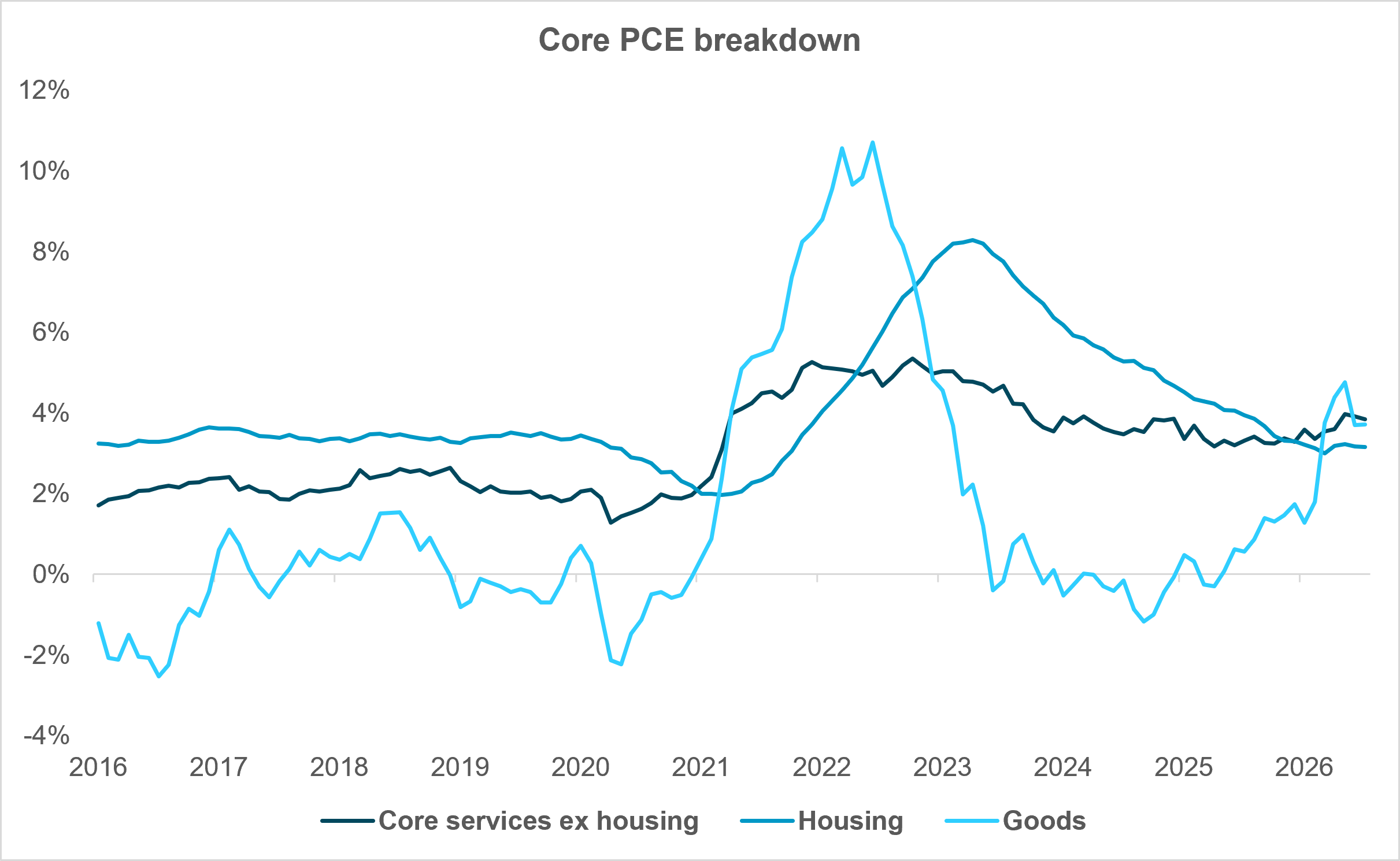
EXHIBIT #2: CORE SERVICES EX HOUSING AND CORE GOODS ARE THE INFLATION DRIVERS
Source: BNY Markets, Bureau of Economic Analysis
The curious thing to us is that the short-term drivers of higher inflation aren’t necessarily reactive to monetary policy. Examining Exhibit 2, we see that the major culprits keeping core PCE inflation higher are higher goods prices. Unsurprisingly, these have been rising since early 2025 (tariffs) – likely not due to demand pressures – and core services ex housing (i.e. “supercore”), which at 3.85%, nearly doubled its pre-pandemic rate of increase. Shelter, which had been largely responsible for the run-up in prices since 2021, has also settled back down to pre-2020 rates.
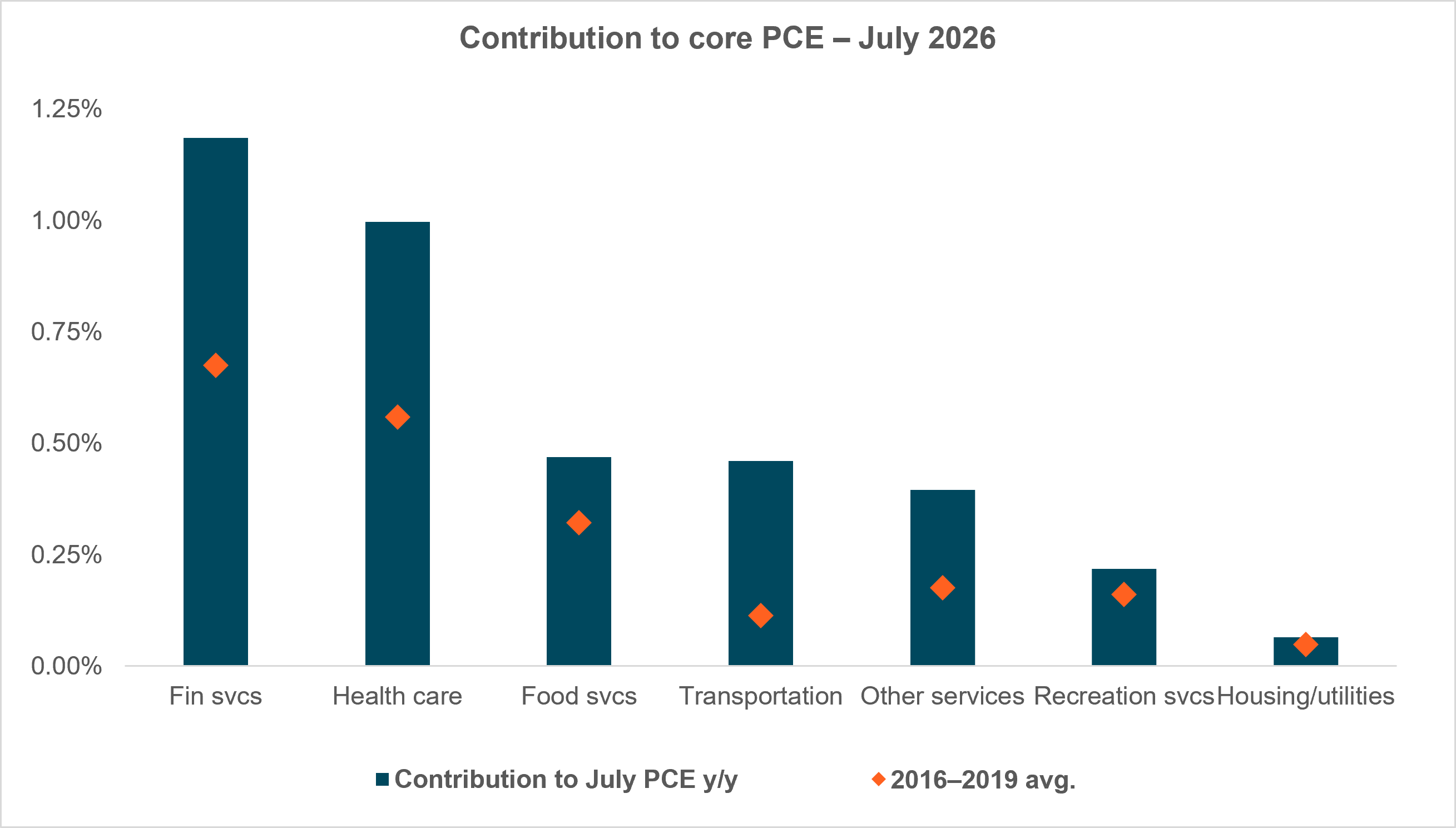
EXHIBIT #3: WHERE DOES SUPERCORE INFLATION RESIDE?
Source: BNY Markets, Bureau of Economic Analysis
We’ll address core goods in a moment. For now, a breakdown of the supercore measure shows that nearly half of its most recent increase (1.9pp) can be attributed to just four items. In Exhibit 3, we plot the main ingredients in supercore inflation, showing the current inflation rate of each, alongside the pre-COVID average.
Note the main culprits. Portfolio management, which is itself imputed from equity market prices, contributed 0.7% to supercore. This is a measurement quirk unrelated to loose monetary policy, and in our opinion not something that will respond to rates. In fact, starting with the August PCE data due out next week, the methodology for calculating portfolio management fees will be revised, likely bringing them down in the PCE calculation. The next significant contributor to the supercore is hospital stays, contributing 0.5%. Again, not a demand-driven item, nor one likely to be reined in by tighter policy, but rather a result of secular trends in the U.S. health care economy. Meals out added another 0.4% to the supercore, likely reflecting higher food costs thanks to the energy shock. And finally, airfares – clearly energy-related, they added 0.3% to the 3.85% supercore. Four items, not necessarily demand-related, and therefore not necessarily responding to higher yields, are major drivers of current core inflation.
This isn’t to say we disagree with the move to increase rates, nor the expectation that they’ll continue to rise somewhat. Our point is that the current policy regime is more about preserving credibility and the Fed’s inflation-fighting bona fides than about rate actions that will, by themselves, crimp inflation, unless demand is similarly restrained. We discuss our longer-term rate view in the next section.
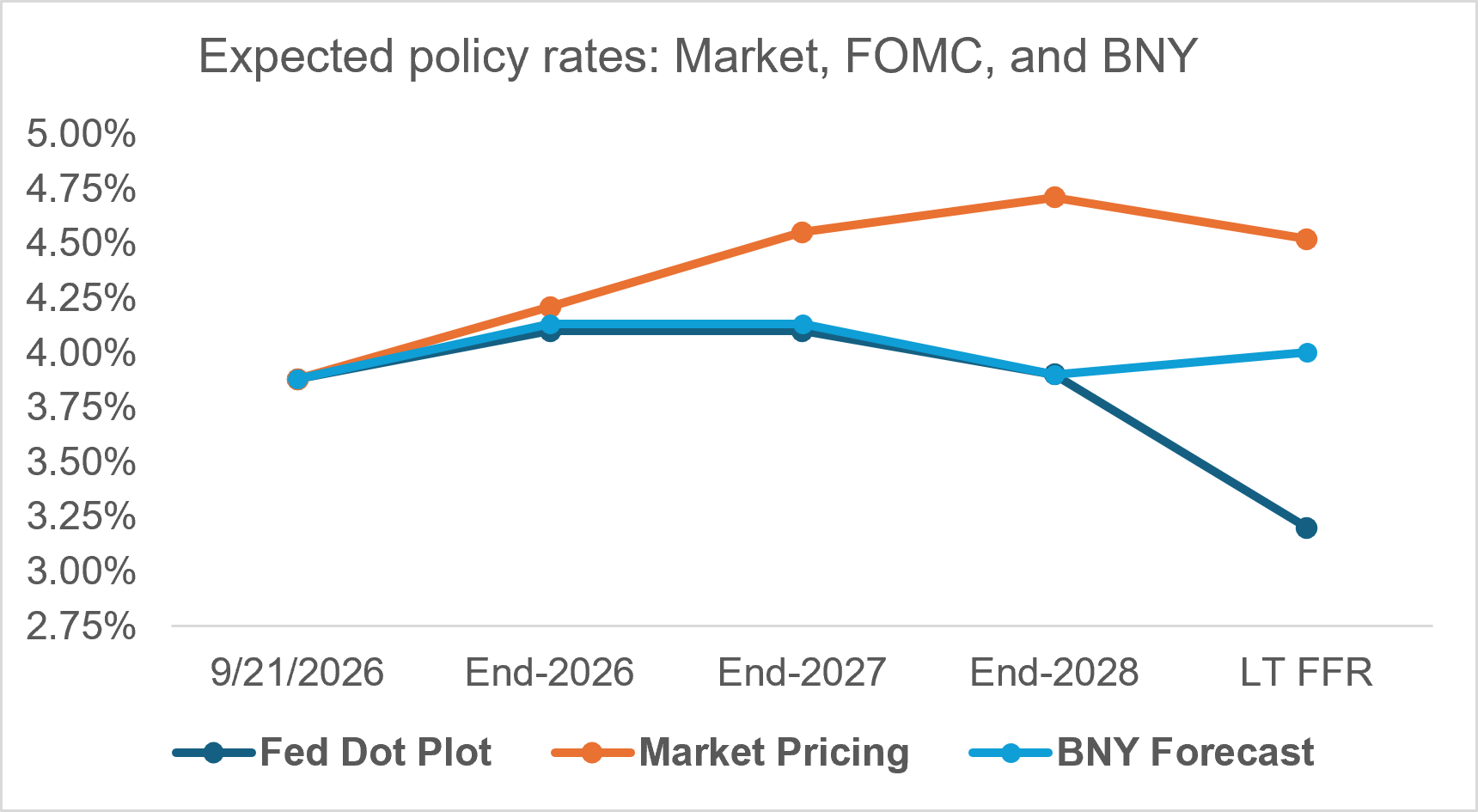
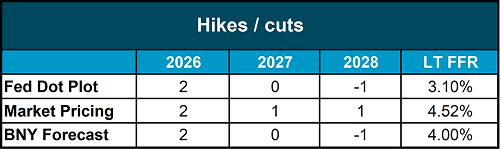
We expect the Fed to raise rates once more for 2026 at the December meeting. Into 2027, we’re less sure whether the Fed can proceed with as many hikes as the market has priced in. The answer hinges on how effective tighter policy can be given the current inflation shock. If tightening serves to cool demand without affecting those prices that are key contributors to current services inflation, we may see the Fed have to relent next year.
So much revolves around the situation in the Middle East, into which we have low visibility. Recall that earlier this year, we expected oil flows to resume by summer, which would have allowed the Fed to refrain from hikes. That call hasn’t played out. A pullback in tensions – and the lower oil prices that would follow – would likely change the markets’ and the Fed’s calculations. But being beholden to a situation that could worsen before it improves isn’t a tenable stance.
Even if we were to see some welcome relief on energy prices, a positive supply shock relative to the status quo – and the economy reacting accordingly – doesn’t mean traditional demand-driven inflation can be ruled out. Until we get to that point, we need to navigate the supply shock and potential demand destruction. For now, we understand the market’s hawkish pricing, but we’re watching for the unintended consequences that could change the outlook.