Bond term premium doesn’t reflect fiscal risk
iFlow > Short Thoughts
Published on Tuesdays, Short Thoughts offers perspectives on US funding markets, short-term Treasuries, bank reserves and deposits, and the Federal Reserve's policy and facilities.
iFlow > Short Thoughts
Published on Tuesdays, Short Thoughts offers perspectives on US funding markets, short-term Treasuries, bank reserves and deposits, and the Federal Reserve's policy and facilities.

John Velis
Time to Read: 5 minutes
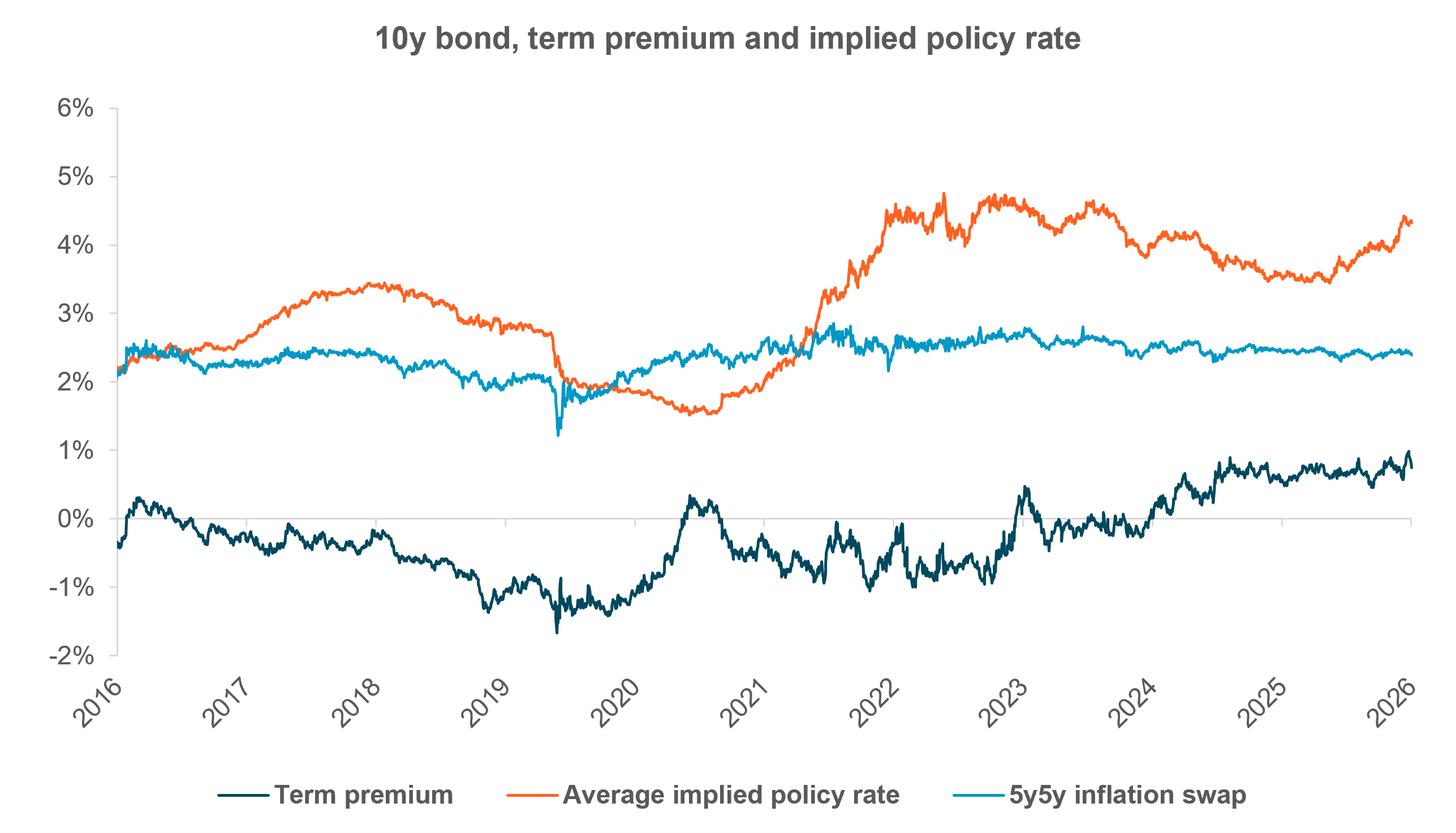
EXHIBIT #1: TERM PREMIUM CONTAINED ALONG WITH INFLATION CONCERNS; POLICY RATE EXPECTATIONS HAVE RISEN
Source: BNY Markets, Federal Reserve Bank of New York, Bloomberg
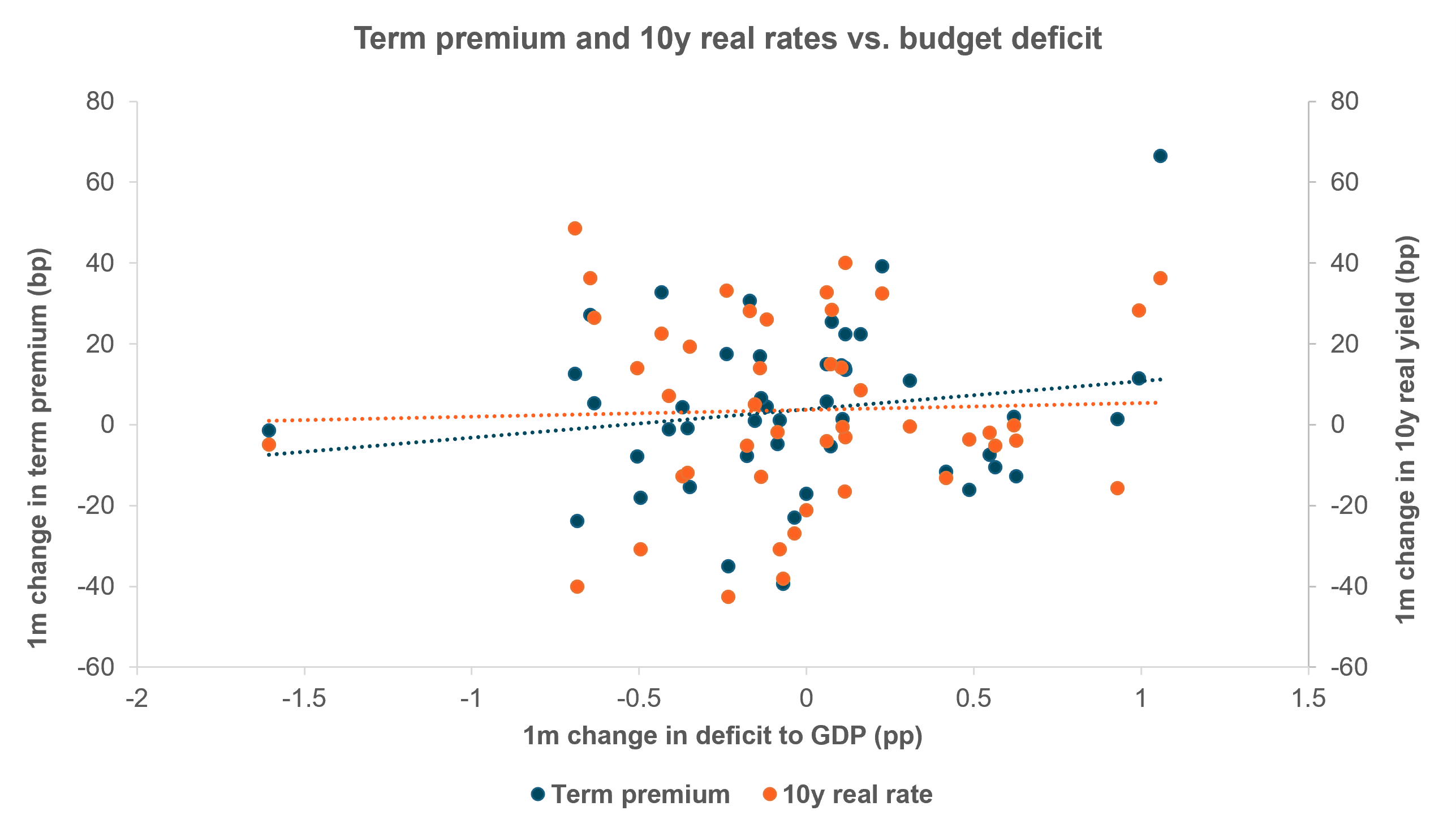
EXHIBIT #2: DEFICIT CHANGES AREN’T DRIVING YIELDS OR TERM PREMIUM
Source: BNY Markets, Federal Reserve Bank of New York, U.S. Treasury Department
We’ve argued that longer-maturity bond yields are elevated mainly because of higher policy rate expectations than higher inflation expectations. Exhibit 1 shows that the 5y5y USD inflation swap, a good proxy for market expectations for the average inflation five to ten years ahead, has been essentially flat for most of the post-COVID period. Despite our medium- and long-term concerns about U.S. fiscal dynamics and their eventual implications for U.S. sovereign bond markets, deficits aren’t exerting upward pressure on yields.
In Exhibit 1, we also plot the Federal Reserve Bank of New York’s widely followed estimate of the 10y term premium. This measure should reflect the market’s perception of the riskiness of lending to the U.S. government over the next decade. Rising credit concerns should push this term premium estimate higher; so far there’s scant evidence of such concerns finding their way into bond yields. True, this premium has increased over the last few years, but it was, in our opinion, artificially restrained during the quantitative easing era, as the Fed took on much of the U.S. government’s credit risk. Once that process ended – and indeed went into reverse in recent years – the term premium reasserted itself and has mostly fluctuated between 70bp and 90bp. Compared to the period before 2005, this is actually on the low side; it fluctuated around 200bp.
In Exhibit 2, we show the relationship between the term premium and changes in the monthly budget deficit since the end of 2022, after the expansionary fiscal policy moves around COVID had played out. If the market saw government debt as riskier as the deficit increased, the blue trend line would be much steeper. As it is, the relationship is statistically insignificant. We did the same exercise with 10y U.S. real (inflation-indexed) yield, and we find an even looser fit between fiscal excess and yields. The bottom line is that we struggle to find any link between rising fiscal deficits and U.S. bond yields – yet.
What this means for bond investing is potentially interesting. Because rising riskiness, as summarized by the term premium estimate, isn’t scaring bond investors away, this is further evidence that yields are driven by rising expectations of tighter monetary policy. We have shown this in the past. The rise since mid-2025 in the average implied policy rate over the next decade (the orange line in Exhibit 1) is the largest contributor to higher yields.
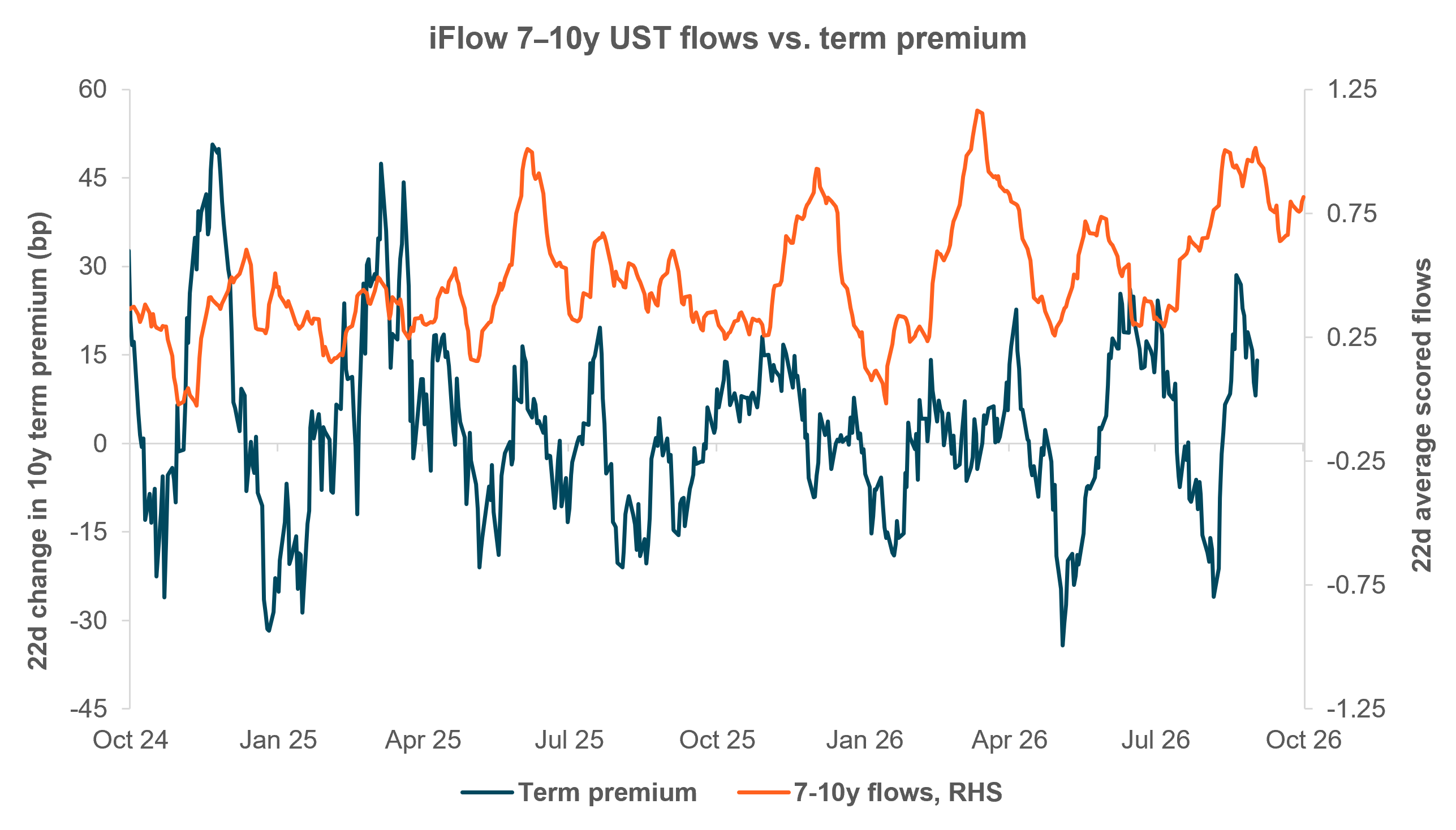
EXHIBIT #3: RISING TERM PREMIUM COINCIDES WITH BOND INFLOWS
Source: BNY Markets, iFlow, Federal Reserve Bank of New York
With fiscal concerns and inflation worries largely absent from current bond pricing, we next ask if the current level of yields far out the curve is attractive enough to induce buyers into duration. In Exhibit 3, we show the one-month change in the term premium (dark blue line) against the subsequent one-month inflows into the 7–10y sector of the U.S. yield curve. The evidence tentatively suggests that over the last two years, when the term premium increases, investors become attracted by lower prices (higher yields) on bonds and come into the market.
Does this mean that we’re close to an equilibrium (for now) in bond yields? It’s quite likely that’s the case. We note that 10y yields have struggled to break above 5.3%. Indeed, when yields reached precisely that level two weeks ago, they fell back thereafter. On October 5, the same day yields hit 5.3%, the term premium was estimated to be well above 90bp, its highest level since 2014. It has subsequently fallen back to roughly 75bp as investor flows returned to the market. The extra compensation offered to investors in the form of a higher term premium was sufficiently high to make bonds an attractive buy.
This doesn’t mean that fiscal concerns won’t eventually weigh on the bond market, and as we move deeper into an era of higher deficits, the concerns could come to the fore. Keeping an eye on the term premium and our investor flow data in relation to changes in this riskiness measure will be important going into 2027. The next quarterly refunding statement from the U.S. Treasury comes out in early November. It’s not expected to indicate any coupon supply increases, a view bolstered by the lack of such questions in the latest Treasury primary dealer survey. However, without fiscal retrenchment, additional long-dated supply is bound to come to market eventually, and this could be when the next leg higher in yields begins, propelled by rising deficit worries alongside monetary policy expectations.
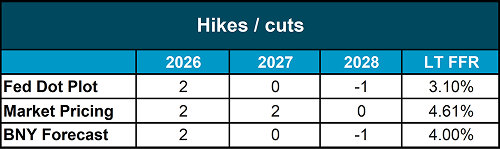
We don’t expect an October rate hike next week, and market expectations agree. At present the market is pricing only a 17% chance of a hike at the next FOMC. We don’t regard the increase in CPI and PPI inflation as large enough to signal that inflation is worsening beyond current levels. Inflation remains driven by supply-side concerns (airfares, for example) or pricing dynamics that aren’t related to the stance of monetary policy (personal services, housing and health care, for example).
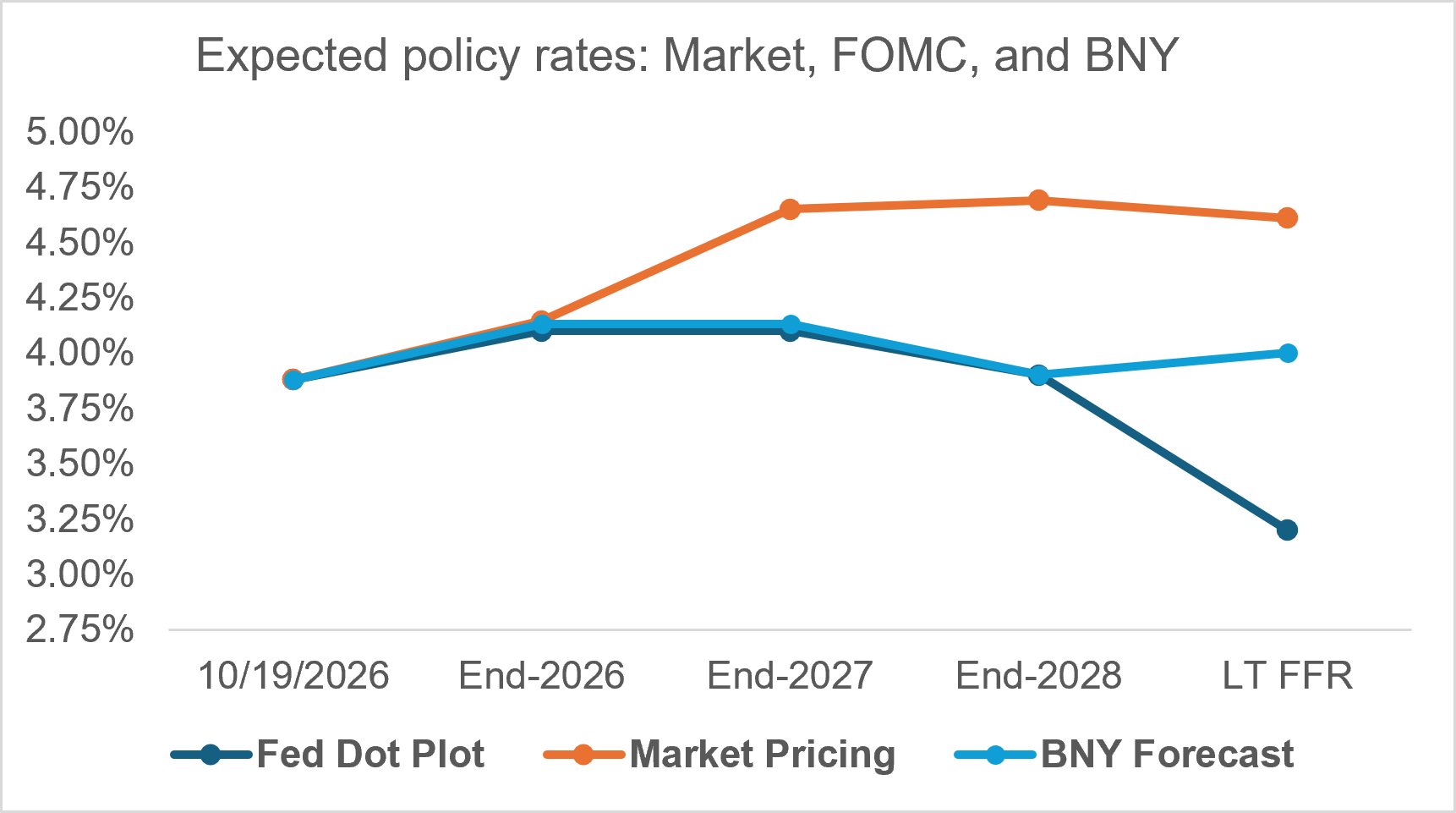
We do think December is the next likely opportunity for an increase in the federal funds rate and expect that to be the last hike in this cycle. We note that the implied federal funds rate for December 2027 is now only 4.64%, implying just under 75bp of additional rate hikes. These market expectations are actually slightly below their most hawkish levels from just a few weeks ago. We have argued that the peak 100bp (including the September hike) that had been priced in would be hard to realize, especially as we get into March and April 2027 when base effects will help lower the annual rate of inflation.