Market Movers: Tightening
Market Movers highlights key activities and developments before the U.S. market opens each morning.
Market Movers highlights key activities and developments before the U.S. market opens each morning.

Geoffrey Yu
Time to Read: 5 minutes
Light CAD conviction ahead of Bank of Canada decision
Source: BNY
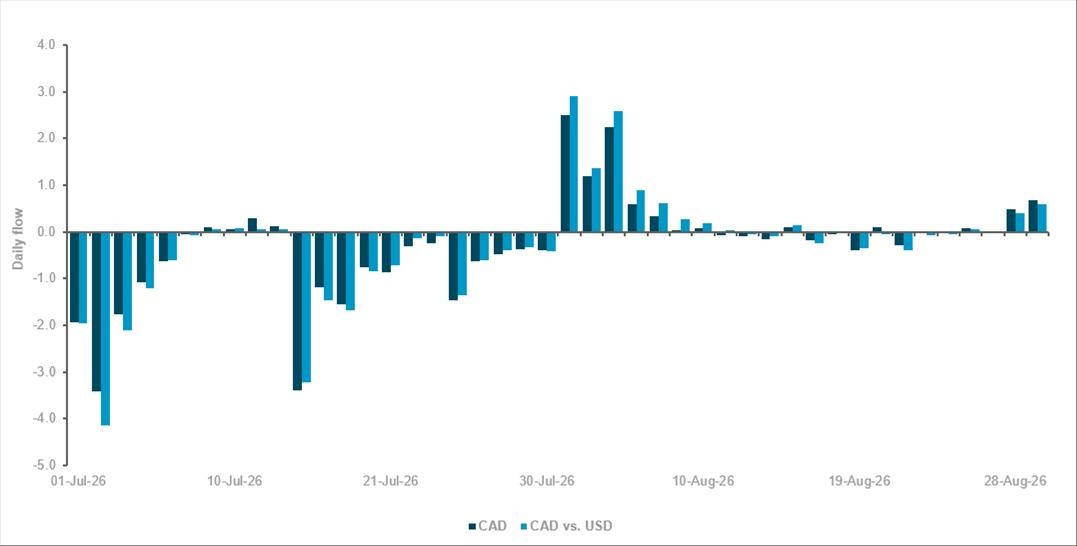
CAD interest remains light ahead of today’s BoC meeting. Selling resumed after the July decision, and efforts at an offset have been tame. Early August inflows appeared to be a case of mean reversion for July, while the rest of the month was largely flat. Some light interest is re-emerging ahead of the decision, but there is no conviction behind it. The only potential source of support is that a two-month rolling average of -0.29 in scored flow is very weak by G10 standards, providing strong scope for mean reversion opportunities. Crucially, there is no sign of damage from the escalating trade dispute with the U.S. Neither is there an impact from the BoC’s inability to hike rates while many G10 peers are moving in the opposite direction. This underscores the strength of weak positioning, leading to mean reversion.
USDCAD is fully driving CAD flow. This also shows that there is very limited activity in CAD on the crosses, which is a surprise. The role of USDCAD within the USD’s overall trade-weighted basket matters for the U.S.’s general terms of trade. The strongest USDCAD selling took place in the week after the July FOMC meeting, indicating that the pair was a participant in the U.S. dollar unwind, which led to total USD exposures falling materially. The flows were not as strong as those seen in EURUSD and GBPUSD but represent a common factor. The challenge is now for USDCAD to find selling interest based on CAD fundamentals, which are lacking for now.
Financial conditions are tightening. The RBNZ hiked to 2.75% overnight, while the Bundesbank and BoJ have signaled further tightening this month. Bond markets are adding restraint, but supply constraints cannot be ignored: Eurozone natural gas prices are at a three-year high, risking another difficult winter and renewed pressure on inflation expectations. We now expect the Fed to respond accordingly. Whatever the source of inflation, price stability mandates must remain credible.
Rate markets are ahead of policy intent. Despite the shift in the global rate outlook, current pricing still appears to exceed central bank tolerance. Even Bundesbank President Joachim Nagel, a hawk by any measure, has stressed the ECB’s “meeting-by-meeting” approach. The baseline is now for policy rates to move above inflation targets, but there is little appetite to push above headline inflation and into outright restrictive territory, particularly without second-round effects.
Trade relations remain a source of restriction. The G20 meeting in Asheville ended with a whimper after China dissented from a joint statement targeting overcapacity. Comparative advantage may be intrinsically disinflationary, but when reinforced by industrial policy it is no longer accepted as benign. Policymakers are increasingly willing to sacrifice cheaper goods to limit long-term deindustrialization, leaving households to share the cost.
The BoC is the outlier today. Markets are pricing in only around a 50% chance of a hike by year-end, while renewed U.S. trade tensions are creating additional headwinds for Canada. Elsewhere, the U.S. ADP report is expected to show stable but historically subdued private sector job creation. By contrast, U.S. industrial activity should remain firm, with factory and durable goods orders pointing to continued resilience.
ECB Governing Council member Joachim Nagel has strongly signaled that the central bank will raise rates next week, saying markets have a good understanding of the ECB’s reaction function; they are pricing in a greater than 95% probability of a September hike. The case for tightening has strengthened after euro area inflation rose to 3.3% in August, well above the 2% target, while economic activity has remained more resilient than expected despite the Iran war. Nagel was more cautious beyond September, stressing that volatile oil and gas prices, financial market instability and broader uncertainty make forward guidance difficult. He therefore backed retaining a meeting-by-meeting approach, suggesting that September tightening is highly likely but that subsequent moves will remain dependent on incoming inflation and growth data. Euro Stoxx 50 -0.52% to 6387, EURUSD -0.216% to 1.1593, BBG AGG Euro Government High Grade EUR +3bp to 3.598%.
Bank of Japan Governor Kazuo Ueda has said the BoJ will continue to raise interest rates as financial conditions remain accommodative, while stressing that the central bank must watch both upside inflation risks and the effects of past hikes. He said underlying inflation is “quite close” to the 2% target and that recent data since the BoJ’s July meeting suggest economic and price conditions are broadly in line with the July projection. Ueda said the BoJ will debate these factors thoroughly at its September 17-18 policy meeting, including whether inflation risks are increasing. He declined to comment on market pricing of a near-certain rate hike, but emphasized that policy decisions will depend on the economy and prices remaining aligned with the baseline scenario. Separately, BoJ hawk Hajime Takata said a 0.25% hike “is not necessarily set in stone” and that back-to-back rate hikes would be a possibility. Nikkei -2.85% to 64326, USDJPY +0.289% to 159.63, 10y JGB +1.8bp to 3.024%.
U.S. Treasury Secretary Scott Bessent has said China blocked a unanimous joint communiqué because of disputes over its large trade surplus. The U.S. instead issued a chair statement saying countries with persistent external surpluses should remove distortions that suppress domestic consumption and overly depend on exports. China did not respond directly to Bessent’s remarks but urged a balanced view of global imbalances and said development is key to solving developing country debt problems. Beijing also called for free trade and broader economic globalization. The statement noted that China dissented on passages covering the Strait of Hormuz, a task force on trade imbalances, IMF surveillance powers and debt restructuring. Bessent said 19 of the 20 members backed the statement. S&P Mini -0.51% to 7660, DXY +0.177% to 99.603, 10y UST +3.4bp to 4.784%.
The U.S. military struck two Iranian government tankers in Tuesday’s latest round of attacks, under a new “tanker for tanker” policy approved by President Trump. The move marks the first time that the U.S. has hit Iranian tankers in retaliation for attacks on ships in the Strait of Hormuz, rather than for violating the naval blockade. U.S. officials said around 100 targets were hit, including IRGC air defenses, radar, mine-laying assets, communications sites, anti-ship missile launchers and drone launchers. Washington said Iran’s retaliation had largely failed, with missiles and drones intercepted or missing targets. U.S. forces have continued escorting ships through the strait, and officials said the strikes had degraded Iran’s capabilities and lowered the threat to commercial shipping for at least a month. Iranian media alleged civilian casualties, which U.S. Central Command denied. Brent +2.211% to 92.49, WTI +2.577% to 87.97, Omani crude +9.778% to 99.81, Dubai crude +4.431% to 90.822.
New Zealand’s Monetary Policy Committee raised the OCR by 25bp to 2.75% at its September meeting. The committee said inflation rose to 4.1% y/y in the June quarter, driven mainly by higher fuel prices linked to Middle East conflict, while excluding vehicle fuels CPI eased to 2.9% y/y. It noted that most core inflation measures remain within the 1-3% target band and inflation expectations are near 2%. The recovery is judged to have resumed after lackluster June-quarter growth but remains uneven across sectors and regions: export-facing activity is supported by resilient demand from trading partners and strong export prices, while weak household income, job insecurity and flat house prices continue to restrain domestic spending. The RBNZ’s OCR forecast was unchanged at 2.8% by end-2026 and 3.25% by end-2027, whereas markets were pricing in more than 3% for year-end before the decision. The inflation outlook has deteriorated, with CPI now projected not to return to 2% until Q2 2028, versus Q3 2027 previously. Weaker growth is also expected: GDP growth for end-2027 was downgraded to 2.7% y/y from 3.5%. The MPC said further gradual tightening may be needed, but future moves will depend on incoming data and medium-term inflation risks. NZX 50 +1.04% to 13931, NZDUSD -1.018% to 0.5836, 10y NZGB -2.1bp to 4.774%.
Bank of Canada rate decision: forecast to hold at 2.25% vs. 2.25%.
U.S. August ADP employment change is forecast to ease to 47k vs. 44k.
U.S. July factory orders are forecast to rise to 0.7% m/m vs. -0.3% m/m. Factory orders ex transportation are forecast at 0.4% vs. -0.4% m/m prior.
U.S. July final durable goods orders are forecast to unchanged at 1.1% m/m. Durable goods ex transportation are projected at 0.4% m/m.
U.S. July final capital goods orders non-defense ex air are forecast to be unchanged at 0.2% m/m. Final capital goods ship non-defense ex air are forecast at 1.4% m/m.
U.S. Treasury sells 17-week bills.
Mood: iFlow Mood widened slightly to -0.112 as renewed geopolitical uncertainty scaled back equity positioning modestly, while demand for core sovereign bonds remained firm.
FX: Flows were moderate, with inflows into G10 and LatAm currencies against mixed EMEA and APAC demand. CNY, HKD and PLN saw the clearest outflows, while NOK and CLP led inflows.
FI: U.S. Treasurys, U.K. gilts and Eurozone, Canadian and Polish government bonds attracted strong demand. LatAm bonds were broadly sold, alongside Danish and Hungarian sovereigns. Chinese government bond outflows continued, but their pace eased.
Equities: Selling was broad-based across APAC and most G10 markets, led by Indonesia, the Philippines, Canada and Norway. Peru, India and Taiwan attracted the strongest buying.
“Monetary policy works to control inflation – not perfectly, not quickly and not without pain. But it works.” – Tiff Macklem
“Monetary policy works with long and variable lags.” – Milton Friedman
Spanish registered unemployment rose by 44,419 m/m in August, or 1.92%, to 2.356 million. However, the total is still 70,593 lower than a year earlier, a fall of 2.91%, and marks the lowest August level since 2007. Unemployment increased most in services, up 28,563, followed by construction and industry and among those without previous employment, while agriculture recorded a modest decline. Female unemployment rose to 1.419 million but remained at its lowest August level since 2008, while youth unemployment increased by 5.12% m/m but was still below 170,000. A total of 1.145 million contracts were registered during the month, with permanent contracts accounting for 38.46% of the total. IBEX 35 -0.95% to 19833, EURUSD -0.216% to 1.1593, 10y Bono +3.6bp to 3.811%.
Australian GDP rose 0.4% q/q in the June quarter (after 0.3% q/q in the March quarter), lifting annual growth to 2.1% y/y. Growth remained subdued, with households cautious and spending mixed. Household consumption increased by 0.4% q/q, but fuel consumption fell and travel softened amid higher prices and Middle East conflict-related disruption. Vehicle purchases rose strongly as households shifted toward electric vehicles. Private business investment fell 0.5% q/q, though it remained 10.4% above the year-earlier level, with data center equipment weaker after a sharp March-quarter rise. Imports increased by 2.4% q/q, while exports rose 0.8% q/q, led by coal after weather disruptions eased. Net trade contributed 0.1 percentage points to GDP. Compensation of employees rose 1.5% q/q, and the household saving ratio edged up to 6.5%. ASX -0.13% to 5807, AUDUSD -0.028% to 0.7142, 10y ACGB +5.1bp to 5.228%.
South Korea’s Consumer Price Index rose 0.2% m/m and 3.1% y/y in August, up from -0.2% m/m and 2.8% y/y in July. Core CPI excluding food and energy increased by 0.2% m/m and 3.4% y/y, accelerating from 0.0% m/m and 2.6% y/y previously. On a m/m basis, food and non-alcoholic beverages rose 1.0% and housing, water, electricity, gas and other fuels gained 0.3%, while transport fell 0.1% and recreation and culture was down 0.4%. Food prices were the main upside driver, offset in part by weaker transport and recreation numbers. The August print suggests inflation firmed up a little, with core inflation continuing to edge higher. KOSPI +0.23% to 6836, USDKRW +0.355% to 1373.25, 10y KTB +2.5bp to 4.31%.
New Zealand building consent data weakened in July, with the seasonally adjusted number of new dwellings granted consent falling 4.3% m/m after a 3.7% m/m drop in June. A total of 3,579 new dwellings received consent in July, including 1,769 stand-alone houses, 1,567 townhouses/flats/units, 196 apartments and 47 retirement village units. On an annual basis, the number of new dwelling consents reached 40,908 in the year ended July, up 21% y/y. Non-residential building consents totaled NZ$8.8bn in the year ended July, down 2.5% y/y, with offices/public transport, storage and education buildings the largest categories. NZX 50 +1.04% to 13931, NZDUSD -1.018% to 0.5836, 10y NZGB -2.1bp to 4.774%.