Market Movers: Slowdowns
Market Movers highlights key activities and developments before the U.S. market opens each morning.
Market Movers highlights key activities and developments before the U.S. market opens each morning.

Geoffrey Yu
Time to Read: 7 minutes
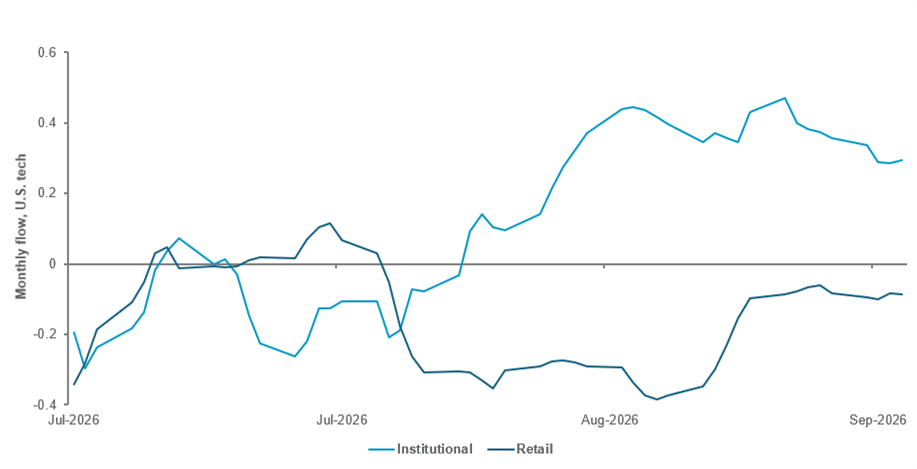
INSTITUTIONAL NAMES DRIVING THE MAJORITY OF FLOW INTEREST IN U.S. TECH
Source: BNY
As questions around the AI trade increase, investor exposures require closer scrutiny. Throughout the summer, iFlow has documented how the twists and turns in South Korean markets were driven by a sharp divergence between institutional and retail participants. Retail investors repeatedly generated surge buying, while institutional demand struggled, likely for technical reasons. Ultimately, retail investors were unable to sustain that momentum, even as institutional selling eased. Both groups are now broadly flat in the APAC semiconductor space, leaving no clear marginal buyer.
A similar divergence is emerging in U.S. technology as concerns over the pace of AI development mount. Unlike in South Korean semiconductor stocks, institutional investors are actively leading purchases of U.S. technology names (GICS level 1). Institutional flows have been solid since the end of July, while retail investors have struggled to generate comparable interest. On a monthly smoothed basis, retail flows have not been net-positive since early August. The risk is that institutional demand has now peaked and begins to fade, leaving no obvious buyer to absorb any reduction in technology exposure. Rising cash and risk-free yields have clearly added to positioning pressure, while the Fed looks set to tighten financial conditions further. This flow setup will remain challenging for technology in the near term, although we stress that there are currently no signs of disorderly exits.
Slowdown risk is emerging. The global economy is facing renewed headwinds, mostly involuntary but some less so. Central banks are stepping up their tightening, while supply chain risks remain a constraint. More significant is the news that U.S. AI firms are looking to slow their pace of development. For many economies, AI has been one of the few areas where investment has made a genuine contribution to growth. A sudden slowdown, without obvious substitutes, would therefore be felt well beyond the sector.
Central banks are focused on supply. Economists and policymakers would argue that the AI complex is currently adding to supply constraints and inflation pressures. Capital markets face an equivalent problem: the sharp rise in debt-funded hyperscaler investment is competing with sovereign issuance and tightening broader funding conditions, potentially forcing greater spending restraint. Slower growth may ultimately prove welcome, but ensuring inflation falls commensurately without triggering a hard landing makes the adjustment increasingly delicate.
Europe faces greater constraints. Germany’s Economy Ministry said in its monthly report that the slowdown in “previously quite robust economic momentum” is becoming visible at the start of this quarter. After last week’s hawkish push, some Governing Council members are now urging caution and warning against rushing into further hikes. A crowded election calendar also tends to bring more spending promises and weaker reform momentum. The EU’s financial services commissioner has already conceded that supervisory reforms are likely to face “dilution.”
Tech sentiment is the focus today. U.S. data and policy commentary are light ahead of Wednesday’s Fed decision. Futures point to a softer open, but nothing yet suggests a sharp market reaction to the AI-related announcements over the weekend. The trade-offs are growing, but there is still sufficient time and financial, political and diplomatic capital to optimize the path for AI development. Bond markets’ tolerance of weak monetary and fiscal credibility is a different matter entirely.
Oman’s Energy Minister Salim Al-Aufi has called for new LNG export routes that bypass the Strait of Hormuz, arguing that Gulf producers need alternatives through Oman, Yemen or northern corridors after months of disruption. His comments reflect growing concern that the region remains too dependent on a single chokepoint for energy exports, particularly as Hormuz normally handles around one-fifth of global LNG supply. The urgency has increased after a planned meeting between Gulf states and Iran on a temporary shipping lane was postponed, while renewed attacks on vessels and infrastructure have kept risks in the region elevated. The broader message is that even if Hormuz flows improve, Gulf exporters are likely to pursue structural diversification to reduce future vulnerability to geopolitical disruption. Brent +3.193% to 107.95, WTI +3.189% to 103.24, Omani crude +1.045% to 122.88, Dubai crude -1.298% to 114.909.
Sweden’s general election remains too close to call: the ruling bloc led by Prime Minister Ulf Kristersson and the opposition led by Magdalena Andersson were separated by just one seat after 87% of votes had been counted. Final results hinge on late-arriving ballots and overseas votes, with officials set to continue counting on Wednesday and possibly Thursday. Turnout was about 80%, down from the previous election. The outcome could reshape Swedish politics: a center-right win could bring the far-right Sweden Democrats into government for the first time, while a center-left comeback would still leave the Social Democrats with their worst result in more than a century. Any governing coalition is likely to have only a narrow majority, could spell protracted negotiations. OMX -0.64% to 3234, EURSEK +0.093% to 11.2635, 10y Swedish GB +2bp to 3.25%.
Chinese local branches of SAFE (State Administration of Foreign Exchange) are urging banks to push clients to hedge more yuan exposure, stepping up a campaign to limit companies’ FX risk. Some regional units have set hedging targets for lenders, summoned underperforming banks and in some cases offered subsidies to local firms. Banks are responding with better pricing and more flexible structures, even sacrificing margins, to lift use of derivatives. The drive comes as the yuan has gained about 6% against the dollar over the past year, increasing concern over exporters’ FX losses amid weak investment and consumption. SAFE said companies should manage currency risk through natural hedging, invoicing changes and derivatives. The move underscores Beijing’s push for a more risk-aware corporate sector and a stronger yuan-linked market structure. CSI 300 -0.67% to 4480, USDCNY +0.002% to 6.7073, 10y CGB -0.3bp to 1.686%.
Recent minimum wage increases in several provinces of China are set to lift labor protections. Guangdong and Yunnan implemented new minimum wage standards from September 1, while Shanxi and Xinjiang will do so from October 1; Jiangsu, Zhejiang and Shaanxi had previously raised standards on January 1. Guangzhou’s monthly minimum wage rises to ¥2,680 and Shenzhen’s to ¥2,700, while Yunnan’s three-tier monthly minimum wages increase to ¥2,270, ¥2,120 and ¥1,970. All provinces’ first-tier monthly minimum wages are now reported to exceed ¥2,000, with Shanghai the highest at ¥2,740. The higher floor also lifts overtime pay, unemployment insurance, probation wages, severance, sick pay and some benefits tied to local minimum wages, while reinforcing protections for low-paid and gig workers.
Fitch Ratings has said China’s 2028 “no hidden debt” target is unlikely to end government support for local government financing vehicles (LGFVs). It sees the goal mainly as a political and accounting milestone, not a point when most LGFVs become financially independent. The debt substitution program has reduced near-term refinancing stress, but it has not fixed weak debt servicing capacity, high leverage or reliance on policy mandates. Fitch expects support to remain the main credit anchor for most issuers, though future backing may become more selective across regions and issuers. LGFVs that have made less progress in repaying debt during the 2024-2028 substitution window could face greater pressure if support differentiates further. Financing conditions remain controlled, and low spreads still largely reflect expectations of state support.
BRICS leaders issued a joint declaration over the weekend urging restraint in the Middle East and calling for the smooth flow of global trade, energy and supply chains. The bloc voiced deep concern over escalating tensions, warning against attacks on civilian infrastructure and nuclear facilities, and stressed the importance of international navigation. It also reiterated “firm opposition” to the forced displacement of Palestinians, rejected changing the geography or demography of occupied territory, and called for an end to violence in Gaza, continued support for UNRWA and full UN membership for Palestine. Beyond the conflict, the declaration highlighted cooperation on non-western payment channels, AI and opposition to unilateral sanctions and tariffs. MSCI EM -1.34% to 1722, MSCI EM Currency Index -0.231% to 1935.75, BBG AGG EM Local Currency Government Bond Index 0bp to 3.963%.
South Korea’s finance minister nominee Lee Hyoung-il has said a corporate tax cut is not under consideration, backing the restored corporate tax rate that took effect this year. He said the government’s one percentage point hike was intended to normalize the corporate tax burden and support a virtuous cycle between growth and tax revenue. On calls for lower tax rates for firms outside the capital area, Lee urged caution, citing tax equality and the broader fiscal impact. He also said an income tax on financial investment and other capital gains should be reviewed only after markets stabilize, while adding that taxing virtual assets would help improve tax fairness. The remarks signal continuity on tax policy and no immediate move toward corporate tax relief. KOSPI -3.26% to 6684, USDKRW -0.349% to 1347.3, 10y KTB +8.7bp to 4.542%.
Canada August CPI is forecast at -0.1% m/m, 3.0% y/y vs. 0.5% m/m, 3.0% y/y in July. CPI ex food and energy is forecast at 2.1% vs. 1.9% y/y. CPI core median and core trim are forecast to be unchanged at 2.0% y/y and 1.9% y/y, respectively.
Canada July manufacturing sales is forecast at -0.2% vs. 0.1% m/m.
U.S. Treasury sells $92bn in 13-week bills and $79bn in 26-week bills.
Mood: iFlow Mood turned positive as demand for global equities outpaced flows into core sovereign bonds.
FX: Broad but moderate outflows across the iFlow universe, with selective buying of JPY, KRW, TWD and USD.
FI: G10 and LatAm government bonds drew broad demand, led by Denmark and the U.K. EMEA and APAC bonds were sold, with South Korea seeing the largest outflows.
Equities: Flows were moderate and mixed across G10, EMEA and LatAm, while China and Singapore saw substantial selling.
“We are ourselves creating our own successors… In the course of ages we shall find ourselves the inferior race.” – Samuel Butler
“At some stage therefore we should have to expect the machines to take control.” – Alan Turing
Switzerland’s producer and import price index rose 0.7% m/m but fell 0.7% y/y in August, with import prices providing the main upward pressure. The producer price index increased by 0.2% m/m but was still down 1.3% y/y, while the import price index jumped 1.9% m/m and rose 0.8% y/y. Petroleum products were the largest driver, rising 27.3% m/m for domestic producers and 27.7% for imports, while imported petroleum and natural gas increased by 23.0%. Chemical products also contributed positively. Core producer prices were unchanged m/m and fell 1.4% y/y, indicating that the monthly rise was concentrated in volatile energy and commodity-related components. SMI +0.71% to 13873, EURCHF -0.142% to 0.94556, 10y Swiss GB +2bp to 0.588%.
Sweden’s CPI inflation rose to 0.3% y/y in August from 0.2% in July, while prices fell 0.3% m/m. CPIF inflation, the Riksbank’s target measure, was unchanged at 0.7% y/y and decreased by 0.2% m/m. Underlying CPIF-XE inflation excluding energy eased to 0.5% from 0.6%, with prices down 0.5% m/m. Food and non-alcoholic beverage prices fell 6.6% y/y, subtracting 0.9 percentage points from headline CPI, while package holidays rose by 12.9% and restaurant prices by 2.7%. Electricity and fuel prices also contributed positively, with diesel prices up 18% y/y. Overall inflation therefore remained subdued, with underlying pressures easing further despite higher energy costs. OMX -0.64% to 3234, EURSEK +0.093% to 11.2635, 10y Swedish GB +2bp to 3.25%.
New Zealand’s services sector expanded for a third straight month in August, with the BNZ-BusinessNZ Performance of Services Index rising to 51.2 points from 50.6 in July. The reading is still only just above the 50-point threshold, signaling a fragile recovery, though it is the strongest since September 2023 and matches December 2025. The three-month moving average also improved to 50.9, its highest reading since July 2023. Sentiment softened, with 60.8% of comments negative, as businesses cited cost of living pressures, interest rates and election uncertainty. Among sub-indices, new orders/business led at 55.2, the highest since May 2023, and stocks/inventories was slightly expansionary at 50.8, while supplier deliveries, employment and activity/sales remained below 50, demonstrating that the recovery remains narrow. NZX 50 -0.14% to 13561, NZDUSD -0.551% to 0.5783, 10y NZGB -2bp to 5.013%.
China’s financial statistics for August showed broad money and credit growth remaining steady. Outstanding aggregate social financing rose 7.2% y/y to ¥464.8tn at end-August, while cumulative financing in the first eight months of the year reached ¥23.91tn, down ¥2.64tn from a year earlier. M2 growth was 7.5% y/y, with M1 at 4.1% y/y and M0 at 11.2% y/y. RMB deposits increased by ¥18.99tn in January-August, led by household and non-bank financial institution deposits. RMB loans rose ¥10.44tn in the first eight months; corporate lending was the main driver, while household loans remained negative. Interbank liquidity was slightly cheaper, with August average repo and interbank lending rates edging lower m/m. Cross-border RMB settlement remained sizable, with current account settlement at ¥1.7tn and direct investment settlement at ¥0.6tn. CSI 300 -0.67% to 4480, USDCNY +0.002% to 6.7073, 10y CGB -0.3bp to 1.686%.
India’s WPI inflation rose to 9.92% y/y in August from 9.78% in July. Price pressures were broad-based: primary articles eased to 7.76% y/y from 8.52%, while fuel and power accelerated to 22.93% from 20.05% and manufactured products edged up to 8.37% from 8.29%. The main drivers were mineral oils, food articles, manufacture of food products, basic metals, non-food articles and chemicals. The WPI food index rose to 7.05% y/y from 6.65%. The June WPI was revised up, lifting the final inflation estimate to 9.97% from 9.87%. India’s provisional August output PPI came in at 110.8, up from 109.9 in July, while its trial input PPI for manufacturing was 104.2, down from 105.9 in July. SENSEX -0.16% to 74782, USDINR -0.113% to 95.5562, 10y INGB +5.5bp to 7.019%.