Market Movers: Scenarios
Market Movers highlights key activities and developments before the U.S. market opens each morning.
Market Movers highlights key activities and developments before the U.S. market opens each morning.

Geoffrey Yu
Time to Read: 6 minutes
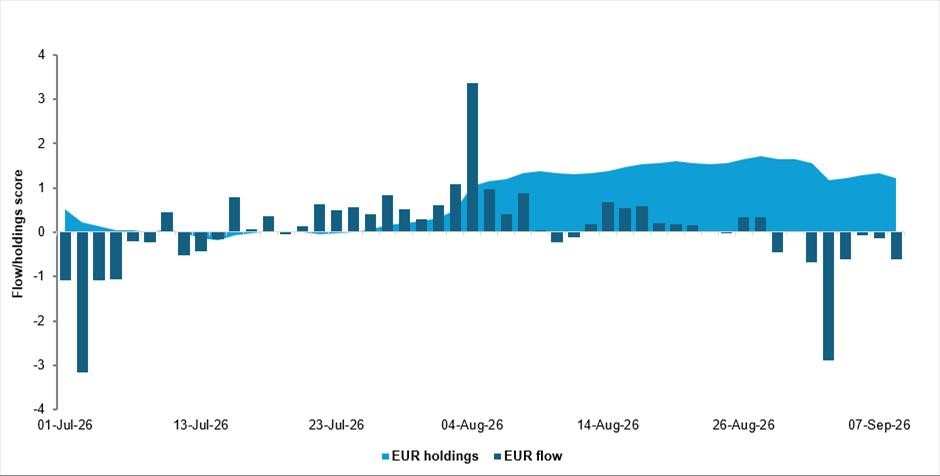
EUR momentum stalls ahead of ECB decision
Source: BNY
EUR is heading into the ECB decision on a weaker but not decisively bearish footing. Forward/swap flows have reversed after a strong mid-July to late-August run, with five consecutive days of net selling. The weakness is concentrated in EURUSD, reflecting renewed dollar demand rather than broad EUR liquidation. Spot flows have also softened, but magnitudes remain small, suggesting limited conviction. By contrast, EURGBP remains well-supported, with markets showing greater confidence in relative ECB-BoE divergence than in outright EURUSD downside.
Positioning is still vulnerable. Aggregate EUR holdings remain elevated at around 1.2x the rolling 12-month average, while cross-border investors remain materially under-hedged, with hedges at only around 40% of their 12-month average. Profitability has also deteriorated, leaving scope for further unwinding if the ECB favors a less aggressive path. The key shift is that markets appear to be moving away from extrapolating repeated hikes and toward a meeting-by-meeting, data-dependent ECB approach. Ahead of the decision, the cleanest read is therefore: soft EUR momentum, elevated residual longs and greater downside risk in EURUSD than in the crosses, with EURGBP still the preferred relative-value expression.
The ECB remains structurally hawkish but still has misgivings about committing to a full cycle. Its decision will be instructive for other central banks. Supply stress, no matter what the source, is important for price stability, but any mismatch with growth must also be addressed. Europe is starting from a weaker growth position, while restraint from rates and the exchange rate is already weighing on demand. The Fed and others will not be immune to the same trade-offs.
Bond markets are striving for resilience, in the face of Brent touching $101.50/barrel and Dutch TTF forward gas prices remaining firmly above €80/MWh. Even for less hawkish central banks such as the BoE, the lack of relief in forward prices and dwindling domestic reserves portend difficult policy decisions this winter. Regulation has the ability to cushion immediate price increases, but greater government commitments on the cost of living will still extract a market cost, either through policy rates or through higher long-dated yields. Avoiding both simultaneously is the key test of policy credibility.
Deals are still on the table. China and South Korea have their differences with the U.S., but negotiations to stabilize economic relationships are being stepped up. Seoul looks set to commit $100bn in U.S. investment, while Beijing is agreeing a framework for up to $30bn in reciprocal tax cuts. Even if fully realized, these figures may pale beside current and contingent U.S. funding needs. Nevertheless, the flows reinforce the U.S.’s enduring strength as an investment destination and anchor in global trade relationships.
U.S. price data will drive the agenda after the ECB decision. PPI is expected to show strong sequential gains across most components, while final demand inflation could reach 5.3% y/y, driven by continued strength in services. Any upside surprise will set up a nervy wait for Friday’s CPI release, as market tolerance of restrictive conditions faces another stress test.
South Korea is nearing agreement on major U.S. energy investments that could exceed $100bn, marking a key step in implementing the trade pact reached with Washington last year. The package under discussion includes financing for up to eight nuclear reactors and a roughly $20bn natural gas power project in Texas to support AI data center expansion. Investments would be spread over several years, with annual South Korean outlays capped at $20bn, and an initial payment of more than $2bn possible this month. The projects would form part of Seoul’s broader $350bn U.S. investment commitment, while also supporting U.S. efforts to expand domestic power capacity, nuclear construction and strategic supply chains. KOSPI -0.25% to 7034, USDKRW +0.161% to 1342.15, 10y KTB 0bp to 4.4%.
BoJ rate-setter Kazuyuki Masu has said Japan’s central bank needs to raise rates further to avoid falling behind the curve on inflation, strengthening expectations for a hike next week. He warned that a rapid increase in the policy rate could become necessary if inflation accelerates, stressing that the priority is to prevent underlying inflation from moving materially above 2%. Masu also argued that Japan’s negative real interest rates should be corrected as soon as possible now that the economy has moved beyond deflation. The speech reinforces the BoJ’s increasingly hawkish tone ahead of next week’s meeting, where a 25bp hike to 1.25% is widely expected, while keeping the door open to a faster pace of tightening beyond that. Nikkei +0.2% to 65271, USDJPY +0.026% to 153.6, 10y JGB +3.6bp to 2.922%.
In a joint press conference hosted by the PBoC and China Securities Regulatory Commission, China issued a five-year plan on “building a financial powerhouse.” CSRC Vice Chairman Li Chao said China will accelerate efforts to build world-class exchanges and strengthen the resilience, efficiency and global competitiveness of its capital markets. Li said regulators will further strengthen investor protection, enforcement against major market misconduct and risk monitoring to preserve market stability. PBoC Deputy Governor Lu Lei stressed that the central bank would “strengthen exchange rate flexibility” but also “steadfastly maintain the stability of the currency’s value.” He also refuted the notion that China used renminbi depreciation to boost competitiveness. CSI 300 -0.53% to 4548, USDCNY -0.032% to 6.7063, 10y CGB -0.1bp to 1.679%.
President Trump said he does not expect the war with Iran to end until after the November 3 midterm elections, arguing that Tehran is trying to influence the vote and will be unable to sustain the conflict much longer. He said oil prices would fall once the war ends and framed the current economic costs, including higher fuel prices, as necessary to prevent Iran from obtaining a nuclear weapon. Trump also said further negotiations with Tehran remain possible but are not currently being pursued. His comments come as fighting intensifies around the Strait of Hormuz and oil facilities in the region, pushing crude back to $100 per barrel and adding to inflation and interest-rate concerns. Brent +0.504% to 101.72, WTI +0.594% to 96.62, Omani crude +4.088% to 121.97, Dubai crude +4.434% to 109.746.
The ECB’s deposit facility rate is forecast to rise to 2.5% from 2.25%. The path beyond that is going to be more challenging. Even hawkish members such as Joachim Nagel have stated that policy will need to be taken on a “meeting-by-meeting” basis after September. President Christine Lagarde may also face more vigorous questioning on the issue of her succession; German Chancellor Friedrich Merz has scheduled a meeting with the ECB with such matters now front of mind.
U.S. initial jobless claims are forecast to ease to 205k vs. 206k.
U.S. August PPI final demand is forecast at 0.4% m/m, 5.3% y/y vs. 0.0% m/m, 4.7% y/y in July. PPI ex food and energy is forecast at 0.3% m/m, 4.6% y/y vs. 0.2% m/m, 4.2% y/y in July. PPI ex food, energy and trade is forecast at 0.3% m/m, 4.8% y/y vs. 0.4% m/m, 4.7% y/y in July.
U.S. August existing home sales are forecast to ease to 3.99 million vs. 4.06 million.
U.S. July final wholesale inventories are forecast to hold at 1.3% m/m.
U.S. Treasury sells $90bn in 4-week bills, $85bn in 8-week bills and $22bn in a 30y bond reopening.
Mood: iFlow Mood narrowed further toward neutral at -0.031, as aggressive core sovereign bond unwinding outpaced moderate equity selling.
FX: Inflows broadened, led by USD, JPY and TWD, while GBP, EUR and MXN saw the largest outflows.
FI: Flows were mixed: buying in Danish and Canadian government bonds and U.K. gilts contrasted with selling in Poland.
Equities: China, Türkiye, Europe and Singapore saw sizable outflows, while Mexico attracted substantial buying. Elsewhere, flows were mixed.
“Strong vigilance is of the essence.” – Jean-Claude Trichet
“For all its difficulty, monetary restraint must be an essential part of any successful effort to damp inflation.” – Paul Volcker
German CPI inflation for August was confirmed at 2.9% y/y, up from 2.8% in July and 2.3% in June, while prices rose 0.2% m/m. Energy remained the main driver, with prices up 10.5% y/y, including fuels at 27.7% and heating oil at 49.6%. By contrast, household energy was 0.7% lower y/y as electricity, gas and district heating prices came down. Food inflation was subdued at 0.1% y/y, while core inflation excluding food and energy stood at 2.4%. Services inflation eased slightly to 2.8%, while goods prices rose 3.0%. Harmonized inflation was also confirmed at 2.9% y/y and 0.2% m/m. DAX -0.07% to 25559, EURUSD +0.035% to 1.1637, 10y Bund -0.8bp to 3.436%.
Italy’s industrial production rose 0.7% m/m on a seasonally adjusted basis in July, while output over May-July declined by 0.1% compared with the previous three months. Monthly growth was broad-based outside energy, with consumer goods up 2.1%, intermediate goods up 0.5% and capital goods up 0.2%, while energy output fell 0.9%. On a calendar-adjusted basis, production was unchanged y/y. Energy rose 6.4% annually, but consumer goods fell by 1.2%, intermediate goods by 0.8% and capital goods by 0.1%. Pharmaceuticals increased by 7.4% y/y and computer, electronics and optical products rose 2.4%, while chemicals fell 3.4%. FTSE MIB +0.54% to 52156, EURUSD +0.035% to 1.1637, 10y BTP -1.7bp to 4.275%.
Dutch manufacturing output surged in July, rising 9.0% y/y after 5.0% y/y in June, the strongest annual increase in four years. On a m/m basis, output increased by 1.6% in July. Gains were broad-based, with production higher in nearly half of the industrial sectors, led by machinery (35.8% y/y), while transport equipment posted the largest decline (-9.9% y/y). Food products and metal products also rose modestly. Producer confidence improved in August, climbing to 3.7 points from 2.4 in July, the highest in four years, with manufacturers more upbeat about output over the next three months. AEX -0.19% to 1100, EURUSD +0.035% to 1.1637, 10y NGB -0.7bp to 3.512%.
U.K. housing market conditions showed signs of stabilizing in August, showed the RICS survey. The house price balance improved to -28 points from -29 in July, a five-month high, while new buyer inquiries rose to -19, the best since January. Sales expectations also recovered, rising to -3 from -13 in July. RICS said activity indicators have become progressively less negative, suggesting the slowdown may be leveling off, though any recovery remains fragile. The outlook for property prices is still weak over the next three months, but prices are expected to be broadly stable over 12 months. RICS also flagged stronger tenant demand and fewer landlord listings, lifting the three-month rent balance to +44 from +33. It warned that higher interest rates or heavier property taxation after the October budget could weigh on prices. FTSE 100 -0.13% to 10656, GBPUSD +0.008% to 1.3548, 10y gilt -0.4bp to 5.257%.
Norway’s CPI inflation rose to 3.3% y/y in August, while prices fell 0.3% m/m. Underlying inflation also remained elevated, with CPI-ATE, which adjusts for tax changes and excludes energy products, increasing by 3.0% y/y and falling 0.5% m/m. The gap between headline and core inflation therefore remained relatively narrow, indicating that price pressures were not driven solely by energy. Monthly declines in both measures point to some near-term easing in price momentum, but the annual rates remain above levels consistent with fully normalized inflation conditions. The August figures therefore suggest that Norwegian inflation pressures are easing only gradually, with underlying inflation still comparatively persistent. OSE +0.02% to 2122, EURNOK +0.297% to 10.7303, 10y NGB -1.1bp to 4.503%.
Czech CPI inflation rose to 1.9% y/y in August from 1.7% in July, while prices increased by 0.3% m/m. The acceleration was driven mainly by transport, where prices rose 9.6% y/y on a 26.2% jump in fuel and lubricant prices, up from 16.8% in July. Housing costs also remained firm, with rents up 6.1% y/y, while electricity and gas prices fell 11.2% and 4.8%, respectively. Food prices provided the main offset, with sharp decreases in pork, poultry, milk and butter. Services inflation remained elevated at 4.5% y/y, compared with just 0.2% for goods. HICP inflation increased to 1.5% y/y from 1.3%. Prague SE +0.61% to 2803, EURCZK -0.05% to 24.249, 10y CZGB +0.7bp to 5.171%.
Türkiye’s industrial production fell 1.0% m/m in July on a seasonally and calendar-adjusted basis and was down 0.3% y/y on a calendar-adjusted basis. Monthly weakness was broad-based, with mining and quarrying down 2.2%, manufacturing down 0.8% and electricity, gas and steam output down 2.2%. By industrial grouping, high-technology production fell particularly sharply, down 5.8% m/m and 8.5% y/y, while capital goods output shrank by 1.6% m/m and 2.6% y/y. Durable consumer goods were a notable exception, rising 3.3% m/m. On a y/y basis, manufacturing still edged up 0.3%, but this was offset by declines in mining and utilities. BI 100 -0.21% to 14475, USDTRY +0.019% to 48.4944, 10y TGB 0bp to 34.24%.