Market Movers: Reflation
Market Movers highlights key activities and developments before the U.S. market opens each morning.
Market Movers highlights key activities and developments before the U.S. market opens each morning.

Wee Khoon Chong
Time to Read: 5 minutes
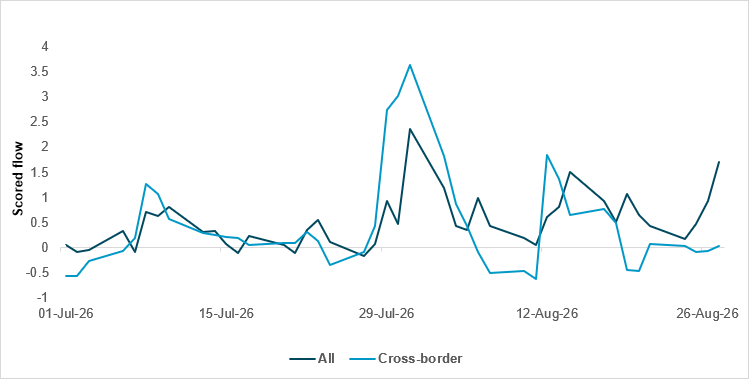
Long-end U.S. Treasury flows remain resilient
Source: BNY
Recent flow data suggest investors have been adding to long-dated U.S. Treasurys in recent weeks, while yields have come down marginally over the past week. That combination points to sustained demand for duration, with investors continuing to extend into the long end even after the latest downward move in yields. The recent increase in inflows suggests demand has remained firm despite a less compelling yield backdrop at the margin.
At the same time, cross-border flows are still resilient in the sense that they have remained broadly flat and, importantly, have not shifted into outflows. This stability indicates that overseas demand for Treasurys has held up despite rate volatility and a changing macro environment. Even without a renewed acceleration in foreign buying, the absence of outflows is significant and suggests global investors are maintaining their exposure to the U.S. rates market. In particular, the Treasury’s recent buyback announcement does not appear to have had a major effect on the overall flow picture. Market behavior continues to be driven more by the broader rate backdrop, supply expectations and investor positioning than by the technical implications of the buyback program. In that context, rising inflows into long-dated Treasurys alongside steady cross-border allocations suggest underlying demand remains intact.
Risk sentiment has deteriorated following Fed Chair Kevin Warsh’s hawkish Jackson Hole message, while renewed U.S.-Iran exchanges near the Strait of Hormuz have added to geopolitical risk. Weak Chinese PMI data have provided another growth headwind.
Inflation risks are also rebuilding. Escalating Russia-Ukraine tensions and Black Sea supply disruptions have pushed the Bloomberg Agriculture Spot Index up more than 13% in August, in its biggest monthly jump since July 2012. Higher food and energy risks, alongside tighter monetary policy, are adding to pressure on long-end yields. JGBs remain a key focus, with the 30y yield approaching the top of its recent range at 4.14%.
Fiscal and political risks are reinforcing the global duration selloff as investors demand greater term premiums. French 10y yields have climbed above 4.15% to their highest level since 2008, on concerns about a difficult 2027 budget process and uncertainty surrounding the presidential election.
The U.S. says it has struck Iranian rocket launchers that were preparing to send mines into the Strait of Hormuz, in its first military action against Iran in more than a month. U.S. Central Command said forces are monitoring the area closely and remain ready to protect commerce through the waterway, which carries a large share of global oil and LNG flows. The move comes as Washington intensifies pressure on Tehran through sanctions. Treasury Secretary Scott Bessent has said the U.S. will target a second bank that does business with Iran this week, as part of an “economic onslaught” against Iran and its trading partners, including China. Iran’s foreign minister has said resuming diplomacy with the U.S. is “not impossible,” but argued that pressure does not work. S&P Mini -0.13% to 7712, DXY -0.156% to 99.547, 10y UST -0.8bp to 4.71%.
President Trump has announced that the U.S. has struck a deal with Venezuela to secure majority control of more than 65 billion barrels of oil reserves. He said the agreement would come at “no cost” to U.S. taxpayers and claimed it would strengthen bilateral ties while helping to lower gasoline prices. Trump said the deal was arranged with Venezuelan officials and private businesses. The announcement comes amid elevated energy costs and tighter global crude flows, with prices at U.S. gas pumps around $4.09/gallon and WTI up sharply since the war with Iran began. The statement provided no details on legal terms, timing or implementation, and no official government document was included in the provided context.
U.S. Treasury Secretary Scott Bessent has said recent yen moves are “pretty well-contained” and not disorderly, reducing immediate expectations of another joint U.S.-Japanese intervention. He noted that the yen’s slide below 160 per dollar has drawn market attention, but framed it as manageable. Bessent said he expects BoJ Governor Kazuo Ueda to “do the right thing” on policy, while declining to tell Japan what to do on rates. He suggested Japan has already overcome deflation and that the era of Abenomics is ending, with the country shifting toward “Takaichi-nomics.” His remarks come ahead of the BoJ’s September 17-18 meeting, where markets are watching for a possible rate hike. Bessent also plans to meet Ueda at the G20 gathering in Asheville.
China has announced property market reforms aimed at strengthening homebuyer protections and accelerating the shift to a new housing development model. The measures tighten presale rules, promote completed-home sales and require more safeguards for buyer funds through regulated accounts and “handover with certificate” practices. For homes sold after completion, mortgage disbursement will only occur after sales registration; for presold projects, funding will be delayed until formal completion registration. Authorities also extended the maximum term of individual home loans to 40 years from 30 years. In parallel, regulators said developers’ reasonable financing needs should be better met, with a greater focus on project viability, and financing channels will be broadened through equities, bonds, asset-backed securities and REITs. The package is designed to reduce delivery risks, improve transparency, raise housing quality and support safer transactions. CSI 300 +0.35% to 4625, USDCNY +0.155% to 6.7197, 10y CGB -0.6bp to 1.69%.
Taiwan’s financial regulator is pushing life insurers to reduce their reliance on U.S. dollar assets and bring more capital home. The FSC wants insurers to reduce currency mismatches, slow their purchases of dollar bonds and U.S. Treasurys and potentially trim allocations to offshore buyout funds. Insurers are being encouraged instead to increase domestic investments in infrastructure, real estate, AI-related projects and other Taiwan-focused assets. Starting this year, they must set annual targets on currency mismatch reduction and domestic allocation, with performance now linked to senior executives’ evaluations. The regulator also plans to expand oversight through quarterly reviews of overseas investments. The broader goal is to turn Taiwan into a regional financial hub, though the move faces limits from a still-scarce domestic investment pipeline. TAIEX -0.44% to 46128, USDTWD -0.12% to 31.666, 10y TGB +0.1bp to 1.863%.
U.S. August Dallas Fed Manufacturing Activity is forecast at 1.6 vs. 1.3.
U.S. Treasury sells $92bn in 13-week bills and $79bn in 26-week bills.
Mood: iFlow Mood remained in risk-neutral territory at -0.09, given a modest selloff in equities.
FX: FX flows were well-contained globally. Latin America broadly saw inflows, with MXN, CLP and PEN bought. SEK saw outflows, as did parts of Asia, with CNY, HKD and Antipodean currencies all facing selling pressure.
FI: Flows in G10 sovereign bonds were mixed with gilts, European sovereign bonds and Treasurys all seeing inflows, while New Zealand and Norwegian bonds recorded outflows.
Equities: Global equity flows were a mixed bag: equities in Peru and Poland experienced inflows, while Thai, Indian and Norwegian equities were sold.
“Risk means more things can happen than will happen.” – Elroy Dimson
“Inflation is always and everywhere a monetary phenomenon.” – Milton Friedman
China’s August PMI release showed a modest improvement in factory activity, while non-manufacturing remained weak. The manufacturing PMI rose to 49.8% in August (49.2% in July), with large firms returning to expansion at 50.6%. Production and new orders strengthened to 50.4% and 50.6%, respectively, signaling firmer supply and demand. Export orders improved to 50.1%, and input and output prices also rose as raw material and factory-gate price pressures picked up. High-tech and equipment manufacturing remained in expansion. Non-manufacturing business activity was unchanged at 49.0% in August, as services were flat at 49.3% and construction edged down to 46.9%. New orders weakened, though input prices and sales prices both improved slightly. The composite PMI output index rose to 49.5%, suggesting overall business sentiment recovered a little, but the economy remained just below the expansion threshold. CSI 300 +0.35% to 4625, USDCNY +0.155% to 6.7197, 10y CGB -0.6bp to 1.69%.
Japan’s industrial production was flat m/m in July (+0.1% m/m on a seasonally adjusted basis). Shipments rose 2.2% m/m, while inventories increased by 0.5% m/m and the inventory ratio fell 1.7% m/m. On an unadjusted basis, production rose 4.1% y/y. The report said industrial output “fluctuates indecisively,” with gains led by production machinery, inorganic and organic chemicals, and electronic parts and devices, while transport equipment excluding motor vehicles, fabricated metals and plastic products weighed on output. The survey also forecast a 6.4% m/m rise in production for August, followed by a 4.2% m/m decline in September. Nikkei -0.14% to 66312, USDJPY +0.245% to 159.7, 10y JGB +2.6bp to 2.957%.
Japan’s Current Survey of Commerce showed commercial sales rose 7.7% y/y in July to ¥58.4tn, while seasonally adjusted sales increased by 1.5% m/m. Wholesale sales climbed 9.0% y/y to ¥44.5tn, and retail sales rose 4.0% y/y to ¥13.9tn; m/m rises were 1.5% and 2.4%, respectively. Within wholesale, gains were broad-based, led by the mineral and metal materials, machinery and other wholesale categories, while apparel and pharmaceuticals edged lower. In retail, the auto sales, other retail, machinery, department stores, non-store retail, and food and beverage store categories all posted rises, offsetting declines in apparel. Department stores and supermarkets sales rose 1.8% y/y, with department stores up 4.3% and supermarkets up 0.8%. Convenience store sales also increased by 1.3% y/y.
Japanese housing starts rose 8.2% y/y to 66,439 units in July vs. a 18.6% y/y increase in June. By segment, housing for rent remained the largest driver at 30,164 units (10.0% y/y), while houses for sale also increased to 18,208 (14.6% y/y). Owner-occupied starts were broadly flat at 17,730 (0.4% y/y). The seasonally adjusted annualized rate came in at 773,916, down from 786,432 in June. Overall, the data point to continued resilience in Japan’s housing market, with rental and for-sale construction supporting the headline gain.
Australia’s business indicators for June showed mixed quarterly momentum. Company gross operating profits rose 1.8% q/q, led by mining (+6.8%), with support from professional, scientific and technical services and manufacturing; retail trade and wholesale trade partially offset the gain. Wages and salaries climbed 1.4% q/q, with all industries rising, led by financial and insurance services, professional, scientific and technical services and construction. Inventories fell 0.2% q/q, dragged down by mining and manufacturing, while wholesale trade and retail trade cushioned the fall. Sales of goods and services rose in nine industries and fell in six, led by mining; professional, scientific and technical services; and wholesale trade, while administrative and support services posted the largest decrease. ASX +0.28% to 5842, AUDUSD -0.056% to 0.716, 10y ACGB -0.6bp to 5.093%.
Australia’s Melbourne Institute Monthly Inflation Gauge increased for a second consecutive month in August, after falling in May and June. The increase was primarily attributed to transport price rises, with annual headline inflation of 4.8%. The monthly cost of living also increased across a range of household types (age pensioners, other government transfer recipients, employees, pensioners and beneficiaries and self-funded retirees).
New Zealand’s August 2026 ANZ Business Outlook showed that firms remain upbeat despite a volatile global backdrop. Business confidence eased to 53.7 points from 56.1, and expected own activity slipped to 48.2 from 49.3, but both remained very elevated. Reported past activity strengthened to 16.4 from 9.7, with services leading the improvement, suggesting the rebound is already underway. Export intentions rose to 31.4 from 26.6, led by manufacturing and agriculture, while employment intentions increased to 19.3 from 18.1, the highest since February. Inflation signals were mixed: inflation expectations rose to 3.26% from 3.14%, pricing intentions firmed up and cost expectations remained high, though the pace of expected cost increases eased. Overall, ANZ said firms remain optimistic that the worst is past and growth is resuming. NZX 50 +1.08% to 13917, NZDUSD +0.017% to 0.5916, 10y NZGB -0.5bp to 4.735%.
South Korean industrial statistics for July revealed a broadly mixed but resilient picture: all-industry production was flat m/m but up 3.1% y/y. Manufacturing output edged up 0.2% m/m and 3.9% y/y, while shipments fell 1.5% m/m but still gained 2.2% y/y; inventories increased by 2.1% m/m and 6.4% y/y. Services output shrank by 1.3% m/m but rose 3.5% y/y. Retail sales weakened, falling 2.4% m/m and 0.8% y/y. On the investment side, equipment investment strengthened sharply, up 7.5% m/m and 24.9% y/y, while construction activity remained soft, with completed construction down by 1.1% m/m and 3.2% y/y. The leading and coincident indicators both improved, signaling some underlying momentum. KOSPI +0.46% to 6820, USDKRW +0.659% to 1366.4, 10y KTB +6.4bp to 4.285%.
South Korean President Lee Jae-myung has nominated Lee Hyoung-il, a career technocrat and First Vice Finance Minister, as Deputy Prime Minister and Finance Minister in a surprise cabinet reshuffle. The move appears to be aimed at stabilizing the administration as President Lee faces mounting political pressure, with his approval rating falling to a record low 42% in a Gallup Korea survey. Meanwhile, a Realmeter poll published on Monday showed the president’s approval rating falling for a seventh consecutive week, dropping to 38.9% and dipping below 40% for the first time since he took office. If confirmed, Lee Hyoung-il will inherit an economy marked by weak job creation, persistent inflation, housing market strains and an uneven recovery led by the semiconductor boom. The reshuffle is broader, covering defense, justice, land, small business, gender equality and senior AI and investment posts, signaling a preference for policy continuity and expertise.
Singapore non-resident deposits fell in July, with total deposits easing to SG$652.18bn from SG$667.69bn in June. Demand deposits dropped to SG$196.46bn from SG$208.35bn, while fixed deposits slipped to SG$368.56bn from SG$371.71bn. Savings and other deposits were little-changed at SG$87.16bn. Broader money measures also softened: M2 edged down to SG$890.92bn from SG$892.40bn and M3 to SG$907.53bn from SG$909.09bn. In contrast, total loans and advances rose to SG$939.06bn from SG$931.34bn, driven by both business loans and consumer lending. On a y/y basis, total loans accelerated to 10.0% from 9.1%, while M1 growth slowed to 5.3% from 8.5%. The release signals weaker non-resident deposit inflows but continued credit expansion. STI +0.69% to 5739, USDSGD +0.126% to 1.2725, 10y SGB +2.9bp to 2.337%.
Taiwan’s manufacturing sector brightened sharply in July, with the overall industrial climate signal rising to 18.57 points from 16.54 in June, lifting the gauge from yellow-red to red. The report said global manufacturing remained resilient, supported by strong demand for semiconductors, high-performance computing and AI in the U.S., Europe and Japan, despite softer Chinese demand. Domestically, export prices, export orders and production all improved, while business sentiment strengthened. Among subsectors, textiles, paper, chemicals, plastics, metal products, machinery, electronic components and computers/optics were mostly upgraded to red or yellow-red, reflecting stronger orders and output. Automotive and parts remained weak at yellow-blue, as production cuts offset boosts from tax cuts and EV policies. TAIEX -0.44% to 46128, USDTWD -0.12% to 31.666, 10y TGB +0.1bp to 1.863%.