Market Movers: Payrolls
Market Movers highlights key activities and developments before the U.S. market opens each morning.
Market Movers highlights key activities and developments before the U.S. market opens each morning.

Geoffrey Yu
Time to Read: 6 minutes
All longs under pressure, not just JPY-funded carry
Source: BNY
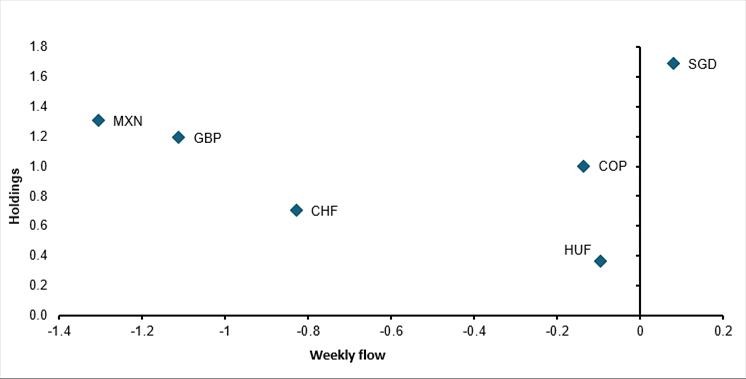
Crowded FX longs are beginning to unwind as the market reassesses the policy backdrop following Jackson Hole and the perceived Fed pivot. Five of the six best-held currencies in iFlow were sold over the past week, suggesting that overheld positioning itself has become a vulnerability. However, the adjustment is not yet being driven by material losses or hedging stress, so we would avoid treating it as a broad liquidation signal. MXN remains fundamentally supported but had become priced for perfection, making it vulnerable to further profit-taking as the Fed shifts more hawkishly. GBP also looks exposed: cross-border positioning is unusually strong, while market pricing appears too aggressive relative to what the BoE can realistically deliver. COP could see additional profit-taking, although its high nominal carry and real rate buffer should make it one of the first currencies to recover if broader carry conditions improve.
CHF looks the clearest candidate for a fuller reversal. Its low yield makes persistent overheld positioning difficult to sustain, and without a compelling valuation case, carry bleed should push holdings back toward underheld. HUF is the main exception. Positioning is much less stretched after severe summer outflows, while the MNB’s shift toward a higher-for-longer stance and lower inflation target provides a strong idiosyncratic catalyst. That policy change improves the case for currency re-rating and leaves HUF well-placed to attract recovery flows, particularly if ECB tightening pressure begins to ease.
JPY takes a breather. Thursday’s sharp unwind in USDJPY longs has partially reversed, with the pair recovering at above 156 ahead of today’s crucial payrolls report. So far, the most relevant data suggest the move was market-driven rather than intervention-led. But that does not mean asset allocators have suddenly rediscovered confidence in Japanese policy credibility, or fiscal credibility more broadly. Global bonds remain under pressure, with sentiment further challenged by reports that the world’s largest sovereign wealth fund plans to reduce its sovereign debt allocation.
No relief from supply shocks. Multi-year and record highs in food and fuel prices are becoming increasingly familiar. Central banks are trying to get ahead of the curve but are also questioning how far they can tighten without doing more harm than good. BoE hawk Huw Pill has argued that a hike was needed to prevent an “insidious catch-up” between supply dynamics and inflation, while cautioning against going much further. That even prominent European hawks such as Pill and Joachim Nagel are increasingly characterizing tightening as insurance underscores the limits of monetary policy when inflation is being driven by supply and fiscal shocks.
Labor relief is partial. Today’s U.S. payrolls report is expected to show just 55,000 jobs added, an improvement from July’s modest contraction. Average hourly earnings are nevertheless expected to rise 0.3% m/m, with unemployment unchanged. The “no-fire, no-hire” economy is increasingly being treated as a steady state, but robust wage growth would keep inflation risks tilted higher. Repricing for the next Fed decision is therefore far from complete; another resilient report would push the central scenario further toward a hike.
Bottom line: There is no short-term fix for bond market volatility. This is a situation to be managed rather than resolved, making near-term risk management increasingly about identifying where rate volatility will force adjustment elsewhere. Margins for error are narrowing across portfolios, while the cross-asset implications of any individual data release are becoming less straightforward. Today’s payrolls report is another test, as the economic, fiscal and policy realities increasingly collide.
U.S. retail diesel prices have risen to a record $5.85/gallon, surpassing the previous June 2022 peak as supply disruptions from the Iran conflict and Russia’s export restrictions have tightened the global market. Flows through the Strait of Hormuz remain heavily constrained, while Russia has extended its diesel export ban through September following refinery attacks. U.S. inventories are also exceptionally low, with distillate stocks at a record seasonal trough and East Coast supplies at unprecedented lows. The surge threatens to intensify energy-driven inflation because diesel feeds directly into freight, agriculture, construction and heating costs. Refiners have limited spare capacity, leaving policymakers with few near-term options as the Federal Reserve approaches its September meeting. Brent -0.231% to 95.3, WTI -0.471% to 90.87, Omani crude +0.712% to 101.92, Dubai crude -1.284% to 98.716.
Global bond prices remain under pressure as Norway’s sovereign wealth fund has proposed cutting government bonds to 50% of its fixed income portfolio from the current 70%, to increase exposure to a broader range of risk premiums. The shift would reduce government bond holdings by roughly $58bn, with U.S. Treasurys expected to see the largest reduction, potentially around $75bn, while Japanese government bond exposure could rise. Euro area sovereign holdings would also fall. Norges Bank Investment Management argues that a 50% allocation would still provide ample liquidity while allowing greater investment in riskier debt. The proposal also recommends weighting the government bond subindex by market value rather than GDP, reflecting the broader rise in public debt across developed economies. S&P Mini +0.05% to 7758, DXY +0.202% to 99.107, 10y UST -0.8bp to 4.76%.
Global food prices rose 1.9% m/m in August to reach their highest level since late 2022, the UN Food and Agriculture Organization has reported, as geopolitical tensions and extreme weather have intensified supply concerns. All major commodity groups recorded increases, led by sugar (+11.9%) and wheat (+2.6% m/m and 15% y/y). Risks are building across several producing regions, with Black Sea disruptions constraining Ukrainian grain exports, poor European harvests increasing import dependence and a potentially strong El Niño threatening further weather-related damage. The FAO has also cut its 2026 global grain production forecast to 2.98 billion metric tons, which would mark the largest y/y decline since 2018, reinforcing the risk of renewed food inflation. Wheat -0.73% to 748.75, hogs -0.388% to 83.45.
India’s overnight money market effectively froze for the first 90 minutes of trading on two consecutive days, as record banking system liquidity eliminated demand for short-term funding. Surplus cash reached about ₹10.5tn after a larger-than-expected $127bn inflow under a central bank capital-raising program, pushing trading volumes to a one-year low. The resulting liquidity glut has driven the overnight funding rate to roughly 30bp below the RBI’s policy rate, creating a monetary policy transmission problem as actual borrowing costs fall below the intended stance. The RBI may therefore need to step up its liquidity absorption operations, including short-term cash withdrawals and potentially bond sales, to pull market rates back toward its benchmark. SENSEX +0.66% to 76657, USDINR 0% to 94.4937, 10y INGB -0.8bp to 6.957%.
U.S. August change in nonfarm payrolls is forecast to rise to 55k vs. -23k.
U.S. August average hourly earnings are forecast at 0.3% m/m, 3.1% y/y vs. 0.1% m/m, 3.2% y/y in July. U.S. August average weekly hours are forecast to hold at 34.3 vs. 34.3.
U.S. August unemployment rate is forecast to be unchanged at 4.1% vs. 4.1%. The labor force participation rate is forecast to hold at 61.4%.
Canada August net change in employment is forecast at 15k vs. 75.1k.
Canada August unemployment rate is forecast to hold at 6.4%. The participation rate is forecast to be unchanged at 65.1%.
Canada August hourly wage rate for permanent employees is forecast to ease to 2.9% vs. 3.0% y/y.
Canada August Ivey Purchasing Managers Index is due out; the prior month’s reading was 55.1.
Mood: iFlow Mood narrowed slightly to -0.096 as demand for core sovereign bonds eased, while global equity buying continued.
FX: USD, NOK and JPY attracted the strongest inflows, while MXN and GBP saw sizable outflows. EMEA and APAC currency flows were mixed and subdued.
FI: Eurozone and Canadian government bonds, U.K. gilts and U.S. Treasurys led buying. EMEA and APAC bonds drew modest demand, while LatAm bonds were broadly sold.
Equities: Buying was concentrated in LatAm, Japan, New Zealand and Taiwan, while Indonesia, China, Canada and Europe saw selling.
“For the day’s work is a great thing, a very great thing! It is at the very foundation of the world.” – Henry Ford
“Being busy does not always mean real work.” – Thomas Edison
Germany’s manufacturing new orders rose by 2.5% m/m in July, in real, seasonally and calendar-adjusted terms and by 13.1% y/y. However, the headline strength was heavily concentrated in large orders; excluding these, new orders fell 1.4% m/m, while the three-month comparison showed a 2.9% rise overall but a 2.2% decline excluding large orders. Other transport equipment surged 126.4% m/m on exceptionally large aircraft, ship and rail orders, while auto orders fell 12.5%. Domestic orders jumped 9.1%, but foreign orders dropped 2.1%, with euro area demand up 12.1% and non-euro-area orders down 10.1%. Real manufacturing turnover fell 1.5% m/m. DAX +0.06% to 26020, EURUSD -0.078% to 1.1617, 10y Bund +0.9bp to 3.352%.
Italy’s retail sales fell 0.4% m/m by value and 0.5% by volume in July, marking a second consecutive m/m decline. Food sales decreased by 0.4% in value terms and 0.5% in volume terms, while non-food sales fell 0.4% and 0.7%, respectively. On a y/y basis, total retail sales rose 0.8% in value but declined by 0.6% in volume, indicating continued price-led growth. Food sales increased by 0.3% by value but fell 1.0% by volume, while non-food sales rose 1.1% by value and slipped 0.2% by volume. Large-scale distribution and online sales outperformed, rising 1.6% and 2.4% y/y in value terms, respectively, with both also recording higher volumes. FTSE MIB -0.39% to 52040, EURUSD -0.078% to 1.1617, 10y BTP +1.2bp to 4.17%.
U.K. construction PMI fell to 44.3 points in August from 44.7 in July, remaining below 50.0 for a 20th consecutive month and signaling a faster contraction in activity. Housing was the main drag, with the residential index dropping to 37.6, while commercial activity (47.8) and civil engineering (40.5) contracted more slowly. New orders declined at the weakest pace since September 2025, while employment fell at the slowest rate since February. Purchasing activity weakened further, but input cost inflation eased to a six-month low despite higher fuel, transport and raw material costs. Business confidence also softened, constrained by weak domestic demand, elevated borrowing costs and geopolitical uncertainty. FTSE 100 +0.02% to 10833, GBPUSD -0.015% to 1.3523, 10y gilt +1.5bp to 5.149%.
Czech CPI inflation for August is estimated at 1.9% y/y, up from 1.7% in July, while prices rose 0.3% m/m. The acceleration was driven mainly by energy, where prices increased by 2.3% y/y and 2.2% m/m, and by alcoholic beverages and tobacco (+4.7% y/y). Services inflation remained elevated at 4.5% y/y, though it was slightly below July’s 4.7%. By contrast, food and non-alcoholic beverage prices fell 4.3% y/y and 1.1% m/m, with unprocessed food down 4.5% y/y. Core inflation excluding energy, food, alcohol and tobacco edged up to 3.3% from 3.2%, suggesting underlying price pressure remains firmer than the headline rate. Prague SE -0.45% to 2803, EURCZK +0.067% to 24.187, 10y CZGB -1.9bp to 5.126%.
South Korea’s current account surplus narrowed to $42.08bn in July from $49.73bn in June, while the January-July surplus reached $233.09bn. The goods surplus remained large at $40.43bn, with exports surging 65.3% y/y to $100.45bn and imports rising 21.7% to $60.02bn. The services account recorded a $1.97bn deficit, reflecting weakness in other business and manufacturing services, while the primary income surplus increased to $4.35bn on stronger equity income. The financial account showed a $40.32bn net increase in assets, including $13.57bn of portfolio investment assets and $27.56bn from other investments, while reserve assets fell $1.80bn. KOSPI +1.64% to 6687, USDKRW -0.376% to 1351.9, 10y KTB -5bp to 4.367%.
Philippines CPI inflation eased slightly to 6.1% y/y in August from 6.2% in July, taking average inflation for January-August to 5.2%. Core inflation also moderated to 4.1% from 4.2%. The slowdown was driven mainly by food and non-alcoholic beverages, where inflation eased to 4.6% from 5.2%, and housing and utilities, which slowed to 7.9% from 8.2%. Food inflation alone decreased to 4.6% from 5.3%, helped by falling prices for vegetables, tubers and pulses. By contrast, transport inflation accelerated sharply to 13.5% from 11.9%. Food, housing and transport remained the largest contributors to headline inflation, adding 1.8, 1.6 and 1.2 percentage points, respectively. PSEi +0.35% to 6091, USDPHP +0.135% to 62.603, 10y PHGB +716.1bp to 7.161%.