Market Movers: Memoriam
Market Movers highlights key activities and developments before the U.S. market opens each morning.
Market Movers highlights key activities and developments before the U.S. market opens each morning.

Geoffrey Yu
Time to Read: 7 minutes
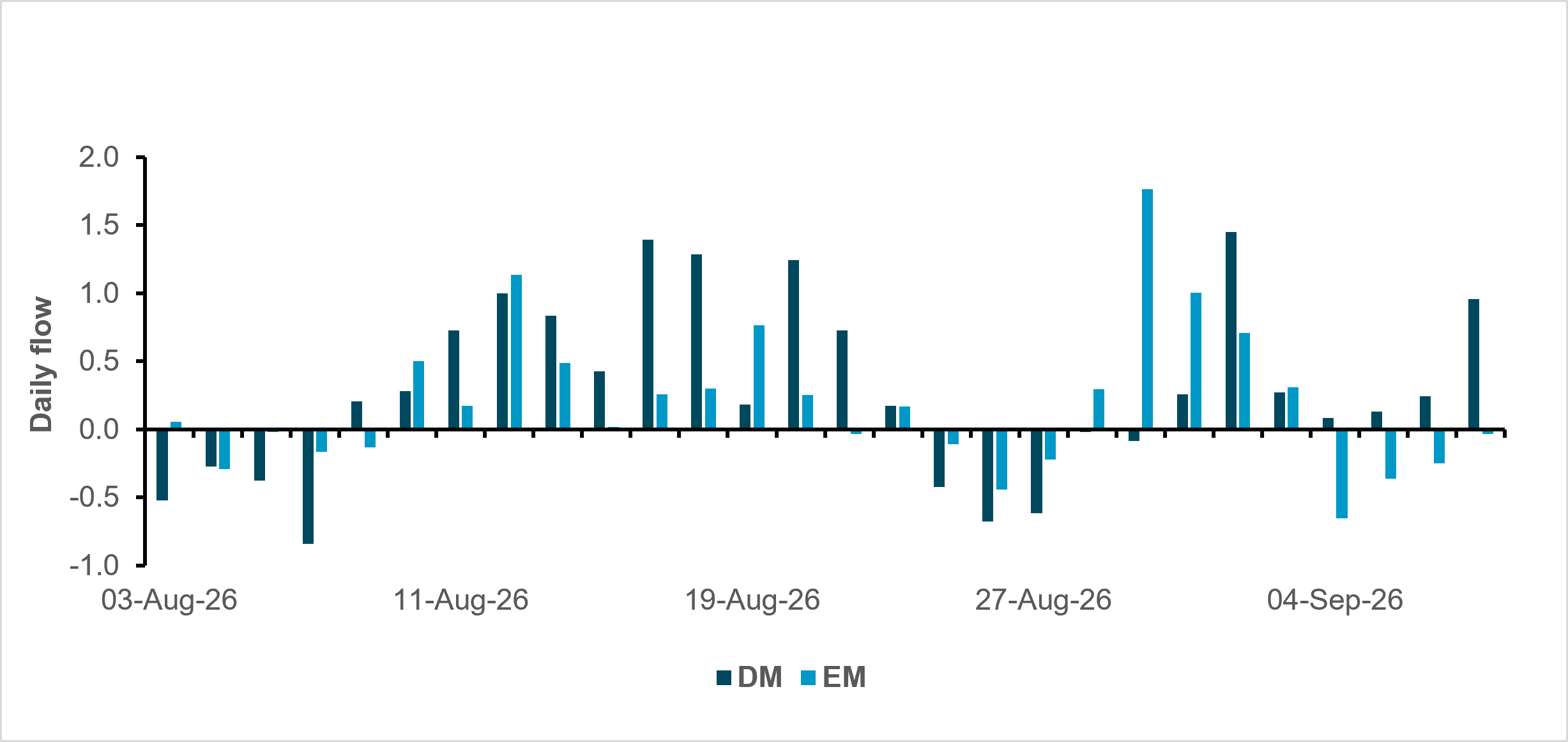
Energy flows continue developed market equities surge
Source: BNY
iFlow shows that global investors are continuing to react to developments in energy markets. Developed market energy stocks have been net-bought for seven consecutive sessions, with signs that surge flows are returning. Initially, we viewed this as tactical interest designed to hedge against short-term supply risks. After all, policy tightening around the world is intended to restrain growth, and energy demand should adjust accordingly, as suggested by the IEA report overnight. However, there are now early signs in our flows that markets are preparing for a more prolonged disruption, as growth weakness is not emerging quickly enough to offset near-term price and supply risks.
Flows into emerging market energy names tracked their developed market counterparts closely until early September. More recently, there have also been signs of a shift in flow direction, although differences in flow and holdings conviction between the two segments are likely to persist. For example, Chinese energy producers have less access to domestically controlled oil and gas reserves than their U.S. counterparts, leaving earnings more exposed to higher input costs, external supply disruptions and sanctions. On a holdings basis, DM energy is also ahead of EM, but the gap remains narrow at around 3 percentage points of their respective rolling one-year averages. Holdings are not stretched in either region, leaving meaningful room for further accumulation if energy supply risks persist.
Oil markets remain nervy. The Houthis’ rapid advance across strategic areas near the Bab al-Mandeb Strait has raised the prospect of further price pressure. Any disruption to Red Sea transit would affect supply chains far beyond energy. Brent approached $110/barrel before easing on reports of impending talks between Gulf Cooperation Council states and Iran. Developments this week only sharpen the focus on de-escalation, but regional players increasingly appear prepared to take matters into their own hands.
Data relevance warrants scrutiny. The assumption is that today’s U.S. CPI release will anchor expectations ahead of the upcoming FOMC decision, but energy prices increasingly point to a different regime. Diesel prices in the U.S. have exceeded $6 per gallon for the first time, and the FOMC will be acutely aware of the broader inflation risks given diesel’s importance across domestic and international supply chains, even if the direct impact is less visible to consumers at the pump. Much like for the ECB, limiting pass-through is now the policy imperative.
The ECB Governing Council is out in force. The ECB hiked rates as expected, but communication from multiple Governing Council members overnight suggests markets should expect more tightening by default, even if that is not the preferred policy path. Bundesbank President Joachim Nagel singled out energy as the determining factor for further hikes. We reinforce our view that monetary policy cannot resolve supply shocks. However, the burden of inflation targeting is increasingly falling on central banks, and markets should be prepared for the unintended, but entirely foreseeable, growth consequences.
Today, America, its friends and its allies come together to remember September 11, 2001. Beyond markets and policy, there are moments that simply call for reflection. Twenty-five years on, we remember the loved ones lost, the heroes who answered the call, and the families and communities whose lives were changed forever.
U.S. retail diesel prices surged to a record $6.05/gallon on Friday, while regular gasoline averaged $4.29, intensifying concerns over a broader inflation shock. The rise reflects supply disruptions linked to the Russia and Iran conflicts and is particularly significant because diesel feeds into costs across farming, food production, freight and shipping. Observers have warned that the pass-through could persist for months, pushing up prices far beyond the energy sector. Agricultural producers are also facing a simultaneous squeeze from higher diesel and fertilizer costs, threatening margins and, in some cases, farm viability. The broader implication is that consumers should expect sustained price pressure as elevated transport and production costs work through supply chains. Brent -2.258% to 105.2, WTI -2.167% to 100.26, Omani crude -2.28% to 119.19, Dubai crude +6.082% to 116.42.
The IEA has reported that global oil markets tightened sharply in August. World oil demand is now forecast to decline by 2.5 mb/d in 2026, 940 kb/d deeper than last month’s outlook, as stalled U.S.-Iranian negotiations push a normalization of flows back to next year. Weakness is expected to be led by middle distillates and petrochemical feedstock, especially in Asia. Demand should rebound by 2.6 mb/d in 2027. On the supply side, global oil production fell 1.6 mb/d m/m to 100.1 mb/d in August, with more than 10 mb/d of Gulf output still shut in. Total supply is projected to drop by 5.7 mb/d this year before recovering in 2027. Refinery throughput rose 960 kb/d m/m to 81.4 mb/d in August, while observed inventories fell by 95 mb, extending the drawdown streak.
Iranian-backed Houthi rebels have seized the Yemeni port city of Mokha. The move is strategically important because Mokha sits near the Bab el-Mandeb Strait, a key route for global trade and energy flows, raising the risk of renewed threats to Red Sea shipping. The takeover follows recent Houthi advances in Taiz and comes amid warnings from the UN that Yemen may be entering a more dangerous phase. Residents have reported shuttered markets, road closures and civilians fleeing south toward Aden. The Yemeni government and Saudi-backed forces say they are responding with airstrikes and have urged restraint, while the UN, Saudi Arabia and the U.S. have called for stronger action to curb Houthi escalation and arms supplies. Brent crude came close to touching $110/barrel on the news.
U.S. Treasury Secretary Scott Bessent has said that the Trump administration will sanction a large, unnamed bank on Monday as part of its campaign to intensify economic pressure on Iran. He said the action was originally due on Friday but was delayed because of September 11 anniversary events. Bessent gave no details of the institution or its country but stressed that the administration will keep targeting entities that do business with Tehran until they stop. The move follows a broader sanctions push since the conflict began in February, including measures against oil exports, shipping networks, weapons procurement, financial intermediaries, digital asset exchanges and aviation links. Last month, Washington also widened secondary sanctions and targeted nearly 60 entities, individuals and vessels under “Operation Economic Outcast.” S&P Mini +0.56% to 7641, DXY +0.044% to 99.091, 10y UST -2.3bp to 4.94%.
Japanese Finance Minister Satsuki Katayama has said Scott Bessent’s “I am the house” remark sounded “a bit scary” in Japanese, but stressed that Japan’s currency policy has not changed since the countries’ joint intervention in late July. She said Tokyo will continue to work to maintain orderly currency markets and stay in close communication with the U.S. Treasury. Katayama largely avoided directly criticizing Bessent, who said he had superior information on the BoJ’s next policy steps and broader Japanese policymaking. Bessent later clarified he was not challenging traders, but trying to provide markets with better framing so they do not panic. Katayama said she interpreted his comments as a straightforward hedge fund-style expression of market views. Nikkei -1.93% to 64011, USDJPY -0.091% to 154.22, 10y JGB +6.4bp to 2.986%.
The central bank of Peru has kept its reference rate unchanged at 4.25%. The board said the decision reflected July inflation readings, with headline inflation at 0.29% m/m and 4.1% y/y, while core inflation rose to 4.6% y/y. It noted that one-year-ahead inflation expectations had increased to 3.0%, the top of the target range, even as underlying inflation excluding transport remained below 2%. The bank said activity indicators remain solid and global risks have eased somewhat, but it highlighted lingering geopolitical and weather-related uncertainties. MSCI NUAM Peru General -2.19% to 59373, USDPEN -0.504% to 3.3735, 10y PGB +9bp to 6.47%.
U.S. real average weekly earnings are due out; the prior reading was 0.2% y/y. The prior reading for real average hourly earnings was -0.1% y/y.
U.S. August CPI is forecast at 0.4% m/m, 3.4% y/y vs. 0.1% m/m, 3.4% y/y in July. Core CPI is forecast at 0.2% m/m, 2.4% y/y vs. 0.2% m/m, 2.5% y/y in July.
U.S. September preliminary University of Michigan sentiment is forecast to ease to 51.0 vs. 51.7. Preliminary University of Michigan 1-year inflation expectations are forecast to rise to 4.2% vs. 4.0%. 5-10-year inflation expectations are forecast to hold at 3.3% vs. 3.3%.
U.S. August federal budget balance is forecast to narrow to -$220.0bn vs. -$344.8bn.
Central bank speakers: The ECB’s Christine Lagarde speaks in Paris; the ECB’s Philip Lane speaks in Wexford, Ireland.
Mood: iFlow Mood returned to neutral as accelerated unwinding of core sovereign bonds outweighed a modest reduction in global equity risk.
FX: Flows were mixed and moderate. KRW, USD and JPY attracted strong inflows, while GBP, MXN and SGD saw substantial outflows.
FI: Danish, Eurozone and Hungarian government bonds, alongside U.K. gilts, drew strong demand. Selling was concentrated in South African government bonds.
Equities: G10 equities led the selling, particularly Europe and Canada, while China and Singapore also saw sizable outflows. Mexican equities attracted the strongest buying.
“Grief is the price we pay for love.” – Queen Elizabeth II
“Look for the helpers. You will always find people who are helping.” – Fred Rogers
U.K. trade figures for July showed goods exports rising 2.8% m/m to £33.9bn and goods imports increasing 2.4% to £55.3bn, leaving a £21.4bn goods deficit. Export growth was led by a 5.2% rise to the EU, while non-EU exports increased by 0.6%. Imports from non-EU countries jumped 6.7%, driven largely by machinery and transport equipment, while EU imports fell 1.4%. In inflation-adjusted terms, goods exports rose by 3.5% and imports by 2.1%. Over the three months to July, the total goods and services trade deficit narrowed by £1.1bn to £9.0bn, as exports increased faster than imports and the services surplus widened to £52.6bn. FTSE 100 +0.14% to 10624, GBPUSD -0.03% to 1.3508, 10y gilt -4bp to 5.334%.
The Office for National Statistics has reported that U.K. economic growth strengthened in July, with monthly GDP rising 0.4% after 0.3% in June and zero growth in May. Services drove the expansion, rising 0.4%, while production increased by 0.2% and construction by 0.1%. The ONS highlighted particularly strong growth in administrative and support services and information and communication, including a 3.5% increase in computer programming and consultancy, with several large respondents linked to AI and cloud computing. Over the three months to July, GDP increased by 0.4%, led by a 0.6% rise in services, while production and construction both fell 0.5%. GDP was 1.6% higher than a year earlier.
Türkiye’s current account recorded a $36mn surplus in July, while the current account excluding gold and energy posted a $4.97bn surplus. The goods balance remained in deficit at $5.58bn, offset by a $8.23bn services surplus, including $5.97bn from travel and $2.89bn from transport. On a 12-month basis, the current account deficit stood at $40.7bn, with a $77.2bn goods deficit partly offset by a $63.5bn surplus in services. Financial flows were supportive in July, with $5.84bn of net portfolio inflows and $514mn of direct investment inflows. Official reserves increased by $14.25bn during the month. BI 100 -0.06% to 14386, USDTRY +0.102% to 48.6052, 10y TGB +16bp to 34.4%.
New Zealand’s manufacturing PMI fell to 53.1 points in August from 54.3 in July but remained above the 50-point expansion threshold for a 13th straight month, signaling continued growth in the sector. BusinessNZ said activity is expanding at a slower pace, with employment the weakest component at 50.0 after easing from 52.2, while new orders and finished stocks remained firmly in expansion at 54.9 and 56.4, respectively. Production and deliveries also softened but remained positive at 54.2 and 52.6, respectively. Respondents cited cost-of-living pressures and the Middle East conflict as headwinds, though steady order books pointed to underlying demand. BNZ noted that the three-month moving average is still rising, suggesting the sector remains resilient despite monthly volatility. NZX 50 -0.95% to 13580, NZDUSD -0.103% to 0.583, 10y NZGB +15.9bp to 5.033%.
Japan’s Business Outlook Survey for July-September showed an improvement in business sentiment and domestic conditions for larger firms. The business conditions index rose to 5.3 points from -0.5 in April-June, and domestic economic conditions improved to 2.9 from -4.5. Manufacturing and non-manufacturing both turned positive for firms with capital of ¥1bn or over. Employment remained tight, although the shortage index eased modestly for large firms, to 26.7 points from 25.7. Forward-looking sentiment remained constructive for large corporations. For FY 2026, firms expect sales growth of 4.1%, ordinary profit growth of 2.3% and software plus plant and equipment investment growth of 11.0%. Smaller firms remained weaker, but improvement was recorded in the ¥100mn to ¥1bn category. Overall, the survey points to firmer corporate confidence, resilient investment plans and persistent labor shortages. Nikkei -1.93% to 64011, USDJPY -0.091% to 154.22, 10y JGB +6.4bp to 2.986%.
Japan’s Corporate Goods Price Index for August fell 0.2% m/m but rose 7.6% y/y, indicating continued strong producer price inflation despite a modest monthly decline. The m/m fall was driven by lower prices for electricity, gas and water, agriculture and fishery products, and petroleum and coal products, while prices of nonferrous metals and food increased. Export prices in contract currency terms rose 0.6% m/m and 11.1% y/y, supported by metals and electronic products. Import prices fell 1.0% m/m but were still up 16.7% y/y, with petroleum, coal and natural gas providing the largest monthly drag. Producer price pressures therefore remain elevated despite some easing in energy-related costs.
South Korea’s exports surged in the first ten days of September, jumping nearly 83% y/y to $35bn. This is the highest figure for the period on record, driven by strong semiconductor shipments amid the AI boom. Imports rose 20.7% y/y to $24.6bn, leaving a trade surplus of $10.4bn. Semiconductors were the key driver, soaring 270% to $16.5bn. Other export gains came from petroleum products (+57% to $1.87bn), automobiles (+10% to $1.7bn), ships (+66.8%) and steel products (+10.3%). By destination, exports to China doubled to $7.95bn and shipments to the U.S. climbed 137.5% to $7bn. Total exports for the period from January 1 to Thursday reached $728.5bn, up 54.1% y/y, with a trade surplus of $212.9bn. KOSPI -1.76% to 6910, USDKRW +0.171% to 1345.2, 10y KTB +5.5bp to 4.455%.
South Korea’s fiscal balance improved in January-July, with the managed fiscal balance posting a ₩64.8tn deficit (vs. ₩87.0tn a year earlier). The improvement reflected strong tax revenue growth, supported by higher incomes and more home transactions. Tax revenue rose to ₩274.0tn (up ₩41.4tn y/y), led by gains in corporate tax from stronger company earnings, income tax from bonuses and housing activity, and securities transaction tax amid heavier trading. Non-tax revenue and fund revenue also increased. Total government spending reached ₩476.2tn (up ₩33.7tn y/y). Central government debt stood at ₩1.354qn at end-July, up ₩15.7tn m/m.
China’s 15th Five-Year Plan for smart connected new energy vehicles sets a roadmap to 2030, positioning the industry as a pillar of modern manufacturing and a strategic growth engine. It aims to cement China’s global auto competitiveness, with new-energy vehicles accounting for 70% of passenger car sales and 40% of commercial vehicle sales, while autonomous driving moves toward scaled deployment. The plan prioritizes breakthroughs in core technologies, including batteries, smart chassis, connected driving, software, chips and advanced materials, alongside stronger industrial chain resilience and security. It also pushes whole-chain digitalization, deeper AI integration across R&D, production and services, and greener development. The document stresses innovation, supply chain upgrades, standards leadership and international cooperation, while targeting higher productivity, improved safety and carbon peaking before 2030. CSI 300 -0.84% to 4510, USDCNY +0.036% to 6.7098, 10y CGB +0.6bp to 1.686%.