Market Movers: Hesitation
Market Movers highlights key activities and developments before the U.S. market opens each morning.
Market Movers highlights key activities and developments before the U.S. market opens each morning.

Geoffrey Yu
Time to Read: 7 minutes
JPY buying at six-week high
Source: BNY
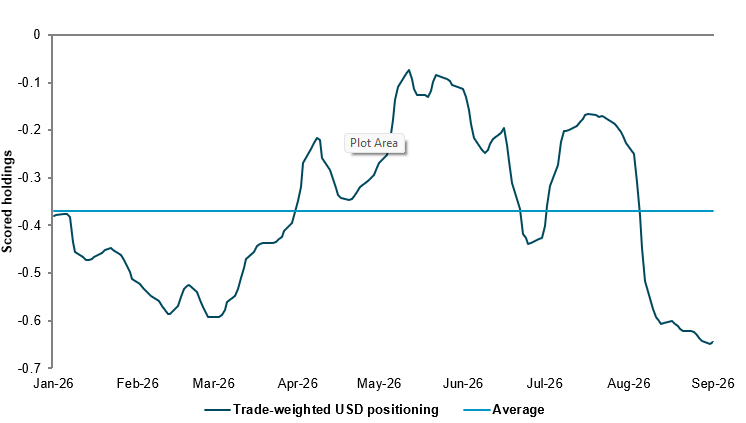
Our data show that JPY flows on Tuesday were the strongest since mid-July, supporting our view that JPY selling has largely run its course after heavy post-intervention sales in July. Investors initially used yen strength to rebuild carry trades or hedge Japanese exposures, and neither the dovish FOMC reaction in July nor the Treasury buyback announcement materially changed that pattern. While investors are not yet building outright JPY longs on a significant scale, 160 increasingly looks like a practical intervention ceiling, making markets more reluctant to add fresh shorts and raising the risk of renewed pre-intervention buying.
We remain skeptical that Japanese authorities can generate sustained JPY appreciation through intervention alone. The government’s policy mix remains reflationary, whereas today’s backdrop is very different from the early Abenomics period: inflation is already materially higher and structural reform is less prominent. However, that does not mean the yen must weaken further. Repeating the tolerance of substantial depreciation that characterized the early Abenomics era would likely face much greater domestic, U.S. and international resistance. The more likely outcome is therefore asymmetric: unilateral or multilateral intervention and political constraints can cap USDJPY around 160, even if the underlying macro backdrop is not yet strong enough to drive JPY materially higher.
JPY is back in focus. USDJPY has continued to decline, as markets remain hesitant to test the Japanese and U.S. authorities’ resolve to defend the yen. Deterrence has been established for now. BoJ data also indicate that no major intervention took place on Wednesday, pointing instead to genuine market concerns. Ministry of Finance currency chief Atsushi Mimura simply said Japan is “ready to continue the battle on FX.”
Bonds attempt to recover. Yields have fallen globally as investors increasingly see value in some sympathy, but volatility will remain elevated. Central banks have now demonstrated a clear willingness to tighten in the face of global and domestic supply shocks, while curve steepening is beginning to impose greater fiscal discipline on governments. Breakevens remain well-anchored, leaving real yields increasingly attractive for long-term fixed-income investors.
Peace remains elusive. Central bankers and economic officials continue to hope for geopolitical relief. Russia’s President Putin has said there is “a chance of constructive peace talks,” while hopes of further de-escalation in the Persian Gulf remain alive. Progress is difficult, but the payoff remains asymmetric: much of the impact from conflict-related supply shocks is already priced in, while a substantive move toward peace could lead to significant re-rating.
Jobless claims and ISM are out today, the final core releases ahead of tomorrow’s labor market report. Overnight, the Challenger survey largely affirmed the “no-fire, no-hire” status quo. The ISM employment index is expected to edge up to 48.3 points, although the prices paid component will likely reinforce lingering inflation concerns.
U.S. announced job cuts in January-August totaled 529,914. This represents the lowest YTD level since 2022 and a four-year low, reinforcing signs of a low-hire, low-fire labor market. Hiring plans over the same period were the strongest since 2023, although available positions appear to be filling only slowly. The data suggest employers remain reluctant to reduce headcount aggressively even as hiring momentum remains subdued. In August, restructuring replaced AI as the leading reason cited for announced layoffs for the first time since February, although it remains the largest driver YTD. The figures are consistent with broader evidence of limited layoff activity ahead of the August payroll report, with unemployment expected to remain close to 4.1%. S&P Mini +0.1% to 7685, DXY -0.409% to 99.189, 10y UST +0.1bp to 4.778%.
Amid a sharp downward move in USDJPY, reports suggest the BoJ is leaning toward a 25bp rate hike to 1.25% at its September 18 meeting, while keeping the option of faster tightening open if inflation risks intensify. Officials still see upside pressure from services inflation, yen weakness and higher import costs, but do not currently view conditions as warranting a 50bp move. The yen weakened slightly after the report, as some traders had positioned for a larger hike following recent hawkish comments. A September increase would come only three months after the June hike, the shortest interval under Governor Kazuo Ueda. Beyond this meeting, the BoJ appears willing to adjust the pace of tightening more flexibly, with policy increasingly shaped by persistent inflation and currency risks. Nikkei -0.17% to 64214, USDJPY -1.198% to 156.81, 10y JGB -7bp to 2.957%.
German Chancellor Friedrich Merz will meet ECB officials next week ahead of the bank’s rate decision, with markets expecting a 25bp hike to 2.50%. The meeting gives Merz an opportunity to discuss Germany’s improving economic outlook, but it also comes amid growing speculation over the ECB’s leadership succession. President Christine Lagarde may not complete her term, due to run until October 2027, while Berlin is weighing whether to back Bundesbank President Joachim Nagel as a potential successor. Germany has never held the ECB presidency, although securing the role could prove difficult given that German officials already occupy several senior European posts. The gathering therefore combines near-term monetary policy with increasingly important questions over the future leadership of the ECB. Meanwhile, Handelsblatt has also reported that Isabel Schnabel could also leave the ECB ahead of schedule. Euro Stoxx 50 +0.16% to 6372, EURUSD +0.164% to 1.1607, BBG AGG Euro Government High Grade EUR +3bp to 3.598%.
Russian President Vladimir Putin has said there is a chance of reaching a peace agreement to end the war in Ukraine, while stressing that any settlement will ultimately have to be resolved directly between Moscow and Kyiv. He said several countries, including the U.S. and China, are prepared to support negotiations and welcomed external efforts to facilitate a deal. The comments represent a relatively constructive signal on diplomacy, although Putin provided no detail on possible terms, sequencing or concessions. At the same time, he maintained a confrontational tone on security issues, repeating accusations that Ukrainian warnings over risks to aircraft in Russian airspace amount to state terrorism. The message therefore mixes openness to talks with continued hardline rhetoric. PFTS 0% to 480, USDUAH +0.288% to 44.7785,10y UGB -21.9bp to 12.391%.
PBoC Governor Pan Gongsheng has said China has no need or intention to use yuan depreciation to gain trade advantages, stressing that the exchange rate should be determined by the market under a managed floating regime. He said China’s export structure has evolved, improving firms’ ability to manage FX risk and making trade less sensitive to currency swings. Pan also reiterated that China is not pursuing a trade surplus and will keep expanding domestic demand and opening its market. Speaking at the G20 meetings in Asheville, he warned that trade frictions and protectionism are hurting the global economy by disrupting supply chains, stoking inflation and unsettling market expectations. He said fixing global imbalances requires structural reforms, with deficit countries cutting fiscal deficits and boosting savings, while surplus countries should lift consumption and investment. CSI 300 +0.1% to 4553, USDCNY -0.014% to 6.7183, 10y CGB -1.2bp to 1.68%.
Bank Negara Malaysia has kept its overnight policy rate unchanged at 2.75%, judging the current stance to be consistent with continued price stability and sustainable growth. It said Malaysia’s economy expanded by 5.7% in H1 and is on track to grow around 5% this year, supported by stronger exports, resilient domestic demand, technology-related trade, tourism and investment. Headline and core inflation averaged 1.8% and 2.0%, respectively, in the first seven months, with limited pass-through from higher external costs. However, the MPC warned that Middle East tensions, elevated commodity prices and tighter global financial conditions remain key risks. Policy therefore remains on hold, with officials closely monitoring inflation pressures and domestic demand. KLCI +0.37% to 1715, USDMYR -0.033% to 4.0452, 10y MGB -0.4bp to 3.931%.
U.S. July trade balance is forecast to narrow to -$90.3bn vs. -$73.3bn. Imports are forecast at 1.2% vs. -1.8% m/m. Exports are forecast at -0.3% vs. -0.9% m/m.
U.S. Q2 final nonfarm productivity is forecast to be unchanged at 1.4% q/q. Q2 final unit labor costs are forecast at 1.3% vs. an estimate of 1.3% q/q.
U.S. initial jobless claims are forecast at 205k vs. 203k.
U.S. August final S&P Global Services PMI is forecast at 56.8 vs. 56.8. August final S&P Global Composite PMI is forecast at 56.0 vs. 56.0.
U.S. August ISM Services Index is forecast to be unchanged at 54.1 vs. 54.1. Prices paid are forecast to ease to 70.0 vs. 70.3. New orders are forecast at 57 vs. 57.2. Employment is forecast to rise to 49.0 vs. 47.4.
Canada Q2 labor productivity is due out; the prior reading was -0.5% q/q.
Canada July international merchandise trade is forecast at CA$3.18bn vs. CA$3.86bn.
Canada August S&P Global Services PMI is due out; the prior reading was 49.1. For composite PMI, the prior reading was 49.7.
Central bank speakers: The Fed’s Christopher Waller participates in a moderated conversation.
Mood: iFlow Mood held in negative territory at -0.107. Demand for core sovereign bonds remained firm, while global equity buying leveled off.
FX: G10 and EMEA currencies attracted broad demand, while LatAm and APAC saw selling. NOK posted the strongest inflows, while HKD, PLN and BRL led outflows. EUR and GBP were lightly sold, against marginal USD and JPY buying.
FI: Strong demand for U.K. gilts, Eurozone and Canadian government bonds and U.S. Treasurys contrasted with heavy selling in Colombia, Denmark and Hungary. Selling pressure on Chinese government bonds eased.
Equities: G10 and APAC equities were broadly sold, led by Indonesia, China, Canada and Europe. LatAm attracted broad-based buying, with Peru recording the strongest inflows.
“Inaction breeds doubt and fear. Action breeds confidence and courage.” – Dale Carnegie
“Our doubts are traitors, and make us lose the good we oft might win, by fearing to attempt.” – William Shakespeare
Euro area composite PMI for August held at 52.0 points, unchanged from July’s eight-month high and signaling another solid month of private sector growth. The services PMI eased slightly to 51.6 from 51.7, while manufacturing momentum strengthened, helping keep overall activity firm. New orders rose at the joint-fastest pace since November, with export orders increasing across the private sector for the first time in four and a half years. Employment also returned to growth for the first time in 2026. By country, Spain and Italy recorded the strongest expansions and Germany improved, while France remained in contraction. Price pressures were broadly stable and still elevated vs. pre-Iran war levels, while business confidence held steady. Euro Stoxx 50 +0.16% to 6372, EURUSD +0.164% to 1.1607, BBG AGG Euro Government High Grade EUR +3bp to 3.598%.
Germany’s services PMI for August edged down to 49.7 points from 49.8 in July, remaining just below the 50-point threshold and signaling another marginal contraction in activity. Underlying demand improved, however, with new business rising for a second month and export orders increasing for the first time since February, at the strongest pace since May 2023. Employment also returned to growth for the first time in eight months, reaching its fastest pace since October. Input cost inflation accelerated to a three-month high, driven by fuel, wages and electronic components, while output price inflation eased slightly. The composite PMI rose to 51.8 from 51.3, supported by stronger manufacturing activity. DAX +0.33% to 25926, EURUSD +0.164% to 1.1607, 10y Bund -1.4bp to 3.362%.
U.K. services PMI rose to 52.5 points in August from 52.1 in July. This is a four-month high, signaling a moderate expansion in activity. New business increased for a second consecutive month as domestic spending and investment sentiment improved, while export sales fell for a sixth straight month. Employment declined again, but at the slowest pace since October 2025, as better order books and stronger optimism reduced the pace of job losses. Input cost inflation accelerated from July’s five-month low, driven by fuel, transport, wages, food and technology costs, while output price inflation also strengthened. The composite PMI rose to 52.5 from 52.2, its highest reading since April, with business expectations improving to a six-month high. FTSE 100 +0.1% to 10767, GBPUSD +0.082% to 1.3497, 10y gilt -3.9bp to 5.191%.
Switzerland recorded CPI inflation of 0.4% m/m and 0.8% y/y in August, with the m/m increase driven mainly by higher housing rents, petrol, diesel, heating oil and hospital services. Core inflation remained subdued at 0.4% y/y and 0.2% m/m, while imported product prices rose more sharply, up 1.4% m/m and 1.5% y/y, compared with domestic goods at 0.1% m/m and 0.6% y/y. Energy and fuel prices increased by 4.1% m/m and 9.2% y/y, including a 25.2% annual rise in petroleum products. Services inflation was 1.0% y/y. Harmonized inflation stood at 0.9% y/y and 0.1% m/m. SMI -0.01% to 14362, EURCHF -0.299% to 0.9392, 10y Swiss GB -0.3bp to 0.454%.
Türkiye’s CPI inflation rose 1.84% m/m and 31.51% y/y in August, while the 12-month average inflation rate stood at 31.79%. Annual inflation was led by housing and utilities at 39.77%, transport at 35.08% and food and non-alcoholic beverages at 33.79%, contributing 5.01 percentage points, 5.94 percentage points and 8.12 percentage points, respectively, to the headline rate. Monthly inflation was driven mainly by transport (+4.82%), housing and utilities (+2.26%) and food (+0.22%). Core inflation excluding unprocessed food, energy, alcohol, tobacco and gold rose 1.84% m/m and 30.68% y/y, while 134 out of 174 CPI subclasses recorded m/m price increases. BI 100 -0.56% to 13972, USDTRY +0.087% to 48.3151, 10y TGB -9bp to 34.26%.
New Zealand’s June-quarter international trade data showed two-way trade rising 16% y/y to NZ$64.9bn. Total exports of goods and services increased to NZ$32.5bn from NZ$28.5bn a year earlier, while imports rose to NZ$32.4bn from NZ$27.5bn. Services exports climbed NZ$1.1bn to NZ$8.2bn, led by travel services (NZ$3.9bn), transportation, other business services and telecoms. Services imports rose NZ$482mn to NZ$9.0bn, driven by other business services, telecoms and transportation. Merchandise terms of trade fell 9.0% q/q as export prices rose 3.5% but import prices jumped 14%. Export volumes rose 6.4% q/q and import volumes fell 2.1% q/q. Key export drivers were dairy and meat, while petroleum products were the main sources of import price pressure. NZX 50 -0.61% to 13846, NZDUSD +0.188% to 0.5863, 10y NZGB -0.1bp to 4.774%.
New Zealand’s ANZ World Commodity Price Index fell 0.4% m/m in August and was down 0.6% y/y, as weaker beef and butter prices outweighed gains in milk powders. Dairy prices rose 1.3% m/m, led by skim milk powder (+6.2%) and whole milk powder (+2.4%), while butter fell 3.0%. Meat and fiber prices decreased by 3.3% m/m, driven mainly by lower overseas beef prices, while horticulture slipped 0.6% and forestry rose 0.5%. Aluminum prices increased by 3.1% amid Middle East supply disruption. In NZD terms, the overall commodity index fell 2.3% m/m as the currency strengthened by 2.2% against USD, reducing local-currency export returns.
China’s services PMI rose to 51.4 points in August from 50.4 in July, signaling a faster but still modest expansion in activity. New business increased for a 44th consecutive month, supported mainly by stronger domestic demand, while export business also grew but at a slower pace. Employment rose for a fourth straight month, making the longest sequence of job creation since 2023, which helped to moderate backlog growth. Input cost inflation picked up slightly but remained modest, while output charges increased for a third consecutive month. Business confidence also improved. The broader composite output index rose to 52.1 from 50.8, with both manufacturing and services showing faster growth in output and new business. CSI 300 +0.1% to 4553, USDCNY -0.014% to 6.7183, 10y CGB -1.2bp to 1.68%.