Market Movers: Energy
Market Movers highlights key activities and developments before the U.S. market opens each morning.
Market Movers highlights key activities and developments before the U.S. market opens each morning.

Geoffrey Yu
Time to Read: 5 minutes
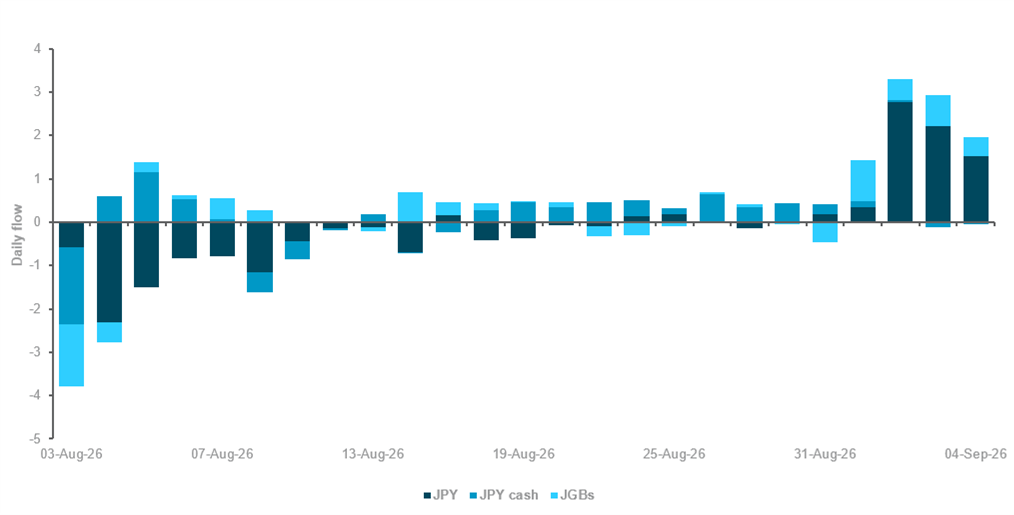
Material additions to liquid exposures in Japan
Source: BNY
JPY strength is drawing investors back into Japanese assets. The currency has continued to appreciate on firm Japanese data and expectations of further tightening in the run-up to the BoJ decision. Even without confirmed intervention, investors appear unwilling to take chances against further JPY strength and have adjusted their views on performance momentum accordingly. Our data show a clear preference for adding exposure to liquid Japanese instruments during this phase. This marks a significant departure from the selling immediately after the confirmed round of intervention in July, when cross-border investors were more inclined to use improved JPY levels as an opportunity to liquidate positions. The change suggests investors are increasingly treating JPY strength as potentially sustainable rather than simply intervention-driven.
JPY purchases are leading a broader recovery in Japanese flows. The past week has generated the strongest JPY buying in recent months, while cross-border interest in JGBs has also picked up materially. This supports the view that value is emerging at current levels, particularly if the BoJ provides “follow-through” via further rate hikes. Meanwhile, purchases of Japanese cash and short-term instruments (CAST) have remained highly consistent over the past month. As the asset class most sensitive to near-term interest rate expectations, these flows point to growing confidence in the BoJ’s tightening path. The combination of stronger JPY, JGB and CAST demand is therefore increasingly consistent with a broader re-rating of Japanese assets. However, aggregate Japanese exposures need to be monitored closely: if positioning strengthens simultaneously across all asset classes, favorable momentum could eventually give way to crowding risk.
Energy risk continues to dominate. The market is now fully braced for Brent crude to trade above $100/barrel on a sustained basis. The global supply implications are clear; the policy implications less so. Central banks appear reluctant to tighten further in response to a supply shock, and outside the U.S., rate expectations are increasingly looking exhausted. Recent developments instead point to a growing political imperative to respond, with cost of living pressures still front of mind for electorates.
JPY continues its ascent. The currency briefly touched a six-month high during Asian trading, further consolidating last week’s gains. The lack of clarity around Japanese policy initiatives is now deterring JPY selling. This marks a shift in the market’s approach, as the previous status quo had largely been interpreted as benign neglect of the currency. The risk now is that positioning across different Japanese asset classes is becoming crowded, while excessive JPY strength could eventually cause the BoJ to step back from its tightening intent.
Canadian tariffs kick in. The U.S. returns from its long weekend facing an additional trade measure, as Canadian duties on around $20bn of U.S. goods take effect today. The amounts remain small relative to the scale of bilateral trade, but the risk is that retaliation broadens into higher-value-added goods, with more meaningful implications for supply chains on both sides of the border.
Catch-up is expected today. The U.S. data calendar is light, leaving markets in a holding pattern ahead of Thursday’s ECB decision and Friday’s crucial CPI print. The U.S. equity catch-up session is likely to be cautious as higher energy prices and supply risks begin to weigh more visibly on risk appetite. Unlike during the spring oil price surge, a stronger policy response is now looking increasingly difficult to avoid, with the Fed likely to lead that adjustment.
Saudi Arabia has halted operations at several southern energy facilities after attacks triggered fires and caused injuries, escalating risks to regional oil supply. The strikes follow repeated Houthi attacks on Saudi energy infrastructure, including the 400,000 barrel/day Jazan refinery, which had already been offline since July. The disruption comes as shipments through the Strait of Hormuz remain constrained by the U.S.-Iranian conflict, increasing the risk of simultaneous supply losses across key Middle East export routes. Oil prices are consequently moving back toward U$100/barrel. The broader backdrop is also deteriorating, with Iran signaling a more aggressive military posture and the Houthis threatening to blockade Saudi oil flows, reinforcing upside risks to energy prices and global inflation. Brent +1.939% to 98.88, WTI +3.072% to 94.29, Omani crude +11.59% to 117.18, Dubai crude +1.465% to 100.162.
Iran’s oil export revenue is collapsing as a U.S. naval blockade since mid-July has cut off shipments from the Persian Gulf and left only dwindling offshore cargoes feeding China. Ship tracker Kpler says crude already on vessels outside the blockade has dropped to about 29 million barrels from around 90 million in mid-July and could be exhausted by mid-October, while payments may dry up by mid-December. No Iranian crude has crossed the blockade since it was reinstated. The squeeze is hitting Iran’s main source of foreign currency, worsening a crisis marked by inflation above 80% y/y, a plunging rial and an IMF forecast of a 5.4% economic contraction this year. Oil accounts for roughly a third of the state budget, and petrochemical exports are also sharply lower. U.S. Treasury Secretary Scott Bessent has highlighted the pressure campaign, while analysts warn Tehran may resist rather than concede.
Japan Health Minister Kenichiro Ueno, who oversees the GPIF, said the pension giant is still considering whether a review of its asset allocation is needed, despite deciding in March that no review was necessary. Ueno said the investment environment has not diverged much from the fund’s assumptions and that the matter is being examined appropriately. The comments follow GPIF’s unusually public committee meeting on August 21, which fueled speculation of a portfolio shift. With about ¥318tn in assets at end-June, even a 1 percentage point allocation change could imply more than ¥3tn in flows. The fund currently targets 25% each in domestic bonds, overseas debt, Japanese shares and foreign equities, while some analysts see scope to raise domestic bond weightings. Nikkei -1.7% to 65269, USDJPY +0.344% to 154.12, 10y JGB -2.8bp to 2.9%.
In Brazil, a new Quaest poll shows Flávio Bolsonaro and President Luiz Inácio Lula da Silva tied at 41% each in a hypothetical runoff, reversing Lula’s one-point lead a week earlier. Bolsonaro is using the Supreme Court turmoil, especially the backlash against Justice Alexandre de Moraes, to mobilize conservative voters and deflect scrutiny from his own ties to the Banco Master scandal. The dispute intensified after leaked messages suggested a closer relationship between Moraes and former Banco Master owner Daniel Vorcaro, and spread further as Justice André Mendonça and Moraes clashed publicly. Lula, meanwhile, faces fresh political headwinds from setbacks in Congress and signs that the economy is cooling amid high interest rates. The first round of voting is on October 4, with a likely runoff three weeks later. IBOVESPA -0.02% to 185147, USDBRL -0.4% to 5.1292, 10y BGB -6.6bp to 14.323%.
U.S. August NFIB Small Business Optimism is forecast to ease to 99.3 vs. 99.8.
U.S. August NY Fed one-year inflation expectations are forecast to ease to 3.60% vs. 3.63%.
U.S. Treasury sells $92bn in 13-week bills, $79bn in 26-week bills, $75bn in 6-week bills and $58bn in 3y notes.
Mood: iFlow Mood narrowed further as core sovereign bond demand weakened, while global equity buying remained steady.
FX: Strong inflows into USD, NOK and JPY, followed by CNY, against outflows from GBP, MXN, EUR and CHF.
FI: Flows moderated, with buying in Canadian, Eurozone and Japanese government bonds, U.K. gilts and U.S. Treasurys. Elsewhere, flows were light and mixed.
Equities: China, Türkiye, Indonesia and Europe saw large outflows, while LatAm equities were broadly bought alongside Taiwan and Thailand.
“The oil age will come to an end not because we have a lack of oil.” – Sheikh Ahmed Zaki Yamani, former Saudi oil minister
“Safety and certainty in oil lie in variety and variety alone.” – Winston Churchill
Germany’s goods exports fell 0.8% m/m to €138.2bn in July (seasonally and calendar-adjusted), while imports dropped 5.7% to €116.9bn, widening the trade surplus to €21.3bn from €15.4bn in June. Exports were still up 6.1% y/y, and imports 3.0% higher. EU-bound exports shrank by 1.6% m/m, including a 2.8% fall to the euro area, while exports to non-EU countries edged up 0.2%. U.S.-bound exports surged 19.1% m/m to €14.4bn and were 28.3% higher y/y. By contrast, exports to China fell 9.5% m/m to €5.6bn, while imports from China were 7.5% lower. DAX -0.66% to 25835, EURUSD -0.104% to 1.1611, 10y Bund +0.2bp to 3.388%.
U.K. retail sales growth slowed in August, reported the British Retail Consortium. Total retail sales rose 0.7% y/y, down from 1.3% in July, while like-for-like sales were up 0.5% y/y, easing from 1.0% previously. The BRC said that the earlier weather-driven lift faded as summer spending pulled forward purchases into May, and most non-food categories lost momentum. Food sales still grew by 2.6% y/y, but this was slower than July’s 3.8%. Non-food sales fell 0.8% y/y after a 0.7% decline in July. The BRC noted weaker demand for big-ticket items such as furniture and household appliances, with shoppers favoring cheaper health and beauty products. FTSE 100 -0.23% to 10797, GBPUSD -0.119% to 1.3525, 10y gilt +1.3bp to 5.189%.
Hungarian CPI inflation was 1.3% y/y and 0.2% m/m in August, while core inflation came in at 2.0% y/y. Services remained the main source of price pressure, increasing by 5.0% y/y and 0.8% m/m, while alcoholic beverages and tobacco rose 3.2% y/y. Food prices fell 1.4% y/y and 0.2% m/m, with particularly large y/y decreases in meat, fruit, butter, cheese and milk. Household energy prices were 4.3% lower y/y, driven by a 10.9% fall in gas prices, while motor fuels increased by 1.3%. Harmonized inflation was slightly firmer at 1.8% y/y, indicating that domestic inflation pressures remain concentrated in services rather than goods. Budapest SI +0.18% to 147811, EURHUF +0.405% to 364.87, 10y HGB -5bp to 5.43%.
China’s August trade data show exports rose 25% y/y (23.9% y/y in July), matching forecasts and underscoring strong external demand, especially for high-tech and AI-related goods, alongside EVs, solar cells and lithium-ion batteries. Imports also accelerated to 28.2% y/y (27.5% y/y in July), suggesting some improvement in domestic activity, though the broader economy remains weak. The trade surplus widened to $119.09bn from $112.5bn the prior month, with the surplus with the U.S. also increasing. Reuters notes that the data highlight China’s continued reliance on foreign demand as domestic consumption, investment and property activity remain subdued. The strength in exports may reduce pressure for an imminent rate cut, while policymakers continue to favor targeted fiscal support and efforts to stabilize external demand. CSI 300 -0.36% to 4559, USDCNY +0.002% to 6.711, 10y CGB +0.3bp to 1.683%.
Japan’s preliminary Monthly Labor Survey results for July showed nominal wages rising solidly. For all workers at establishments with five or more employees, cash earnings rose 4.7% y/y to ¥436,401. Scheduled earnings increased by 4.1% y/y to ¥280,797, while special payments climbed 6.3% y/y to ¥134,819. For full-time workers, cash earnings rose 4.7% y/y to ¥578,123, and scheduled earnings increased by 3.9% y/y. Part-time workers also saw gains, with cash earnings up 4.7% y/y and hourly scheduled pay rising 5.7% y/y to ¥1,460. Real wages improved as well, with cash earnings up 2.4% y/y in CPI ex imputed rent terms and 2.6% y/y in CPI all items terms. Nikkei -1.7% to 65269, USDJPY +0.344% to 154.12, 10y JGB -2.8bp to 2.9%.
Japan’s final real GDP rose 0.4% q/q in Q2 (1.3% seasonally adjusted annual rate, saar) . This was slightly firmer than the preliminary pace but below the consensus. On a y/y basis, real GDP increased by 1.4% and nominal GDP by 5.5%. Domestic demand was a drag at -0.1 percentage points, as weaker residential and non-residential investment offset modest gains in private consumption and government spending. Private consumption was flat q/q, while household consumption edged down 0.1% q/q. Public demand also fell 0.8% q/q, despite government consumption rising 1.7% q/q. Net exports contributed 0.5 percentage points, supported by exports rising 0.4% q/q and imports falling 1.7% q/q. The GDP deflator was 2.6% y/y, indicating ongoing price pressure. Overall, growth remained positive but was driven more by external demand than by domestic momentum.
Japan’s preliminary balance of payments data for July showed the current account surplus widening to ¥2.989tn (+¥402.6bn y/y), as the services deficit narrowed and the primary income surplus expanded. Trade and services remained in deficit at ¥912.8bn, with the trade deficit widening to ¥399.9bn even as exports rose to ¥11.256tn (+24.1% y/y) and imports climbed to ¥11.656tn (+25.9% y/y). The services deficit improved to ¥512.9bn. Primary income posted a surplus of ¥4.290tn, while the secondary income deficit eased to ¥387.9bn. In the financial account, direct investment helped lift net inflows, while portfolio investment showed volatility.
Japan’s trade statistics for early August showed exports rising 18.0% y/y to ¥6.050tn, while imports increased by 26.1% y/y to ¥7.170tn. As a result, the trade balance remained in deficit at ¥1.120tn, widening sharply from the ¥558bn shortfall a year earlier. The release is a preliminary report for the first half of August and does not provide destination-level export detail. The faster pace of import growth versus exports suggests external demand improved but the trade gap widened because inbound purchases expanded faster.
New Zealand’s Business Financial Data for the June quarter showed broad-based improvement across market industries. On an annual basis, sales reached NZ$214bn, up NZ$17bn or 8.9% y/y, while purchases rose $14bn to $151bn, wages increased by NZ$1.2bn to NZ$33bn and operating profit climbed NZ$2.1bn to NZ$29bn. Seasonally adjusted sales rose q/q in 13 out of 14 industries, led by wholesale trade, electricity, gas, water and waste services, and manufacturing. Wholesale trade sales were up 6.4% q/q, with basic material wholesaling boosted by petroleum-related pricing. Manufacturing sales rose 3.1% q/q, while stocks of finished goods increased. Overall, the release points to solid growth in sales and profits, despite purchases growth outstripping sales. NZX 50 -1.08% to 13793, NZDUSD -0.68% to 0.5842, 10y NZGB -2.2bp to 4.761%.
Australia’s consumer confidence fell 5.2% m/m to 84.4 points in September, reversing August’s 6.0% rise. The Westpac and Melbourne Institute survey showed weakness across the board: current conditions dropped 6.8% m/m, expectations fell 4.1% and perceptions of family finances, the economy, and major household purchases all softened. Confidence about buying a dwelling also declined sharply. On a y/y basis, overall sentiment was down 11.6%, while current conditions and expectations fell 12.2% and 11.2%, respectively. The reading suggests Australian households remain cautious despite prior monthly gains, with both current and forward-looking assessments deteriorating in September. ASX -0.28% to 5813, AUDUSD -0.125% to 0.721, 10y ACGB -1bp to 5.188%.
Australia’s NAB Business Survey for August showed business conditions slipping 5 points to -1, moving into negative territory for the first time in six years and down to the weakest level since August 2020. Business confidence also fell 2 points to -8, now 12 points below January. The deterioration was broad-based: conditions were weaker across six out of eight industries, led by construction, mining and manufacturing, and across most states, with New South Wales and Tasmania the exceptions. Profitability dropped sharply, sliding 10 points to -9, as input cost growth continued to outpace product price growth, squeezing margins. Trading conditions eased to +4, employment edged down to +3, forward orders improved to 0 and capacity utilization slipped to 82.5%. The survey highlighted slowing activity, persistent cost pressure and softer demand as the main drags.
South Korea’s Q2 preliminary national accounts showed real GDP rising 0.6% q/q, matching the advance estimate. On the production side, manufacturing grew by 1.4% q/q, led by computer, electronic and optical products. Services rose 1.0% q/q, while construction fell 1.9% q/q. On the expenditure side, private consumption increased by 0.4% q/q, government consumption by 0.1% q/q, facilities investment by 0.2% q/q and intellectual property products investment by 3.4% q/q. Exports climbed 1.3% q/q, supported by semiconductors and machinery, while imports rose 0.7% q/q. Nominal GDP grew 9.2% q/q, and the GDP deflator rose 21.9% y/y. The gross saving and household saving ratios increased, while the domestic investment ratio declined. KOSPI -0.58% to 6955, USDKRW +0.183% to 1344.5, 10y KTB +4bp to 4.39%.
Taiwanese price data for August showed subdued consumer inflation but elevated producer and external price pressures. CPI was -0.01% m/m (after a flat prior month), as lower transportation fees (on cheaper air fares) and a drop in vegetable prices were partly offset by higher fruit and egg prices. On a y/y basis, CPI rose 2.04%, driven by higher fuel and lubricants, electricity, fish and seafood, household operations, food away from home and residential rents, while vegetables and vehicles fell. Core CPI slowed to -0.16% m/m and 2.30% y/y. PPI increased by 1.04% m/m and 16.75% y/y, led by petroleum and coal, computers, chemicals and electronics, while farm products fell. IPI and EPI also remained strong in USD terms. TAIEX -0.47% to 47106, USDTWD +0.054% to 31.535, 10y TGB +1.1bp to 1.88%.
Taiwan’s banking system is facing a tightening liquidity squeeze, with funds reportedly shifting into equities and pushing up borrowing costs for households and firms. Several banks are said to have halted new mortgage applications or limited lending to VIP and existing clients, while mortgage queues and funding delays have lengthened. Personal loan rates that had at one point fallen to around 2% are now commonly above 3%, with total borrowing costs near 4%. The strain is also spreading to small and medium-sized builders, who are finding land and construction financing harder to obtain from banks and increasingly turning to leasing-finance firms at rates as high as 6%. The central bank says it will use open market operations to manage liquidity, but market participants say money remains tight.