Market Movers: Attrition
Market Movers highlights key activities and developments before the U.S. market opens each morning.
Market Movers highlights key activities and developments before the U.S. market opens each morning.

Geoffrey Yu
Time to Read: 6 minutes
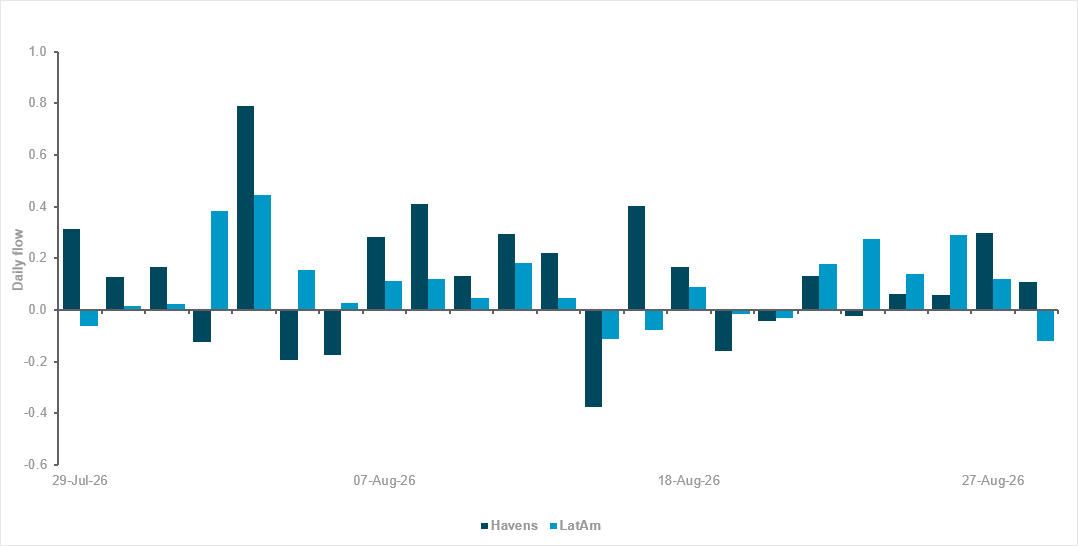
Quality and real rate interest supported havens and Latin American FX in August
Source: BNY
Aggregate iFlow FX data showed little conviction in August. USD reversed course after the July FOMC meeting, while regions facing uncertain prospects for real rates – whether driven by nominal rates or inflation – also underperformed. APAC and CEE were the weakest on aggregate, while EM and G10 recorded modest inflows. Latin America and safe havens performed best, suggesting markets were not broadly pursuing carry; otherwise, the two groups would have moved in opposite directions.
Safe haven flows were led by SGD and CHF. JPY remained driven by domestic factors and struggled for much of the post-intervention period. SGD and CHF nevertheless benefited from their quality status. Although outright currency performance was weak, improved valuations allowed asset allocators to add exposure at more attractive levels.
We expected Latin American FX, including commodity-linked EM currencies, to perform better, but only MXN showed sustained strength. Broader inflows emerged late in the month, with BRL posting a modest weekly inflow despite weak monthly and quarterly performances. This suggests that expectations of lower U.S. real rates are driving up interest in the region, although Kevin Warsh’s comments last Friday may slow the momentum.
Bond attrition: Markets are increasingly treating geopolitics as an attritional backdrop and focusing instead on the relentless rise in bond yields. Kevin Warsh’s hawkish Jackson Hole message has reinforced the pressure, leaving rates rather than equities as the key transmission channel. Whatever the immediate catalyst, persistent inflation, fiscal concerns and energy risk continue to push investors to demand greater compensation for duration.
Markets versus policy: The confrontation between bond markets and policymakers is becoming a battle of attrition. Japan is the clearest additional pressure point, with 10y JGB yields reaching levels last seen around three decades ago. Intervention and policy signaling might slow the adjustment but will increasingly struggle to reverse it without a change in the underlying fiscal or inflation outlook.
ECB digs in: Attrition is also shaping the ECB’s response, with Olli Rehn explicitly using the term to describe the Middle East conflict. He warned that prolonged disruption could sustain inflation pressure even without a wage-price spiral.. That framing reinforces the path toward another ECB hike in September: policymakers appear increasingly unwilling to wait for second-round effects before acting, although the ECB is more assertive than its peers.
Inflationary expansion: Manufacturing remains resilient enough to keep central banks uncomfortable. Global PMIs broadly point to expansion, but price pressures remain persistent. Today’s U.S. ISM is expected to deliver a similar combination: robust manufacturing activity alongside an uncomfortably high prices paid reading.
The day ahead: Bond yields remain the decider as markets enter a crucial U.S. data week culminating in Friday’s payrolls. JOLTS provides the main labor market signal today. In an attritional market, weaker employment data, especially in wages, may be needed to relieve pressure on rates. Comparative labor resilience would risk extending the sell-off as central banks lean into supply-driven inflation.
The U.S. is preparing further retaliation if Canada’s latest counter-tariffs take effect on September 8, raising the risk of a deeper bilateral trade war. U.S. Trade Representative Jamieson Greer said Washington could respond with additional tariffs, import bans or other restrictions after Canada targeted around 700 U.S. products in response to 50% U.S. tariffs on Canadian imports totaling roughly $20bn (USD). Canadian measures focus heavily on steel and aluminum, while some provinces have also restricted U.S. alcohol sales and government procurement access. Energy appears likely to remain outside the dispute for now. Trade negotiations have effectively stopped, with both sides far apart, suggesting the next phase is more likely to involve escalation than compromise unless one side backs down. TSX 60 Future -0.37% to 2121, USDCAD +0.138% to 1.3873, 10y CGB +1.4bp to 3.738%
Japan’s 10y government bond yield has reached 3.0% for the first time since 1996, intensifying concerns over fiscal sustainability and the risk of capital repatriation from overseas assets. The move followed comments by U.S. Treasury Secretary Scott Bessent indicating that Washington expects the BoJ to raise rates more aggressively and support a stronger yen. Markets were already pricing in a 25bp hike to 1.25% at the September meeting. Higher domestic yields could encourage Japanese life insurers to reduce U.S. bond holdings and shift capital back home, with potential spillovers for global rates. The yen remains weak at close to 160 to the dollar despite recent joint intervention, keeping both monetary policy and FX coordination firmly in focus. Nikkei -0.15% to 66215, USDJPY -0.157% to 159.98, 10y JGB +4.8bp to 3.005%.
Iranian President Masoud Pezeshkian has said Tehran would immediately reciprocate if the U.S. were to return to its commitments under the interim June agreement, reinforcing Iran’s preference for diplomacy over renewed military confrontation. Speaking around the Shanghai Cooperation Organization summit in Bishkek, Pezeshkian used meetings with regional leaders to argue that continued war is in no country’s interest and that dialogue remains the preferred route. The message suggests Tehran is leaving the door open to reviving the interim framework, but only on the basis of reciprocal U.S. compliance. The comments also show Iran using the summit to reinforce diplomatic ties with major regional powers while the relationship with Washington remains unresolved and domestic political uncertainty around the supreme leadership continues. Brent +2.211% to 92.49, WTI +2.577% to 87.97, Omani crude +9.778% to 99.81, Dubai crude +4.431% to 90.822.
ECB policymakers Olli Rehn and Martin Kocher have both signaled that further tightening may be needed if Middle East-driven inflation pressures persist. Rehn warned that prolonged conflict, higher energy prices and disruption around the Strait of Hormuz could keep euro area inflation elevated, making market pricing for a September rate hike understandable. Kocher was more explicit, saying another increase would be necessary if the ECB’s new projections confirm that upside inflation risks have intensified. Both stressed that policy should remain data-dependent and decided meeting by meeting given geopolitical uncertainty. The common message is that the ECB remains focused on preventing inflation from becoming entrenched above the 2% target, even if further tightening begins to weigh more directly on growth. Euro Stoxx 50 -0.52% to 6387, EURUSD -0.216% to 1.1593, BBG AGG Euro Government High Grade EUR 0bp to 3.568%.
SEMI has said that the global semiconductor market is expected to exceed $2tn by 2030, driven by AI infrastructure demand. This is far above earlier forecasts of around $1tn based on PCs, smartphones and consumer electronics. The market is seen topping $1.5tn this year, but growth is uneven, with PC and smartphone shipments still weak. AI data centers are boosting demand for advanced logic chips, high-bandwidth memory, DRAM, high-layer-count NAND, testing and advanced packaging. SEMI also raised its 2028 wafer fab equipment forecast to $22bn from $200bn, testing equipment to $23.5bn from $20.8bn and packaging equipment to $10bn from $8.6bn. Semiconductor materials are projected to reach $83bn this year and $92bn next year, with Taiwan likely accounting for about 30% of next year’s market. Aluminum (LME) +0.221% to 3244.32, iron ore (SGX) -0.011% to 99.35, copper (CMX) +0.113% to 669.5.
U.S. August final S&P Global Manufacturing PMI is forecast at 53.3 vs. 53.2.
U.S. August ISM manufacturing is forecast to ease to 55.2 vs. 55.6. ISM prices paid is forecast to ease to 70.8 vs. 71.1. ISM new orders are forecast at 57.0 vs. 56.7. ISM employment is forecast to ease to 52.5 vs. 52.8.
U.S. July construction spending is forecast at flat vs. -0.1% m/m.
U.S. July JOLTS job openings are forecast to ease to 7.313 million vs. 7.359 million.
U.S. August Dallas Fed Services Activity; the previous month’s reading was 6.6.
Canada August S&P Global Manufacturing PMI; the previous month’s reading was 53.5.
Central bank speakers: Fed Governor Michael Barr speaks about the economic outlook and financial inclusion. The ECB’s Joachim Nagel speaks in Asheville, U.S. The ECB’s Boris Vujčić speaks in Berlin.
U.S. Treasury sells $85bn in 6-week bills and $52bn in 52-week bills.
Mood: iFlow Mood widened slightly to -0.103 as stronger demand for core sovereign bonds offset softer global equity buying.
FX: G10 and LatAm currencies were broadly bought, while EMEA and APAC flows were mixed. NOK and CLP led inflows, while CNY saw the clearest outflows.
FI: Strong demand for U.K. gilts, U.S. Treasurys, Eurozone and Polish government bonds contrasted with broad selling in LatAm and Hungary.
Equities: DM EMEA and EM APAC equities were broadly sold, led by Norway, the Eurozone, Indonesia, Thailand and China. Peru, Poland and Hong Kong attracted selective buying.
“In economics, things take longer to happen than you think they will, and then they happen faster than you thought they could.” – Rüdiger Dornbusch
“In general, survival is the only road to riches.” – Peter L. Bernstein
Eurozone manufacturing PMI rose to 52.7 points in August from 51.9 in July, reaching a 51-month high and signaling a further acceleration in industrial activity. The output index increased to 53.3, its strongest level in 54 months, while new orders rose at the fastest pace since early 2022 and export demand expanded for only the second time in four and a half years. Germany provided the largest boost, with France also improving, while Italy and Spain remained in contraction. Purchasing activity returned to growth, although supply chain disruption persisted and delivery times lengthened further. Input cost inflation eased to a six-month low, while employment stabilized after more than three years of decline and business confidence strengthened further. Euro Stoxx 50 -0.52% to 6387, EURUSD -0.216% to 1.1593, BBG AGG Euro Government High Grade EUR 0bp to 3.568%.
Euro area inflation rose to 3.3% y/y in August from 2.9% in July, while prices increased by 0.4% m/m. The acceleration was driven overwhelmingly by energy, where inflation jumped to 14.3% from 10.3%. Services inflation eased to 3.0% from 3.3%, while non-energy industrial goods rose to 1.2% from 0.9% and food, alcohol and tobacco remained at 1.2%. Core inflation excluding energy, food, alcohol and tobacco edged down to 2.4% from 2.5%, suggesting underlying price pressures remain comparatively contained. National readings were mixed, with Spain at 4.5%, France at 2.7%, Germany at 2.9% and Italy at 3.2%, highlighting continued divergence across the bloc.
Germany’s manufacturing PMI for August rose to 54.3 points from 52.2 in July, setting a 51-month high and signaling a further acceleration in the sector’s recovery. New orders increased at the fastest pace since February 2022, supported by stronger export demand, defense spending, data center investment and stockpiling. Output growth also strengthened to its highest rate since January 2022, while purchasing activity rose at the fastest pace since May 2022 as firms sought to secure inputs. Supply chain pressures intensified, with delivery times worsening amid electronic component shortages and low Rhine water levels. Input cost inflation eased to its weakest since February, while employment continued to decline but more slowly than at any point since September 2023. DAX -0.73% to 26066, EURUSD -0.216% to 1.1593, 10y Bund +3bp to 3.354%.
France’s manufacturing PMI rose to 51.1 points in August from 49.8 in July, returning above the 50-point threshold and signaling a renewed improvement in operating conditions. Output increased for the first time since April, although growth was only marginal and driven entirely by intermediate goods producers. Demand remained weak, with new orders falling for a fourth consecutive month and export sales continuing to shrink. Purchasing activity dropped at the fastest pace since June 2025, while inventories were reduced further amid longer supplier delivery times. Employment provided a brighter signal, rising at the fastest pace in a year. Inflation pressures eased further, with both input and output price growth slowing to the weakest rates since February. Business expectations, by contrast, turned pessimistic. CAC 40 -0.13% to 8324, EURUSD -0.216% to 1.1593, 10y OAT +3.7bp to 4.214%.
Italian CPI inflation rose to 3.3% y/y in August from 2.9% in July, while prices were up 0.5% m/m. The acceleration was driven mainly by energy, with regulated prices rising 18.8% y/y and non-regulated energy by 16.9%. By contrast, services inflation eased, including transport services at 0.9% and recreational and personal care services at 2.6%. Core inflation excluding energy and fresh food edged down to 1.5% from 1.6%, while inflation excluding energy slowed to 1.7%. Goods inflation accelerated to 4.1%, while services eased to 2.4%. Harmonized inflation rose to 3.2% y/y from 2.9%, with the monthly HICP increase just 0.1%. FTSE MIB -0.79% to 52198, EURUSD -0.216% to 1.1593, 10y BTP +4.4bp to 4.195%.
Italy’s manufacturing PMI fell to 49.6 points in August from 51.3 in July, slipping back into contraction for the first time since January. New orders declined for a second straight month and at the fastest pace in almost 18 months, while production saw its first fall in seven months. Export demand also weakened, though less sharply than domestic orders. Softer demand prompted the steepest drop in purchasing activity in nearly a year and reduced pre-production inventories. Cost pressures eased, with input price inflation slowing to its weakest level since February and output price inflation to a five-month low, although energy and freight costs remained elevated. Employment rose modestly and business confidence improved despite weaker current conditions.
Italian Q2 GDP growth was 0.2% q/q and 1.0% y/y, confirming the preliminary estimate, while the carry-over growth rate for 2026 remained at 0.8%. Domestic demand was supportive, with household consumption and gross fixed investment both rising 0.3% q/q and contributing 0.2 percentage points and 0.1 percentage points, respectively, to growth. Inventories added a further 0.2 percentage points, while net exports subtracted 0.3 percentage points as imports increased by 1.7% and exports by 0.8%. On the production side, services grew by 0.4% and more than made up for declines in industry (-0.5%) and agriculture (-0.2%). Hours worked rose 0.3%, while per-capita employee compensation increased by 0.6%.
Spain’s manufacturing PMI fell to 49.5 points in August from 50.2 in July, slipping back into contraction and marking its weakest reading since March. Output and new orders both declined, with production falling at the fastest pace since late 2023 as domestic and export demand weakened. Employment also fell, extending the current downturn to one year, while purchasing activity contracted at the sharpest rate since April 2025. Supply chain disruption remained significant, with delivery times lengthening amid Middle East shipping problems and shortages. Cost pressures intensified sharply as energy and transport prices rose, pushing input inflation above pre-Iran war levels and lifting output charges. Business confidence weakened and remained below its historical norm. IBEX 35 -0.95% to 19833, EURUSD -0.216% to 1.1593, 10y Bono +3.6bp to 3.811%.
U.K. manufacturing PMI eased to 51.7 points in August from 51.9 in July, remaining in expansion for a tenth consecutive month but marking a five-month low. Output and new orders both continued to rise, though at slower rates, while export orders increased for an eighth straight month. Employment strengthened more clearly, with job creation reaching a two-year high as firms responded to higher production requirements and improved demand. Business confidence also rose to a six-month high. Cost pressures moderated, with input price inflation slowing for a third consecutive month to its weakest reading since February, while supplier delivery delays were the least severe in six months. Overall, activity remained positive despite a modest loss of momentum. FTSE 100 -0.85% to 10732, GBPUSD -0.067% to 1.354, 10y gilt +17.2bp to 5.235%.
The U.K.’s August BRC Shop Price Monitor showed overall shop prices rising 1.5% y/y, from 0.9% in July. This is the biggest jump since February 2024. On a m/m basis, prices increased by 0.8%, after -0.1% in July. Food inflation accelerated to 2.8% y/y from 2.2% in July, with fresh food at 3.0% y/y and ambient food at 2.5% y/y. Food prices also rose 1.0% m/m. Non-food prices increased by 0.9% y/y, compared with 0.2% in July, and rose 0.7% m/m after -0.3% the prior month. The report points to firmer retail price pressures, led mainly by food, while non-food inflation also moved back into positive territory.
U.K. house prices rose 0.2% m/m on a seasonally adjusted basis in August, reversing July’s 0.1% contraction, while y/y growth edged up to 1.6% from a revised 1.4%. The average non-seasonally adjusted house price was £275,465, slightly below July’s £276,581. Despite the monthly increase, the housing market remains subdued, with the three-month on three-month change at -0.4%. Affordability is gradually improving as house price growth continues to lag earnings, but higher mortgage rates are offsetting some of that benefit. Market conditions remain sensitive to energy-driven inflation and interest rate expectations, although softer private sector wage growth may provide the BoE with more room to assess whether further tightening is necessary.
Switzerland’s manufacturing PMI rose 3.9 points to 57.1 in August, remaining comfortably above the 50-point expansion threshold and marking a sixth consecutive month of growth. The improvement was driven by stronger production, order books and purchasing activity, indicating continued momentum in the industrial sector. Employment also strengthened, with the jobs component rising 2.7 points to 50.4 and moving back into expansion for the first time since November 2025. Price pressures eased during the month, providing a more favorable backdrop for manufacturers. Services activity remained strong but moderated, with the services PMI falling 5.6 points to 58.3 after three consecutive monthly increases between May and July. Overall, both sectors continue to signal solid expansion. SMI -0.33% to 14239, EURCHF +0.009% to 0.93919, 10y Swiss GB +2.5bp to 0.468%.
Sweden’s manufacturing PMI rose to 56.1 points in August from 55.7 in July. This meant it remained above its historical average of 54.3 for a 14th consecutive month and signaled continued solid industrial expansion. Three of the five sub-indices contributed positively, led by production, followed by employment and lower inventories of purchased materials. New orders provided the largest negative contribution, while shorter supplier delivery times also restrained the headline index, suggesting activity is stabilizing at a high level rather than accelerating further. Cost pressures strengthened sharply, with the input price index jumping to 75.4 from 67.2, indicating renewed pressure from raw materials and global supply chain disruptions. If sustained, this could squeeze margins and raise future inflation risks. OMX -0.86% to 3281, EURSEK +0.043% to 11.1321, 10y Swedish GB +4.2bp to 3.154%.
Poland’s manufacturing PMI for July rose to 49.0 points from 46.1 in June, marking the highest reading in three months and signaling a much slower deterioration in business conditions. Output and new orders both decreased more gently, while export orders fell at the slowest pace since January. Employment increased for the first time since April 2025, although the rise was only marginal, while purchasing activity continued to contract. Supply chain pressures eased, with delivery delays the least severe since February. Cost inflation also moderated further, as input prices rose at the slowest rate since February and output charges at the weakest pace since March. Business expectations improved from June but remained below their long-run average. WIG -0.75% to 151409, EURPLN +0.079% to 4.3337, 10y PGB +3.3bp to 6.094%.
Türkiye’s manufacturing PMI rose to 48.1 points in August from 47.7 in July, reaching a three-month high but remaining below the 50-point threshold and signaling continued contraction. New orders and export business both declined again, though at slower rates than in July, while production fell for a third consecutive month. Employment and purchasing activity were also reduced, with staffing cuts the sharpest since April. Firms continued to draw down inventories as demand remained weak. Cost pressures strengthened, with input price inflation rising to a three-month high amid higher fuel, oil and raw material costs, while selling price inflation also accelerated. Supply chain disruption persisted, with delivery times lengthening amid the Middle East conflict. BI 100 +0.14% to 14354, USDTRY +0.032% to 48.2745, 10y TGB +2bp to 34.39%.
Czechia’s manufacturing PMI climbed to 54.1 points in August from 52.2 in July, which represented the strongest improvement in operating conditions since April 2022 and a sixth consecutive month of expansion. New orders increased at the fastest pace since February 2022, supported by stronger domestic and international demand, while output growth accelerated to its strongest print since March. Employment also returned to growth as firms responded to rising workloads, although backlogs increased at the fastest pace since December 2021. Supply chain pressures remained significant, with delivery times worsening on material shortages and logistics disruption. Input cost and output price inflation both eased but remained high by historical standards. Business confidence strengthened to a five-month high. Prague SE -0.17% to 2792, EURCZK -0.034% to 24.149, 10y CZGB +7.7bp to 5.203%.
Australia’s current account balance narrowed to a deficit of AU$27.2bn in Q2 (seasonally adjusted), as the trade in goods and services deficit remained the main drag. Imports rose 4.0% q/q, led by a 6.9% increase in goods, with fuels and lubricants up 42.5% on higher crude oil and refined petroleum prices, and non-industrial transport equipment up 38.1% on record electric and plug-in hybrid vehicle imports. Services imports fell 4.1% q/q, reflecting fewer Australians traveling overseas, especially to Europe and North America. Exports rose 2.8% q/q, supported by a 3.9% increase in goods, with higher prices for coal, lithium and other mineral fuels amid global supply disruptions. The net primary income deficit widened slightly to AU$21.9bn. ASX -0.52% to 5812, AUDUSD -0.014% to 0.7155, 10y ACGB +8.5bp to 5.178%.
Australia’s international investment position at end-June 2026 showed a smaller liability position of AU$638.9bn, down AU$122.8bn from the revised end-March figure of AU$761.7bn. The net foreign equity asset position improved to AU$847.1bn from AU$661.0bn, while the net foreign debt liability position widened to AU$1.486tn from AU$1.423tn. The move in the overall position was driven mainly by a sharp decline in the net foreign equity liability side, partly offset by a larger debt burden. The data show significant valuation effects over the quarter, with price changes and exchange rate movements dominating the adjustment to the net international investment position. The release highlights a stronger equity asset balance, but on the debt side Australia remains a substantial net debtor.
Australia’s August S&P Global Manufacturing PMI was unchanged at 52.0 points, indicating a modest continued improvement in sector conditions. The report showed the fastest rise in new orders since January, helped by renewed export growth as new export orders returned to expansion following a small decrease in July. Employment rose for a fourth straight month and backlogs fell sharply, while business confidence strengthened to its highest reading since February. However, production slipped after a slight July increase and firms reduced input buying and stocks. Cost pressures intensified as input inflation picked up slightly, driven by higher freight and fuel costs, though output price inflation eased for a third straight month to its slowest level since February. Supplier delivery times lengthened sharply again amid shipping delays and Middle East-related disruptions.
Japan’s manufacturing sector strengthened further in August, with the S&P Global Manufacturing PMI rising to 54.9 points from 54.5 in July, making an eighth straight month above 50. The improvement was driven by the sharpest increase in new orders in more than eight and a half years, supported by firmer demand, new client inquiries and robust sales of semiconductors and AI-related products. Export orders also expanded at the fastest pace since early 2018, with stronger demand from North America, Southeast Asia and China. Output, purchasing activity and employment all rose, with staffing growth the fastest since February 2018. Cost pressures eased slightly but remained historically elevated, reflecting Middle East disruption, product shortages and a weak yen. Business confidence improved, though supply bottlenecks and price pressures remain a concern. Nikkei -0.15% to 66215, USDJPY -0.157% to 159.98, 10y JGB +4.8bp to 3.005%.
Japan’s Q2 corporate survey by the Ministry of Finance showed a broad improvement in business conditions. Current profits for all industries rose 24.6% y/y in Q2, up from 14.6% in Q1, with manufacturing profits surging 57.0% y/y and non-manufacturing profits rising 9.8%. Sales grew 5.9% y/y, while capital spending increased by 1.6% y/y, though manufacturing capex fell 3.7% y/y and non-manufacturing capex rose 4.7%. On a seasonally adjusted q/q basis, current profits increased by 11.0%, sales by 2.7% and capital spending by 1.5%. The data point to stronger corporate earnings momentum, led by manufacturers, alongside modest investment growth.
APAC manufacturing remained expansionary in August, but momentum was increasingly uneven. The Philippines (54.9) recorded the strongest acceleration, with output, orders, exports and hiring surging, while Japan benefited from robust semiconductor and AI-related demand. Taiwan (54.7) and Thailand (53.8) maintained solid growth despite modest PMI declines, while South Korea’s expansion (52.3) softened even as export orders rose at the fastest pace since 2020. Malaysia (50.2) remained close to stagnation as demand and production slowed, while Indonesia (49.8) slipped back into contraction amid weaker output and renewed job losses. Overall, export-oriented North Asia remained resilient, but supply chain constraints, freight disruption and input shortages lifted cost pressures in Japan, Taiwan and Australia. Elsewhere, inflation pressures generally eased, suggesting the slowdown in the region remains demand-led rather than being driven by renewed price shocks. MSCI Asia +0.03% to 278, USD vs. APAC FX Index -0.006% to 102.9156, BBG AGG APAC Government High Grade USD 0bp to 5.101%.