Rotating exposures
iFlow > Investor Trends
Investor Trends provides a deep dive into patterns and behaviors in equity, bond and currency markets around the globe, underpinned with deeper macro insights.
iFlow > Investor Trends
Investor Trends provides a deep dive into patterns and behaviors in equity, bond and currency markets around the globe, underpinned with deeper macro insights.

Geoff Yu
Time to Read: 4 minutes
Exposures are rotating rather than reversing. JPY selling has largely run its course as intervention risk caps USDJPY near 160, institutional investors are replacing retail as the marginal buyer of EM APAC semiconductors, and cross-border demand for long-end USTs is weakening without turning into outright selling. The common thread is greater selectivity: investors are still willing to own risk, but with less tolerance for policy, leverage, and duration uncertainty.
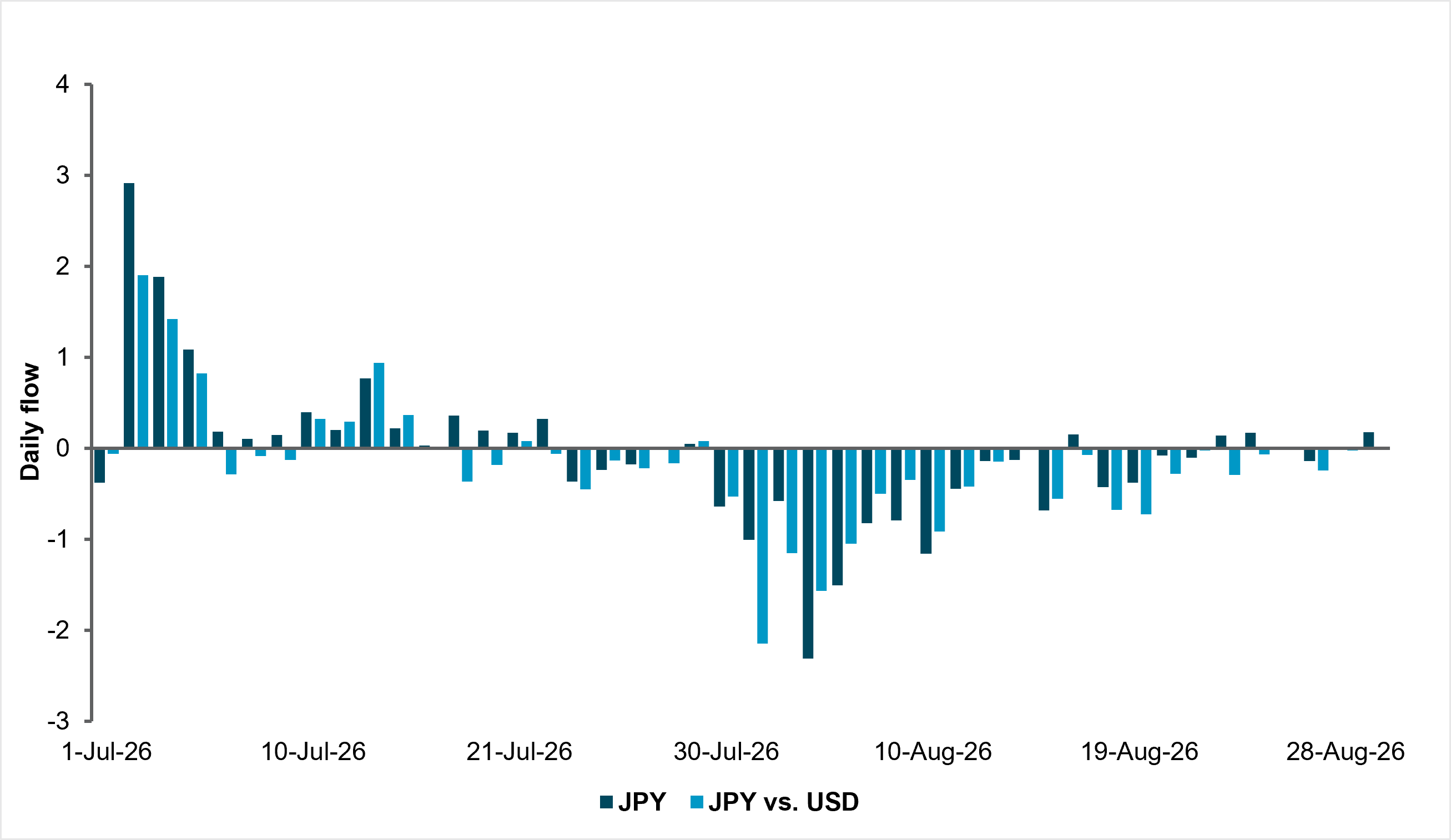
EXHIBIT #1: DAILY JPY AND USDJPY FLOWS (INVERTED) HAVE TURNED NEUTRAL
Source: BNY
Our take
Our data show that JPY selling – both on an aggregate basis and on the dollar leg – has largely ended. Heavy sales came through after the initial round of intervention in July, a sign that the market was using the opportunity of a stronger JPY to either re-engage in carry trades or hedge local exposures. Even the headwinds introduced by the July FOMC decision and more recent Treasury buyback announcement didn’t alter the path. After spending close to $96.4bn (with additional support from the U.S. Treasury), USDJPY is back to 160, validating the JPY shorts and USDJPY longs.
However, JPY sales have ceased. Notwithstanding IMF rules around intervention, the 160 level appears to be the hard “cap” for markets. The market isn’t fully turning into long JPY yet (or reducing shorts), but a repeat of early July – pre-intervention buying – is possible. At current valuations, the market is fully vigilant of intervention at any point.
Forward look
We are deeply skeptical of the Japanese authorities’ ability to boost JPY. U.S. Treasury Secretary Scott Bessent stated on Tuesday that “Abenomics was reflationary, Japan can sit back and enjoy.” The comment implies that for low-growth, low-yield economies, a reflation period can make currency performance far more tolerable. Disinflationary factors such as loss of foreign exchange earnings and exchange rate pass-through will be offset by rising domestic demand. The current Japanese government’s large budget is designed to trigger reflation on a sustained basis.
Prime Minister Sanae Takaichi’s economy is different from Shinzo Abe’s. We acknowledge that Abenomics enabled transformation for Japan to a point, but the strong emphasis on structural reform is what’s lacking in current plans, despite a very strong mandate for change. Furthermore, Abe’s inflation starting point was very different compared to the country’s current inflationary state, and there will be strong U.S. and global pushback if Japan reinstitutes Abenomics’ initial push for JPY weakness to help stimulate the economy; USDJPY appreciated by over 50% during the first three years of his term.
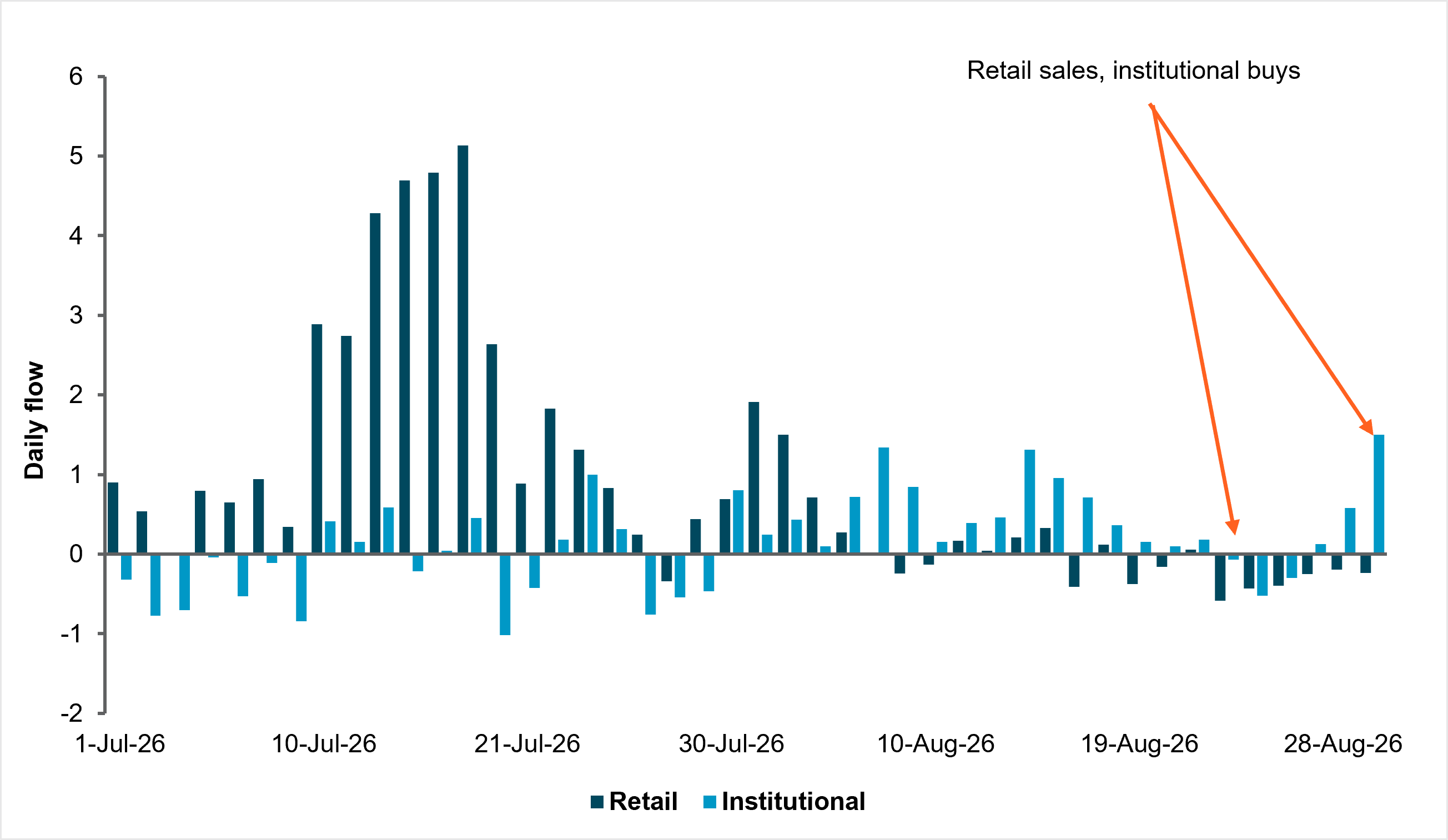
EXHIBIT #2: RETAIL FLOWS INTO EM APAC SEMIS (GICS L2) TURN, INSTITUTIONAL NAMES BUYING
Source: BNY
Our take
Retail investors are clearly exiting EM APAC semiconductor shares. Throughout the turbulence in recent months, our data showed that retail participants (iFlow data incorporate both onshore and offshore for South Korea) were actively buying amid the volatility. In contrast, institutional names were constrained by single-stock ownership rules. They either had to sell or were unable to actively add to holdings.
Retail leadership has ended. Our data show that since the first week of August, institutional names have been very active in purchases, culminating in a strong inflow on Monday that was the largest over the last two months in scored terms. In contrast, retail flows registered six straight days of sales. Flow sizes were limited, but this is the most significant outflow in months. Flow leadership of EM APAC semiconductors has fully switched to institutional names.
Forward look
We expect volatility to decline. As South Korea has introduced more restrictions on leveraged products, we don’t expect a repeat of the volatility seen through the summer months. Political support for retail has also wilted: on Tuesday, a presidential advisor who “backed the introduction of leveraged single-stock ETFs” stepped down. Going forward, institutional ownership means more “sticky money,” and reinforces South Korea and Taiwan positions as the best-owned EM markets. Both are still strongly tied to the U.S. IT investment cycle, but the change in positioning means less volatility up ahead.
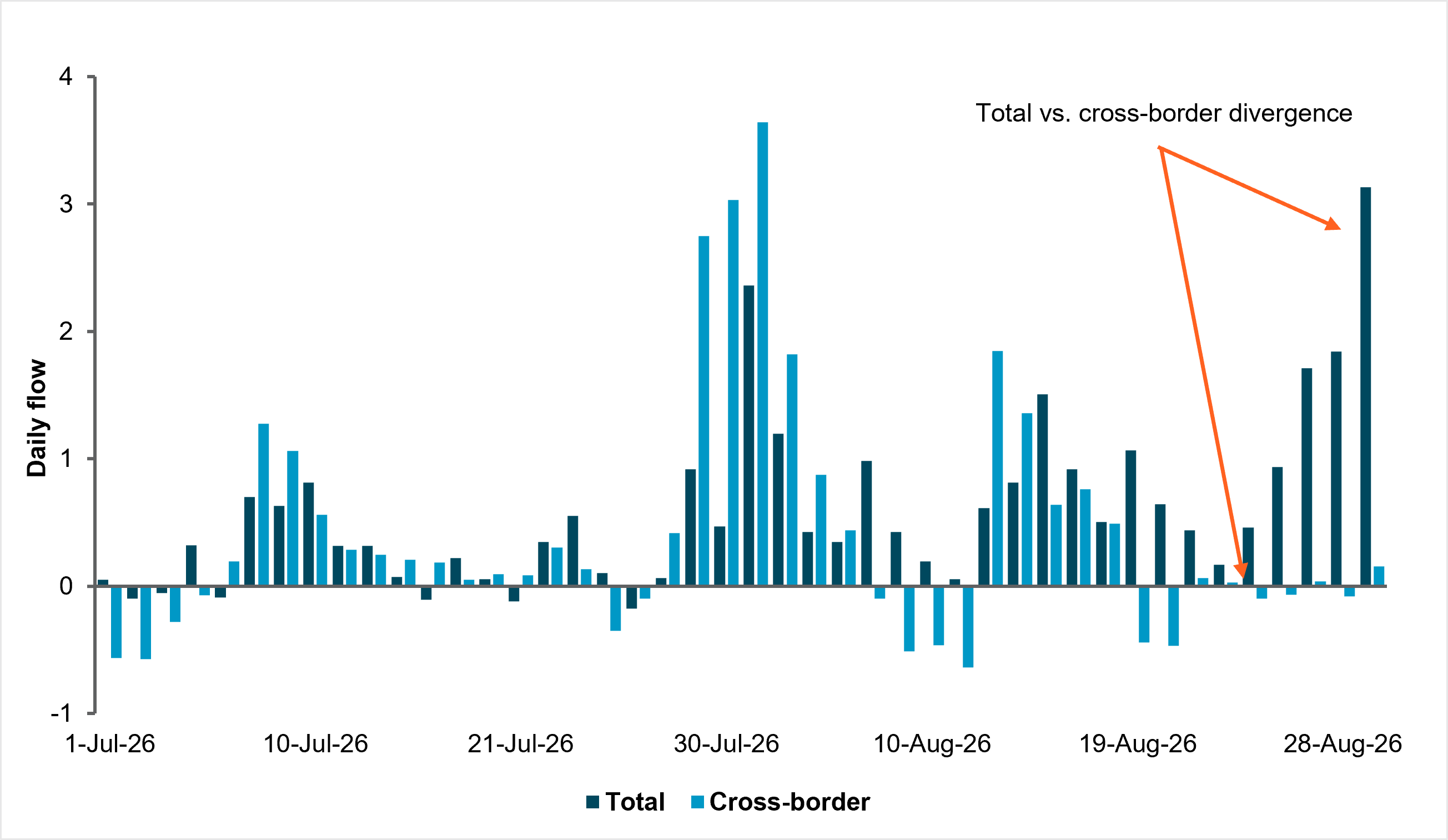
EXHIBIT #3: WEEKLY SCORED FLOW, CASH AND SHORT-TERM INSTRUMENTS (CAST)
Source: BNY
Our take
Cross-border investors are stepping back from duration. Our data show that cross-border flows into the 10y+ part of the U.S. curve have generally tracked the aggregate figure, but for the first time in the last two months, that interest is now declining. They were comfortable owning the dollar, and real rates were still positive. Even after the July FOMC, which affected the front end more, interest generally held well. The past two weeks have been different, suggesting that the Treasury buyback announcement was less favorable for external participation. While there’s no sign of active selling, purchase interest has been flat, while domestic flows have added aggressively.
Forward look
The data indicate that cross-border investors don’t wish to hold dollar and duration risk simultaneously. Fed Chair Kevin Warsh’s comments at Jackson Hole showed intent to anchor credibility, but developments over the past month suggest cross-border investors demand more compensation. If dollar real rates are to decline, term premia need to rise, and vice versa. The flow divergence vs. onshore investors underscores the delicate balance between monetary and fiscal policy – not just for the Fed but all central banks facing fiscal dominance risk. The dollar’s reserve currency and reserve asset status means that cross-border investors won’t liquidate in size; our data confirm this view. Aggregate asset exposures to the U.S. remain at a high level, but have likely peaked.
Expect JPY longs to rebuild tactically around intervention risk, favor South Korea and Taiwan semiconductor exposure as institutional ownership becomes stickier, and stay cautious on long-end U.S. duration – but liquidation risk is low. Prefer exposures where positioning is improving and policy risk is better compensated, rather than relying on broad dollar or duration trades.