Fiscal pressures pushing back tightening
Appearing every Wednesday, Investor Trends provides a deep dive into patterns and behaviors in equity, bond and currency markets around the globe, underpinned with deeper macro insights.
Appearing every Wednesday, Investor Trends provides a deep dive into patterns and behaviors in equity, bond and currency markets around the globe, underpinned with deeper macro insights.

Geoff Yu
Time to Read: 9 minutes
European rate pricing remains stretched. Market expectations for interest rate hikes across Western Europe are still running too hot. The fundamentals behind our view haven’t budged since we first called for a pullback in pricing last month: second-round effects are nowhere to be seen across the Eurozone, no central bank is signaling a prolonged cycle, and the divergence between headline and core inflation remains intact. Meanwhile, new risks have emerged that are directly tightening financial conditions.
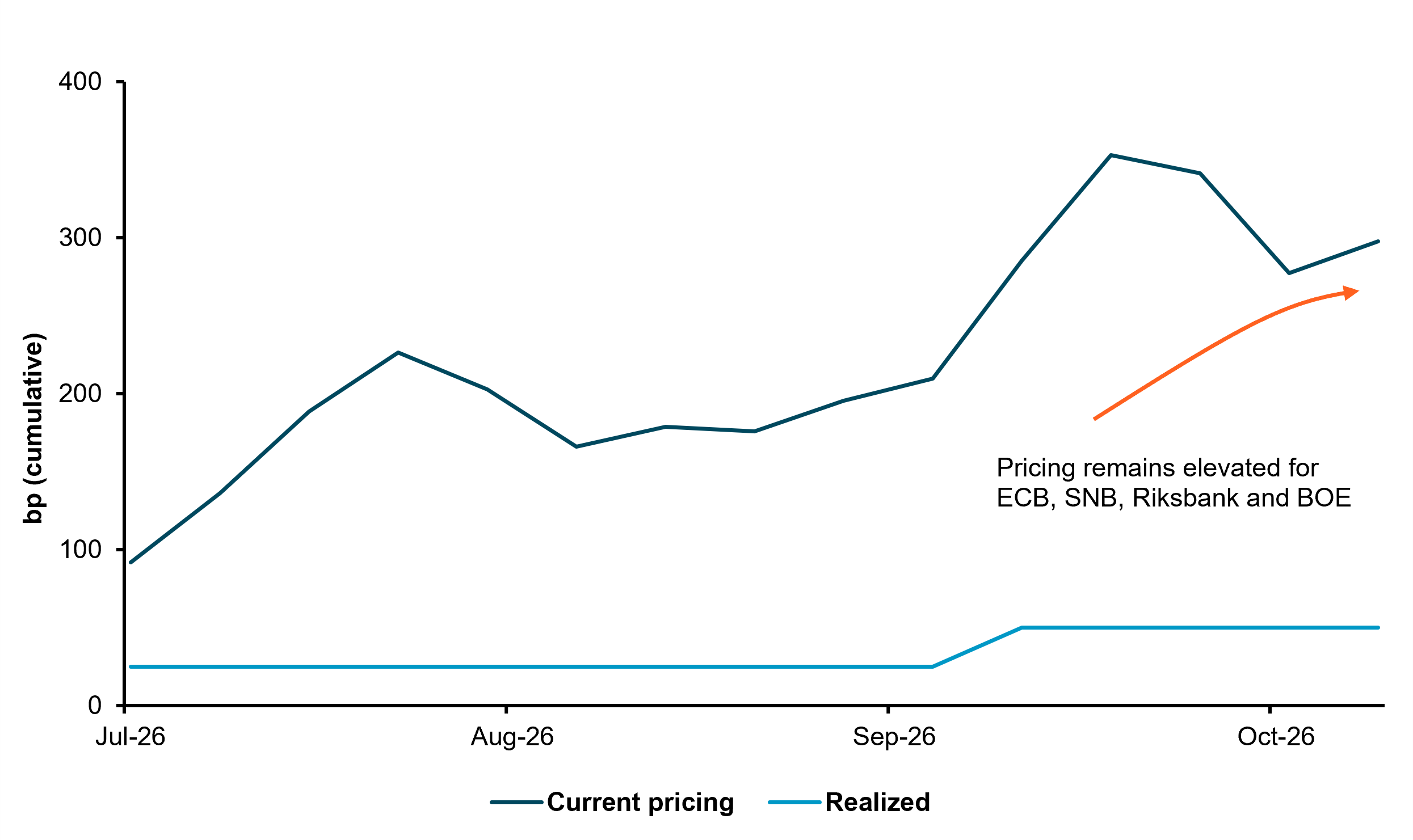
Yet since last month, only around 55bp has been shaved off the combined tightening priced for the European Central Bank (ECB), Swiss National Bank (SNB), Swedish Riksbank and Bank of England (BOE). Markets still expect nearly 300bp of hikes through June 2027, against our call for 50bp at most over the same period.
No hawkish surprises in September. The only hike among these four central banks in September came from the ECB, a 25bp move that was fully priced. There were no surprises, and guidance stayed restrained, even in the face of hot September headline inflation prints. No policymaker can rule out a move under current conditions, but there’s little appetite to commit to the sustained tightening that markets are pricing.
Meeting-by-meeting approach is the main signal. Policy guidance across Europe has settled on a meeting-by-meeting approach. However, the burden of proof lies with officials to justify a hike rather than a hold, an asymmetry that market pricing barely reflects. If central banks do tighten, front-loading makes the most sense heading into a difficult winter in which energy supply remains tight. Early moves would also reduce the need for action in H1 2027, which is where we see pricing overshooting the most.
EXHIBIT #1: ECB, SNB, RIKSBANK AND BOE PRICING GAP VS. REALIZED HIKES STILL NEAR YEAR-TO-DATE HIGHS*
Source: BNY, Bloomberg. *Norway excluded due to the global energy market impact on its economy and monetary and fiscal policy.
Labor demand isn’t driving wages higher. We remain confident that European growth will end the year on a strong note, and forecasters increasingly agree. Following the German government’s upgrade of its 2026 forecast to 1.3%, the IMF’s latest assessment for Germany has matched that figure, up from 0.7% previously. The IMF has also lifted its U.K. growth forecast for this year to 1.3%.
Inflation expectations, however, have barely moved, a sign that demand pressures remain contained. We believe falling wage growth is a critical factor behind this restraint.
Surveys confirm noninflationary expansion. The latest PMIs were robust across much of the Eurozone, employment components included. The Eurozone composite PMI registered a net pickup in headcount, led by services, while manufacturers stopped shedding staff. Germany’s survey was also constructive, yet forward-looking wage indicators held steady.
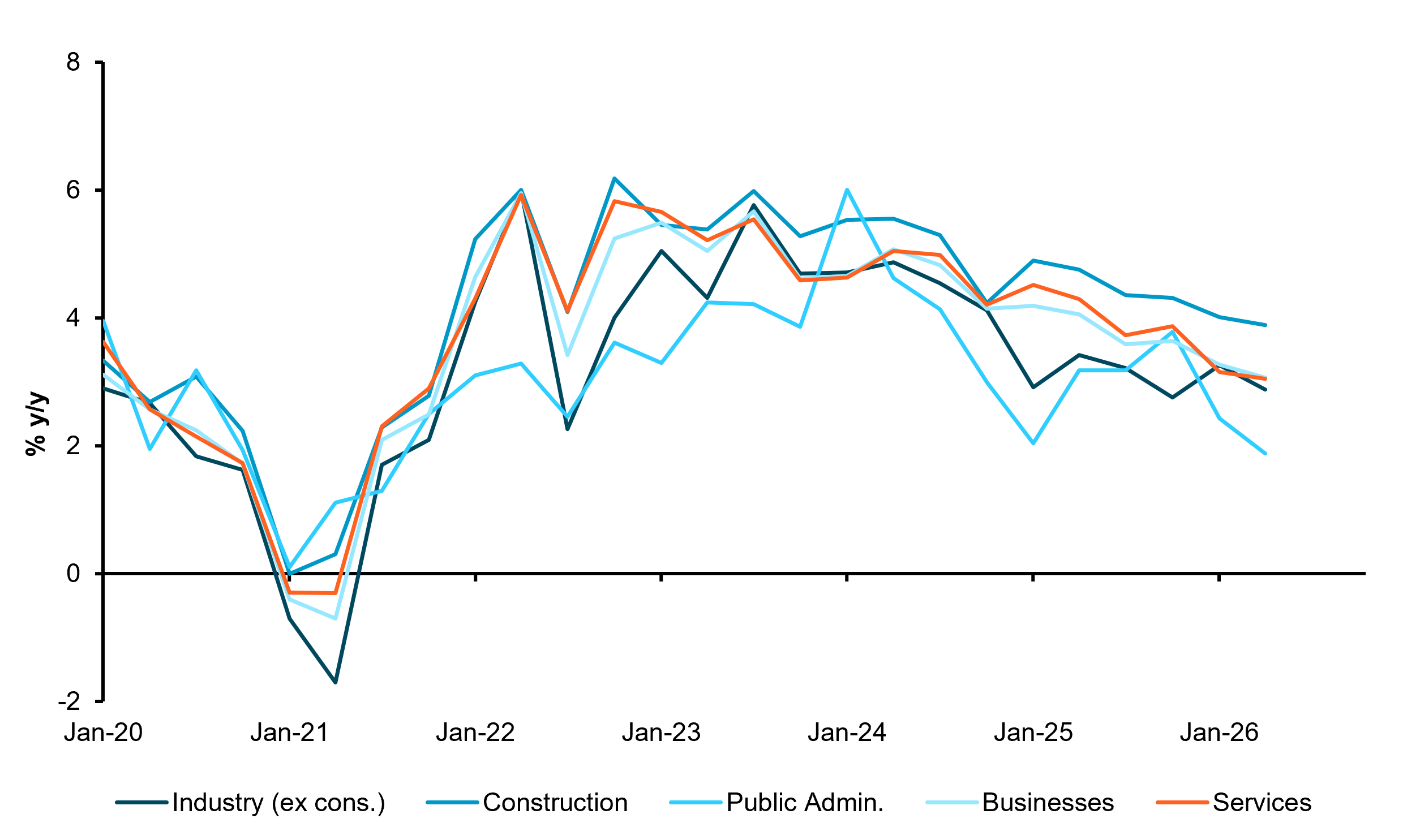
In the U.K., the composite PMI showed employers cutting staff again, and the BOE remains resolute that the labor market is cooling, a conclusion backed by its own Agents’ surveys. Most tellingly, back in the Eurozone, the ECB’s latest Q2 wage surveys show wage growth declining in every core industry (Exhibit 2).
Language on second-round effects is clear. Central banks in Europe will only commit to tightening on clear evidence of second-round effects. The prevailing message across the region is one of vigilance, especially from the ECB, which is seen as the most hawkish of the group. This week, Governing Council member Olli Rehn noted that energy prices have “not so far spread to other prices or wages,” though he warned that risks would rise if the Middle East conflict drags on. The majority on the BOE’s Monetary Policy Committee also sees “little evidence” of second-round effects but has pledged not to “wait too long” before responding.
EXHIBIT #2: EUROZONE WAGE GROWTH CONTINUED TO DECLINE IN Q2
Source: BNY, Macrobond
Fiscal stress is the new risk. The biggest shift in the European outlook over the past month has been the aggressive widening in OAT-Bund spreads, reflecting mounting market concern over France’s fiscal outlook. France’s deficit worries are hardly new, but with funding constraints tightening worldwide, in both quantity and price, fiscal risks are being amplified.
Moves in Italian BTP-Bund spreads have stoked fears of contagion, though we believe such fears are misplaced for now. European authorities have far better visibility over the risks, and Europe’s reaction function and toolkit are stronger and better tested than they were in 2011.
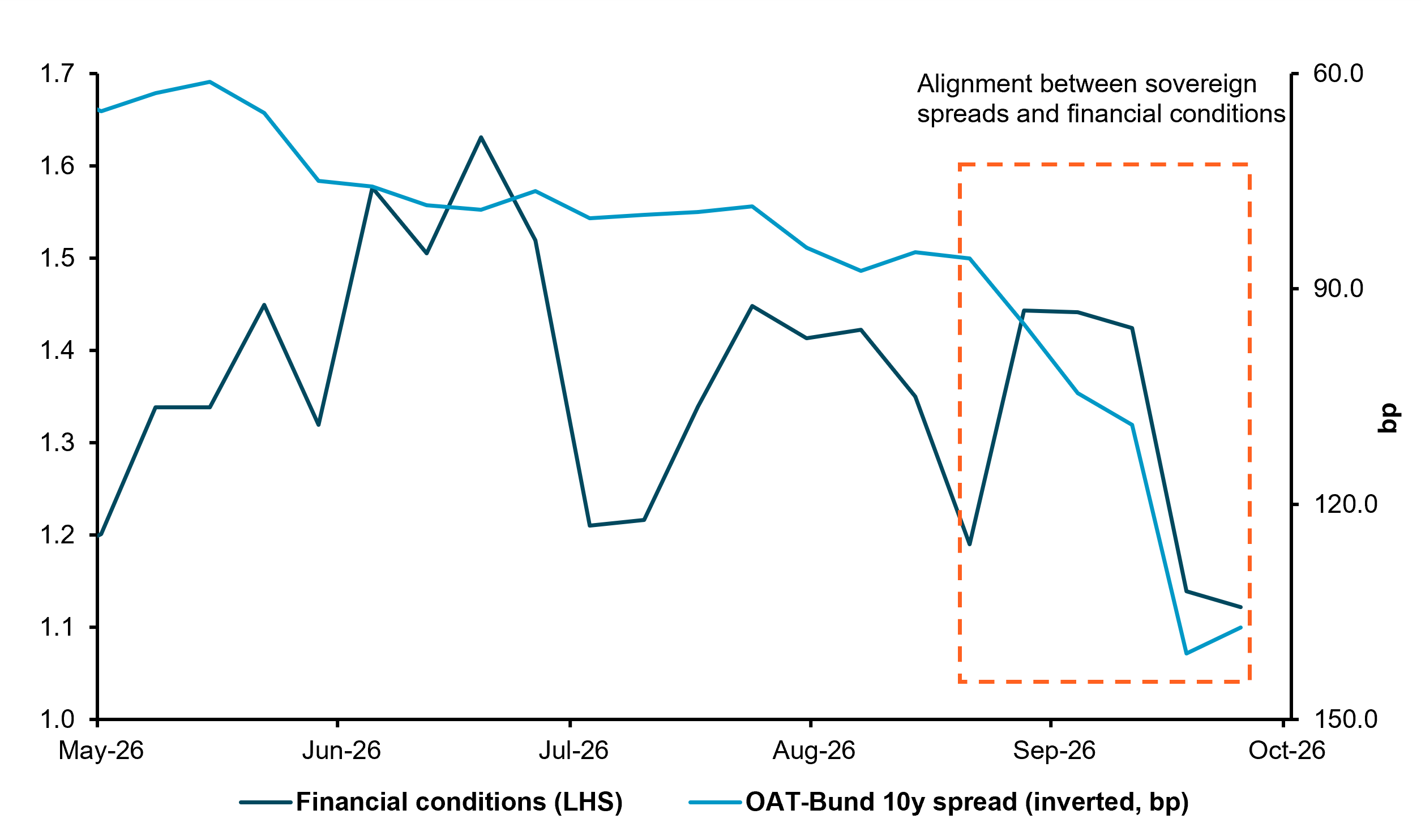
Financial resilience doesn’t imply market irrelevance. Previously, we highlighted that fiscal policy was becoming a binding constraint. Higher rates and shrinking room for productive spending limit governments’ ability to respond to spread widening. The widening in the 10y OAT-Bund spread has closely tracked Eurozone financial conditions, which are now at their tightest since May (Exhibit 3). Even so, financial conditions remain relatively loose overall, not ideal for policymakers given current inflation. A steeper yield curve can tighten them and “do the central bank’s job.”
Bond markets are doing their job and imposing fiscal discipline. Since the U.K.’s 2022 mini-budget, governments have learned to heed bond market signals. The immediate tests are the upcoming French and U.K. budgets. Getting them passed isn’t the problem, and both finance ministries have pledged fiscal responsibility. Execution and delivery are the bigger challenges, especially as investors favor spending cuts over revenue-raising. Whatever the outcome, the bond market moves of recent weeks make fiscal restraint across Europe’s major economies unavoidable, leaving central banks little reason to “lean into” these moves with rate hikes.
EXHIBIT #3: OAT-BUND SPREADS ARE NOW TRACKING TIGHTER FINANCIAL CONDITIONS
Source: Bloomberg, Macrobond
Credit tightening is a new policy risk. While we don’t see broader contagion from the current widening in OAT-Bund spreads, fixed-income volatility is here to stay until the inflation and policy cycle turns. The scale of the OAT, BTP and gilt markets means rising sovereign risk premia will demand a commensurate repricing elsewhere, with credit most exposed.
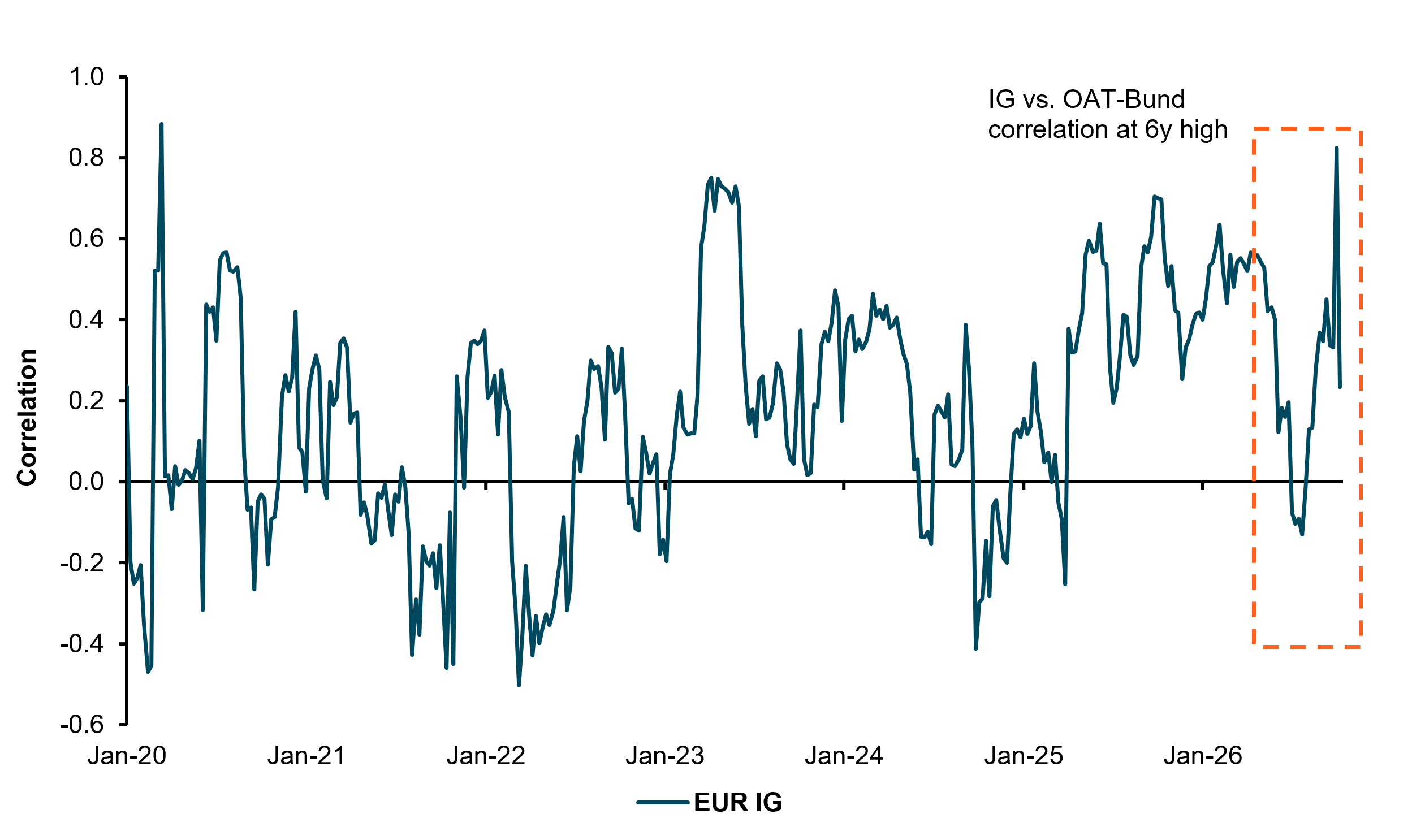
Last week, the rolling 12-week correlation between Eurozone investment-grade (IG) option-adjusted spreads and the OAT-Bund spread rose above 0.8 for the first time since Q1 2020 (Exhibit 4) – a sign that the sovereign-to-credit transmission channel is switching on.
Credit growth could slow. Although the correlation has since eased, markets will brace for a repeat, layering additional risk premia onto credit. The impact falls mainly on borrowers reliant on capital markets rather than on households and smaller enterprises, but the latter are exposed if banks pass higher costs through the loan channel. We’ll watch European lending surveys closely in the months ahead. The ECB will be well aware that wider spreads amplify tightening by adding risk premia on top of actual increases in borrowing costs.
A balance sheet response would end rate hikes. With sovereign and corporate spreads in focus, the ECB has already faced questions over activating the “Transmission Protection Instrument,” created in 2022 to counter disorderly widening in Eurozone sovereign spreads. We don’t see this as necessary for now; an end to quantitative tightening (QT) is the more likely step if OAT-Bund spreads begin widening again. But if the ECB’s balance sheet is deployed, even in the name of “transmission protection,” an end to rate-based tightening won’t be far behind, lest balance sheet support and rate hikes work against each other.
BOE QT adjustment is ignored by rates markets. We believe pricing in the U.K. is even more stretched than in the Eurozone. The BOE has already adjusted its QT program to account for its impact on the long end of the gilt curve and paired this with cautious guidance on tightening. Interest rate markets are ignoring both.
EXHIBIT #4: CORRELATION BETWEEN OAT-BUND AND EUROZONE IG SPREADS HIT ITS HIGHEST SINCE 2020
Source: BNY, Bloomberg
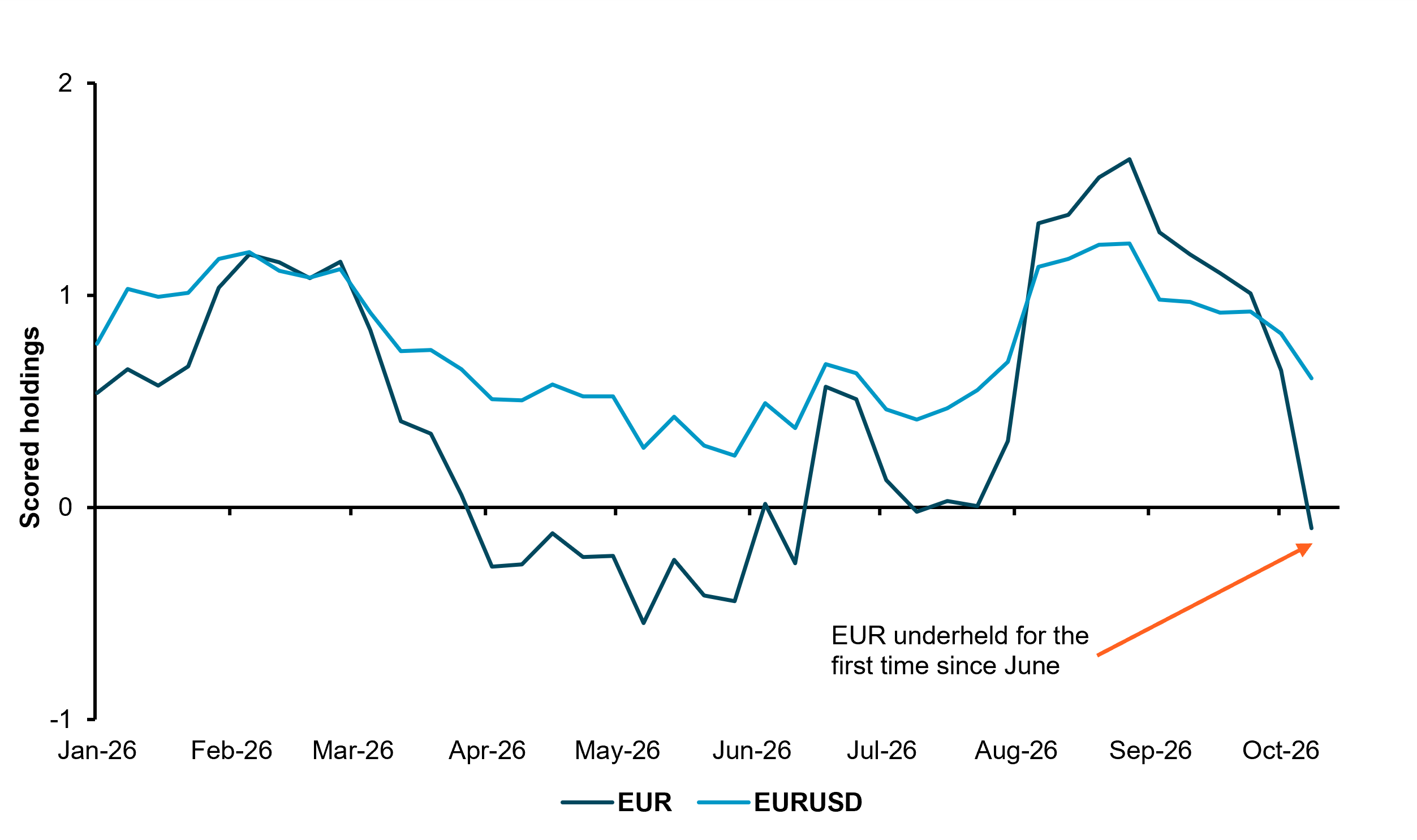
iFlow shows custody clients are back to net short in euros. This was the default position for much of Q2 as markets scrambled for dollars (Exhibit 5), but the latest move is more euro-specific, driven by increased hedging among cross-border clients. Our new iFlow Hedge Ratio indicator shows that custody clients cut hedges throughout Q3 as the ECB took a hawkish turn. In hindsight, this left their unhedged euro exposure overextended, and a correction – rebuilding those hedges – is now under way.
The euro still isn’t aggressively underheld. The sharp swing in EUR holdings – from around 50% overheld relative to the rolling 1y average to slightly underheld – is striking, but in absolute terms current EUR shorts aren’t excessive. Custody client flows and hedging decisions tend to move more slowly than leveraged positioning, where short interest is more extreme according to the latest CFTC figures.
The most recent extreme underholding of EUR was in late 2024, when politics in Germany and France were even more febrile and the ECB eased 100bp over the year. That level is a demanding benchmark, but it was also the last time a path toward parity in EURUSD looked credible. Current EUR holdings and valuations are a long way from 2024 levels, leaving room for further selling. We’re reluctant to call a bottom in the currency until tightening is priced out of the curve.
EUR-cross hedging is more active than EURUSD. Unlike overall EUR holdings, EURUSD holdings aren’t weak relative to recent history, suggesting more of the EUR hedging is taking place on the crosses. iFlow points to some rotation out of the Eurozone into Switzerland and the Nordic economies, where fiscal strength is unimpeachable, while the U.K. has also been a beneficiary.
Weaker euro eases pressure to tighten elsewhere in Europe. As a byproduct, this rotation has pushed up effective exchange rates across the rest of Europe and, at the margin, reduced the need for tightening there. Any escalation in Eurozone sovereign risk would drive safe-haven flows into the franc, wiping out residual SNB pricing in an instant and rekindling talk of FX intervention – a tool that is most effective when Swiss rates are at zero or even negative.
EXHIBIT #5: EUR IS BACK TO UNDERHELD FOR THE FIRST TIME SINCE EARLY JUNE
Source: BNY IFlow
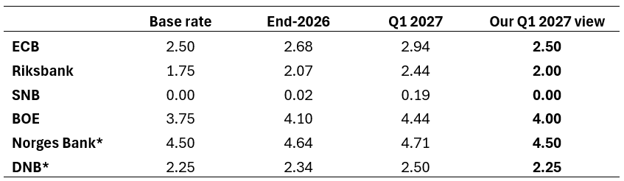
The ECB will skip October and could be done for the year. The ECB remains vigilant, but its language on second-round effects points to a skip in October. Attention is also turning to the race to succeed President Christine Lagarde, which could further complicate decision-making. Given the emergence of sovereign risk and uncertainty surrounding the French budget, we see a December hold as probable unless natural gas prices move closer to the “severe” inflation scenario in the ECB’s staff projections.
The Riksbank will continue to push for SEK strength. The Riksbank still has hikes in its outlook, but underlying inflation remains below target, so we expect a single insurance hike at most. We see strong value in SEK, and the currency should gain further in a world where fiscal credibility is richly rewarded. The central bank will welcome SEK appreciation in lieu of further rate-based tightening, as a stronger currency helps contain headline inflation.
The BOE will stay cautious and wait for budget. The BOE’s caution is well established, and given the weakness of the labor market, any hike would be framed as insurance. A Q4 hike is likely, though we hold this view with low conviction. The fiscal impulse from the budget will also shape the BOE’s upcoming rate decision. The latest fiscal guidance doesn’t point to a prolonged fiscal expansion, reinforcing our view that bond markets are enforcing discipline on government spending.
EXHIBIT #6: OUR EUROPEAN RATE VIEW VS. OIS PRICING (%)
Source: BNY, Bloomberg. *Norges Bank has a separate reaction function due to energy; Danmarks Nationalbank (DNB) will track the ECB.
Energy escalation: Although the ECB has reminded rates markets that it “doesn’t set policy based on energy prices,” any external shock that drives natural gas prices toward the severe inflation scenario in its staff projections will prompt a reaction. These prices matter for every economy in Europe.
Wages: The ECB’s latest wage tracker doesn’t foresee an aggressive rise in H1 2027, and other central banks expect limited wage growth. However, collective bargaining outcomes are an upside risk to monetary policy outlooks globally, and next year’s bargaining round is a significant one. Strong real wage gains would challenge our view that households continue to exercise self-restraint.