Budapest’s fiscal ambitions lead CEE
Appearing every Wednesday, Investor Trends provides a deep dive into patterns and behaviors in equity, bond and currency markets around the globe, underpinned with deeper macro insights.
Appearing every Wednesday, Investor Trends provides a deep dive into patterns and behaviors in equity, bond and currency markets around the globe, underpinned with deeper macro insights.

Geoff Yu
Time to Read: 9 minutes
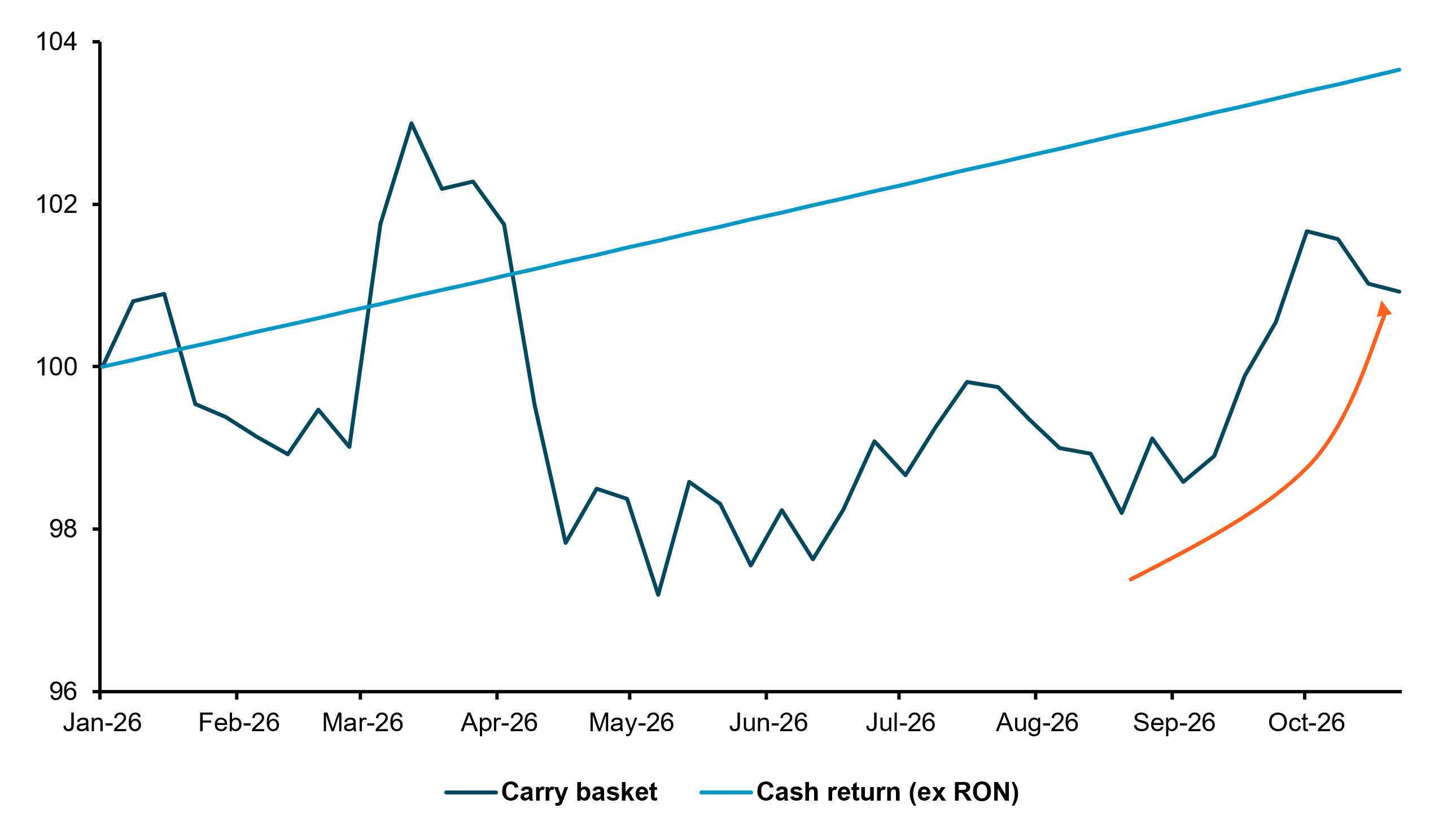
FX lags as the ECB stays hawkish. We continue to expect CEE assets to perform strongly into year end, but October has been disappointing. FX weakness remains pronounced: An equally weighted carry basket of Central Europe 3 (CE3) currencies – CZK, HUF and PLN – against the EUR and USD is still running at just below a 1% year-to-date gain, close to 2.5pp below the cash equivalent (Exhibit 1). The EUR may have struggled over the past few weeks due to sovereign risk, while tightening financial conditions haven’t yet prompted the ECB to abandon its current policy trajectory. Markets perceive that CEE central banks can’t match the policy paths currently priced for the ECB and the Fed, and a weak global carry environment is an additional headwind.
French spillovers can generate risk premia. We don’t see current developments in French government bonds as a repeat of 2011–2012. Near-term financial spillovers into other Eurozone economies are unlikely, let alone into CEE and the rest of the EU. The French economy will likely underperform in the near term. This is already reflected in its asset performance, but France’s share of CEE trade is limited. The highest is Romania’s at close to 5%, Poland’s is 4.5%, and below 4% for Hungary and Czechia. In contrast, Germany’s share of trade with these four economies ranges from 18% for Romania to 29% for Czechia. Even without broad financial contagion, any associated risk premia imposed on Eurozone assets could be magnified for CEE economies, holding back performance against the USD, CHF and other perceived safe havens.
EXHIBIT #1: CE3 CURRENCY PERFORMANCE CONTINUES TO STRUGGLE
BNY. Carry basket equally weighted across CZK, HUF and PLN vs. EUR and USD, including carry. Cash yields weighted by bond-market size.
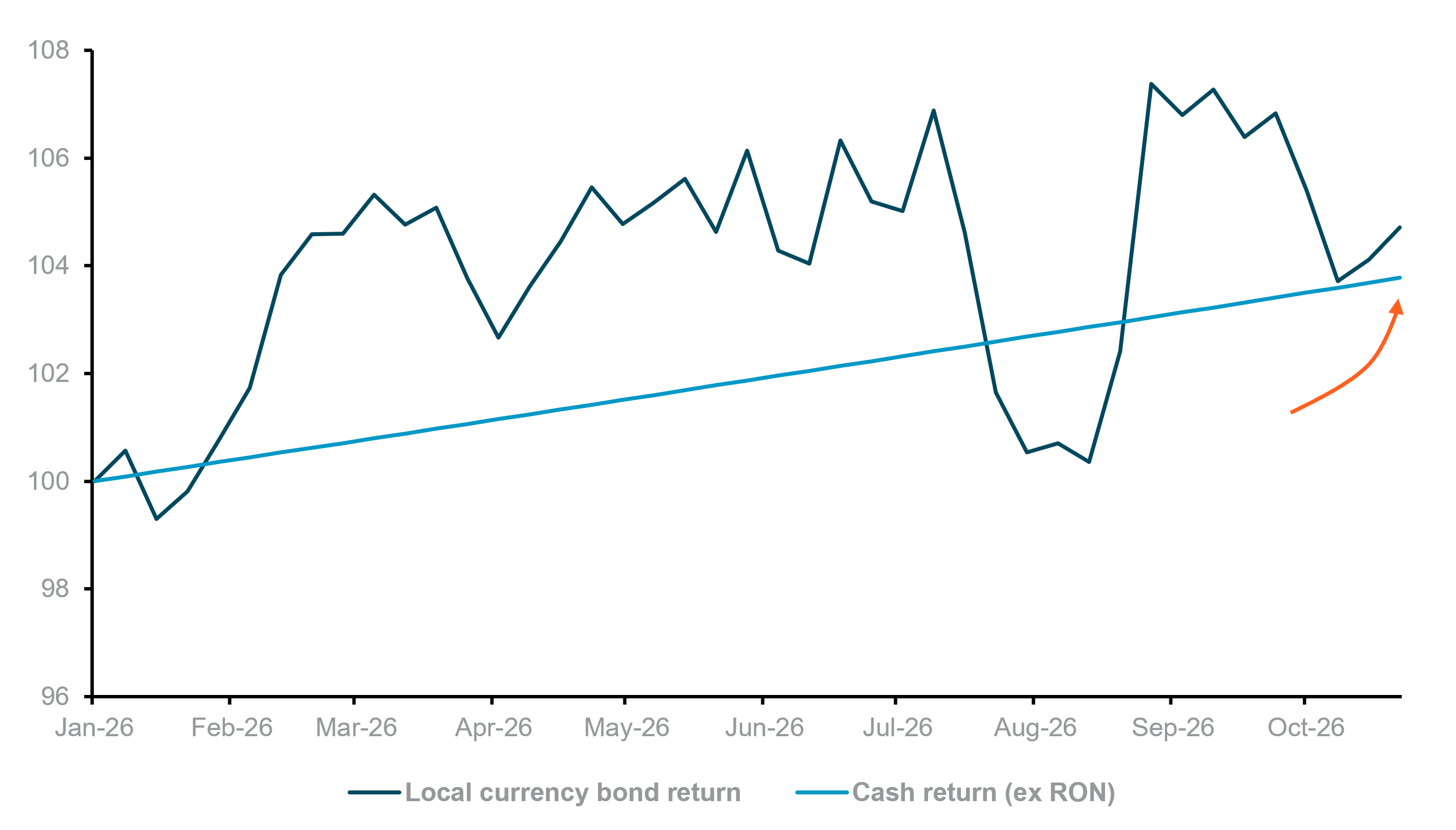
CEE fixed income is stabilizing. France’s fiscal performance is deteriorating, but its deficit is still expected to be well below those of its CEE peers, apart from Czechia. France’s main source of stress arises from a failure of its own currency and independent monetary policy to ease financial conditions. In the face of pressure from steepening yield curves, CEE central banks can hold the line on rates, leaving their respective currencies to bear the burden of adjustment. Real rates remain sufficient to anchor duration performance, and the issuance-weighted total return basket for CEE bonds continues to recover despite a more challenging environment for credit and emerging-market sovereigns with similar ratings profiles (Exhibit 2).
Hungary is now the positive fiscal outlier. FX and monetary policy flexibility don’t mean that markets are giving all sovereigns with their own currencies a free pass on real rates or deficit reduction. As “risk-free” real rates continue to rise, capital is becoming scarcer, and all issuers will need to differentiate themselves. Hungary has taken these risks to heart: its recent budget announcement, if implemented, would make the country a clear positive outlier in deficit reduction, with an explicit goal of euro entry. Markets have already rewarded Hungarian duration this year. If Budapest executes well, the rest of CEE may revisit their own frameworks, contributing to a comprehensive re-rating of regional duration.
EXHIBIT #2: CEE BOND BASKED GENTLY REBOUNDS
Source: BNY, Bloomberg. Unhedged fixed-income and cash indices, weighted by bond-market size
CEE fiscal profiles are among the worst in the EU. Even without a change of government this year, it’s likely current market pressures would have driven CEE capitals toward significant fiscal consolidation. Hungary and Poland are both expected to post budget deficits larger than 7% of GDP this year (Exhibit 3), whereas France is expected to reach only 5.4%. Deficit risks are skewed to the upside in the near term if borrowing costs remain high and more energy support schemes are required this winter due to global supply challenges.
The EU will struggle to impose discipline. Hungary, Poland and Romania all remain under the EU’s excessive deficit procedures, though Hungary’s process is currently in abeyance. Enforcement will be difficult due to current macroeconomic and market conditions. Poland’s very high level of defense spending (4.7% of GDP this year) is also a geopolitical necessity for the EU in its search for strategic autonomy, and markets will look favorably upon potential productivity and growth improvements associated with such investments.
EXHIBIT #3: CEE DEFICITS ARE WELL ABOVE THE 3% EU BENCHMARK
Source: BNY, Bloomberg, Eurostat
Hungary can afford to spend political capital. The biggest challenge across CEE is cutting social spending, especially in Poland and Romania, where governments comprise very weak coalitions. The new Hungarian government’s mandate stands apart, and the budget indicates that it is, in the Hungarian central bank’s own words, “front-loading” fiscal adjustment and spending political capital on arguably the toughest reforms.
The long-term goal is Eurozone membership. This is highly beneficial for investors because the milestones are well-established and measurable: political intent has been declared, entry into Exchange Rate Mechanism II (ERM II) is next, followed by meeting the convergence criteria for inflation, debt and deficits. The total return opportunity for Hungarian assets is clear if the country enters ERM II by the government’s 2030 deadline. Other major reforms are needed, such as banking union entry and supervisory reforms, but we don’t see these steps as controversial or challenging.
Croatia and Bulgaria borrow more cheaply than Hungary, Poland and Romania. The Hungarian government has repeatedly stated that short-term fiscal pain in pursuit of early Eurozone entry will be worthwhile in the long run as borrowing costs decline. Even after a decline of nearly 250bp in Hungary’s 10y yield, its borrowing spread over 10y Bunds remains higher than in 2018. It’s also well above those of Croatia and Bulgaria – the most recent entrants to the Eurozone. Polish and Romanian borrowing spreads are even higher and also barely changed from 2018 (Exhibit 4).
Hungary’s economy tops Croatia’s and Bulgaria’s combined. Its stock market capitalization also exceeds their combined total, and its per-capita GDP is just below Croatia’s and 30% above Bulgaria’s. However, Hungary’s sovereign ratings profile (BBB average) is weaker than Croatia’s (A average) and the same as Bulgaria’s. Despite Hungary’s economic scale, the borrowing gap persists, and the government is clearly trying to close it. Poland’s economy is even stronger than Hungary’s and would be the biggest remaining “catch” for Eurozone enlargement, but the political will isn’t there.
EXHIBIT #4: EURO MEMBERS BORROW MORE CHEAPLY
Source: BNY, Bloomberg, Eurostat
Hungary’s targets will be painful. The plans Hungary announced this week are extremely ambitious but will impose a very high cost. The government is targeting a reduction in the budget deficit to 4.9% next year, a drop of around 2.5pp of GDP based on current estimates. This is austerity in all but name, something Hungary hasn’t tried in over a decade and certainly not voluntarily. The country managed a deficit reduction of 2.9pp of GDP in 2012 amid the Eurozone sovereign debt crisis and 4.2pp of GDP in 2007.
The Eurozone periphery sets the benchmark. The most significant fiscal adjustment in the EU over the past 15 years remains the mandated changes imposed by the EU-ECB-IMF troika during the sovereign debt crisis. Greece’s deficit reduction averaged 1.4pp of GDP per year between 2013 and 2019 (Exhibit 5), and it can now repay loans early. Ireland is an outlier, the record holder for reducing deficit in a single year in 2009. Using Bulgaria and Croatia as benchmarks, their average annual deficit reductions before COVID were 0.4pp and 0.8pp of GDP, respectively. Within the CEE, only Poland comes close to consistent deficit reduction, but its recent performance has deteriorated.
There’s no alternative. Italy and France are among the worst performers in fiscal adjustment, even during the most stringent years after the Eurozone debt crisis. Neither managed more than 2pp of GDP in consolidation in a single year during that phase, arguably when growth conditions were stronger. That shortfall has directly contributed to their current fiscal predicaments. Hungary can benefit from a strong government majority and a weak fiscal starting point. If global real rates are moving structurally higher, aggressive rate cuts or even quantitative easing offer no hiding place, barring a major growth shock that would hit public finances in any case.
Watch for fiscal slippage. Clear progress toward ERM II entry by 2030 – the target year for the deficit to fall below the 3% of GDP convergence threshold – will help close the 100–150bp spread gap against Croatia and Bulgaria at the 10y maturity. Fiscal slippage due to political pressure, on the other hand, will be devastating for confidence in the region: if a government with such a large majority can’t implement fiscal reform, there will be little hope for the rest of CEE or even Europe, where weak parliamentary coalitions, which find it notoriously difficult to implement cuts, are now the norm.
EXHIBIT #5: EUROPEAN FISCAL CONSOLIDATION, 2013–2019
Source: BNY, Bloomberg
Core inflation in CEE is uneven. In the near term, CEE asset performance depends on central bank policy consistency. We maintain that central banks across Europe will try to limit further rate hikes. The recent steepening in yield curves has generated a fiscal response that will tighten financial conditions. The ECB has already been vocal on this factor, but central banks continue to monitor core inflation for signs of second-round effects. Across CEE and core Eurozone economies, core inflation isn’t running higher than headline inflation, but the picture is uneven.
Cuts are unlikely in CEE for now. Hungary is the only CEE economy where core inflation matched headline inflation on a sequential basis in September, its central bank is now aligning with the government’s euro-entry objective and has effectively adopted a lower inflation target. Meanwhile, headline inflation in Poland is the highest in CEE y/y, but core inflation is surprisingly flat despite the high level of current household subsidies. Weak core inflation is contributing to a very conservative tightening path for the National Bank of Poland (NBP), but high headline inflation increases the risk of expectations becoming unanchored. Governor Adam Glapinski has stated a readiness to hike again, but the Monetary Policy Council is split, and we’re concerned about complacency surrounding core prices.
EXHIBIT #6: THE ELECTION REPRICED HUNGARIAN DURATION
Source: BNY, Bloomberg; change from end-March to early July
iFlow shows Hungarian bonds are well owned. Despite the favorable structural narrative for Hungary, we wouldn’t recommend adding to existing positions, preferring instead to let duration do its job. iFlow indicates that Hungarian bonds are very well owned (Exhibit 7), with only a limited decline in holdings over the past quarter. This contrasts strongly with Poland, where bond holdings have halved, while Eurozone holdings have fallen to their lowest levels this year as broader yield-curve steepening and fiscal risks weigh on performance.
Fiscal change in Poland offers favorable risk-reward. If Hungarian bonds continue to outperform, we see a case for the remaining non-Eurozone CEE economies to revisit their fiscal frameworks. Markets would need to reward a clear commitment to ERM II and eventual Eurozone membership with an immediate reduction in borrowing costs. Politically, this is difficult in Poland, but if Hungary’s experience makes an overwhelmingly positive financial case, a shift in the domestic narrative, coupled with low external holdings, could generate strong performance. We expect real rates, NBP hawkishness and peaking inflation to drive performance, with asymmetrical upside based on flows and holdings.
EXHIBIT #7: HUNGARIAN BONDS ARE WELL HELD; WATCH FOR ROTATION
Source: BNY, Bloomberg; change from end-March to early July
Eurozone fiscal slippage is the biggest risk. Our base case for France remains benign. If recent political turbulence across the Eurozone results in massive fiscal slippage as governments promise additional spending and borrowing to fend off popular discontent, markets’ reaction will be overwhelmingly negative. We highlighted in our latest Eurozone rates assessment that the correlation between French-German spreads and the option-adjusted spread of investment-grade (IG) credit has reached its highest level since the pandemic extremes. CEE sovereigns have risk profiles similar to those of Eurozone IG credit and wouldn’t be immune to severe contagion.
Energy challenges are a second risk. Even with ambitious fiscal targets, Hungary’s government has acknowledged that energy costs remain the biggest stress point; the country has some of the highest energy prices in Europe. Reducing energy dependencies will take time, and household energy price caps will be retained. As with all facets of fiscal and monetary policy in Europe, if winter gas prices move toward the ECB’s severe scenario, fiscal outlays will need to increase. Given political imperatives, this would mean governments’ deficit targets for 2027 could need to be abandoned before the year even starts.