PCE Revision Won’t Change Inflation Story
iFlow

John Velis
Time to Read: 4 minutes
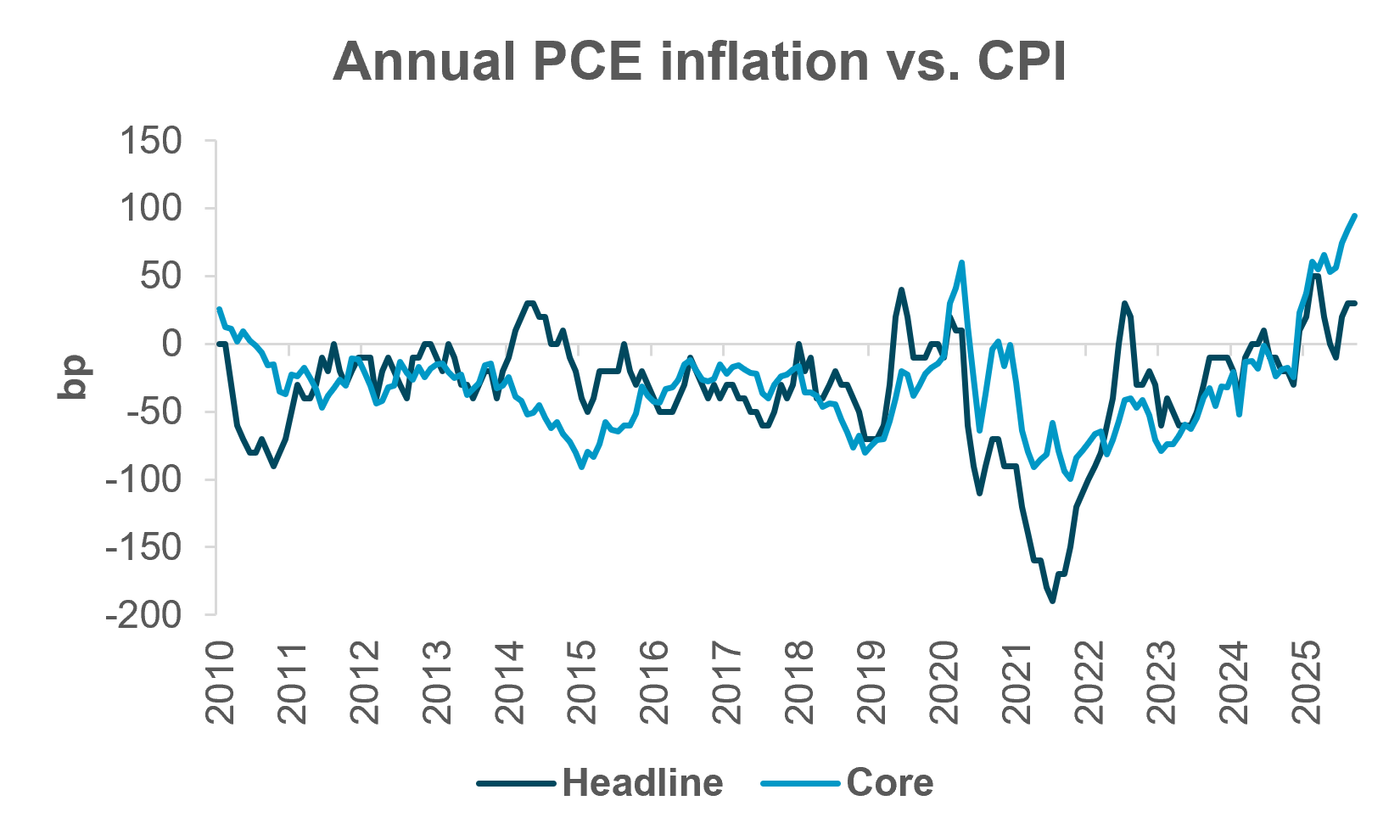
Limited impact: While personal consumption expenditures (PCE) revisions do not dramatically alter the inflation picture, they do clean up a noisy part of the Fed’s preferred inflation gauge. In July, headline PCE overshot the consumer price index CPI (3.7% vs. 3.4%) and core PCE ran far above core CPI (3.3% vs. 2.4%). This mainly reflects a methodological quirk rather than stronger consumer inflation. In particular, it shows how PCE captured portfolio management fees as equity markets rose.
Why it matters: For most of the cycle, core PCE ran below core CPI. This was normal, given the different scope, weights and formulas employed by the two data programs. By contrast, PCE has lately started running meaningfully hotter than core CPI, raising a critical question: Was inflation really getting firmer, or was the data distorted? The coming revision strongly suggests that idiosyncratic distortions played a major role.
EXHIBIT #1: PCE HAS BEEN RUNNING HOTTER THAN CPI RECENTLY
Source: BNY Markets, Bureau of Labor Statistics, Bureau of Economic Analysis
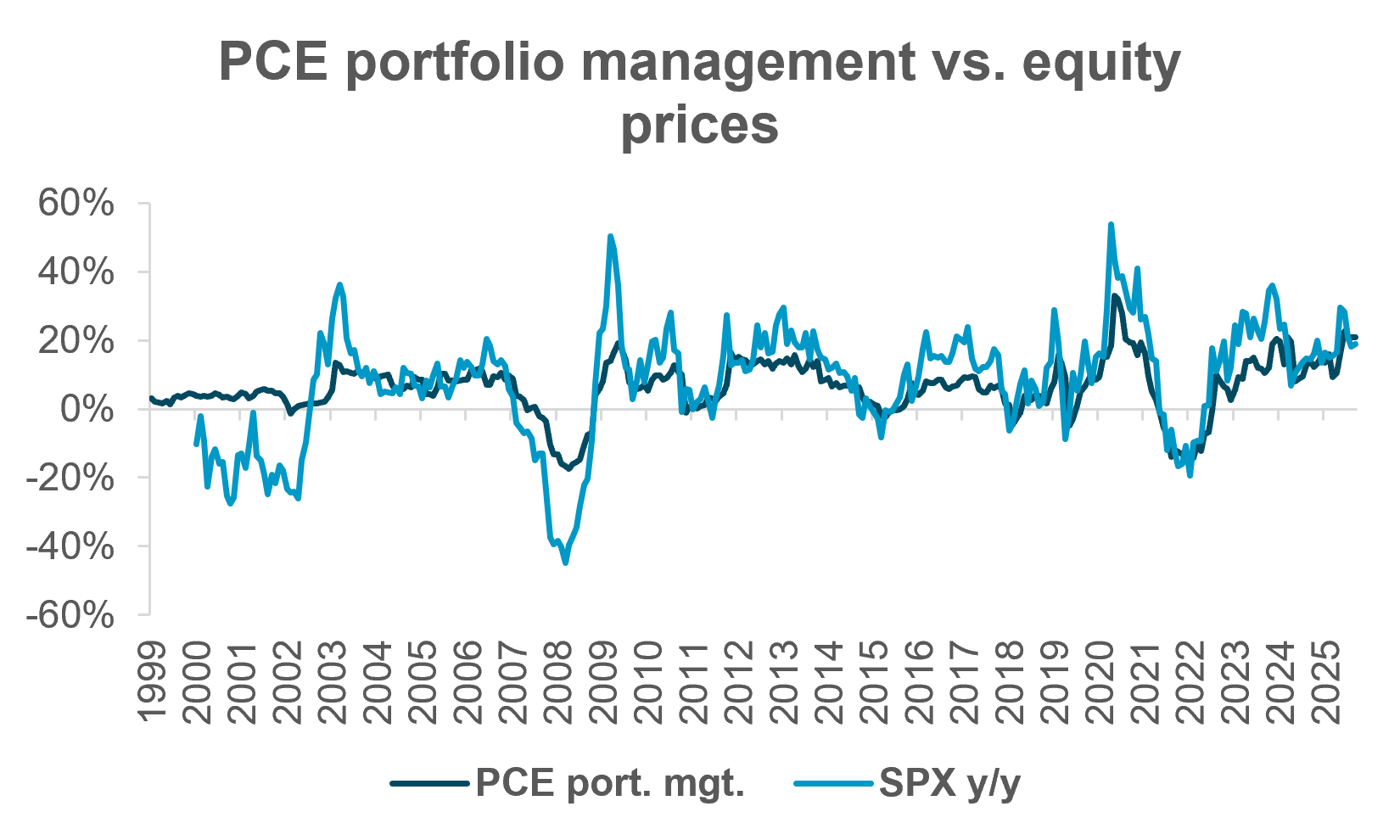
Key distortion: The divergence is largely because PCE includes portfolio management and investment advisory fees, while CPI does not. Under the old framework, nominal spending in this category was deflated using a producer price index tied closely to assets under management. Because advisory fees are usually charged as a percentage of assets under management (AUM), a rising stock market mechanically boosts fee income even when fee schedules do not change. As a result, equity gains flowed into measured inflation.
EXHIBIT #2: PORTFOLIO MANAGEMENT PRICES USED TO TRACK EQUITY PRICES
Source: BNY Markets, Bureau of Economic Analysis, Bloomberg
Outsized effect: While this category makes up about 8% of the overall PCE basket, it contributed 0.6 percentage points of the total increase in headline PCE. In core PCE, a 9% weighting drove a 7% contribution to the 3.3% annual increase. In core services ex-housing, or supercore, a 16% weighting added more than 1.1 percentage points to the annual increase. When equities rally, PCE can get an artificial boost from a category only indirectly tied to underlying consumer inflation. That has resulted in an unusually wide gap between PCE and CPI in recent months.
Sensible fix: The Bureau of Economic Analysis’s (BEA) revision looks like the right move. Instead of relying on a market-sensitive price series, the new method uses a labor-based quantity extrapolator tied to data on employment and hours. That should sharply reduce the impact of asset-price swings and give a cleaner read on real service consumption and implied prices. Put simply, a stock market rally should no longer be mistaken for inflation in the same way.
Important context: Portfolio management fees are not the whole CPI-PCE story. The two indexes are built differently. CPI measures out-of-pocket costs and gives much more weight to shelter. PCE has broader coverage, includes spending made on behalf of households and uses a chain-weighted framework that better captures substitution. Those structural differences usually explain why core PCE runs below core CPI. They do not fully explain why PCE recently moved above CPI. The portfolio management distortion looks like the main story.
Fed signal: This might send a dovish signal to the Fed, but only in a mechanical sense. While the revisions should lower recent core PCE readings and narrow the gap with CPI, the significance of this shift should not be overstated. This is not proof that the economy suddenly delivered cleaner disinflation — it is a statistical correction. It means less noise, not less inflation.
Call to focus: The real message is simple and urgent. PCE moved well above CPI partly because the two gauges differ in scope and weights, but also because PCE picked up a portfolio management component whose measured price rose with the stock market. This week’s revisions directly fix that problem. Focus on the signal, not the headline change.
Main point: The revisions improve the quality of the inflation signal, but do not materially change the macro backdrop.
What changed: PCE had been overstating inflation because portfolio management fees were rising with equity markets.
Why it matters: The revision should narrow the gap between PCE and CPI and remove a key distortion.
What to do now: Treat any softer PCE print as a measurement fix, not a major shift in the inflation trend.