Foreign flows to Japan not an FX story
iFlow > Equities
An in-depth look each Friday at the factors shaping equities markets in developed and emerging economies around the world.
iFlow > Equities
An in-depth look each Friday at the factors shaping equities markets in developed and emerging economies around the world.

Geoff Yu
Time to Read: 4 minutes
USDJPY 160 is emerging as a credible near-term intervention deterrent, but neither a cheap yen nor higher yields are reviving cross-border demand for Japanese assets. JGBs remain the weak link, while equities continue to attract broad-based institutional demand and appear largely insulated from FX volatility.
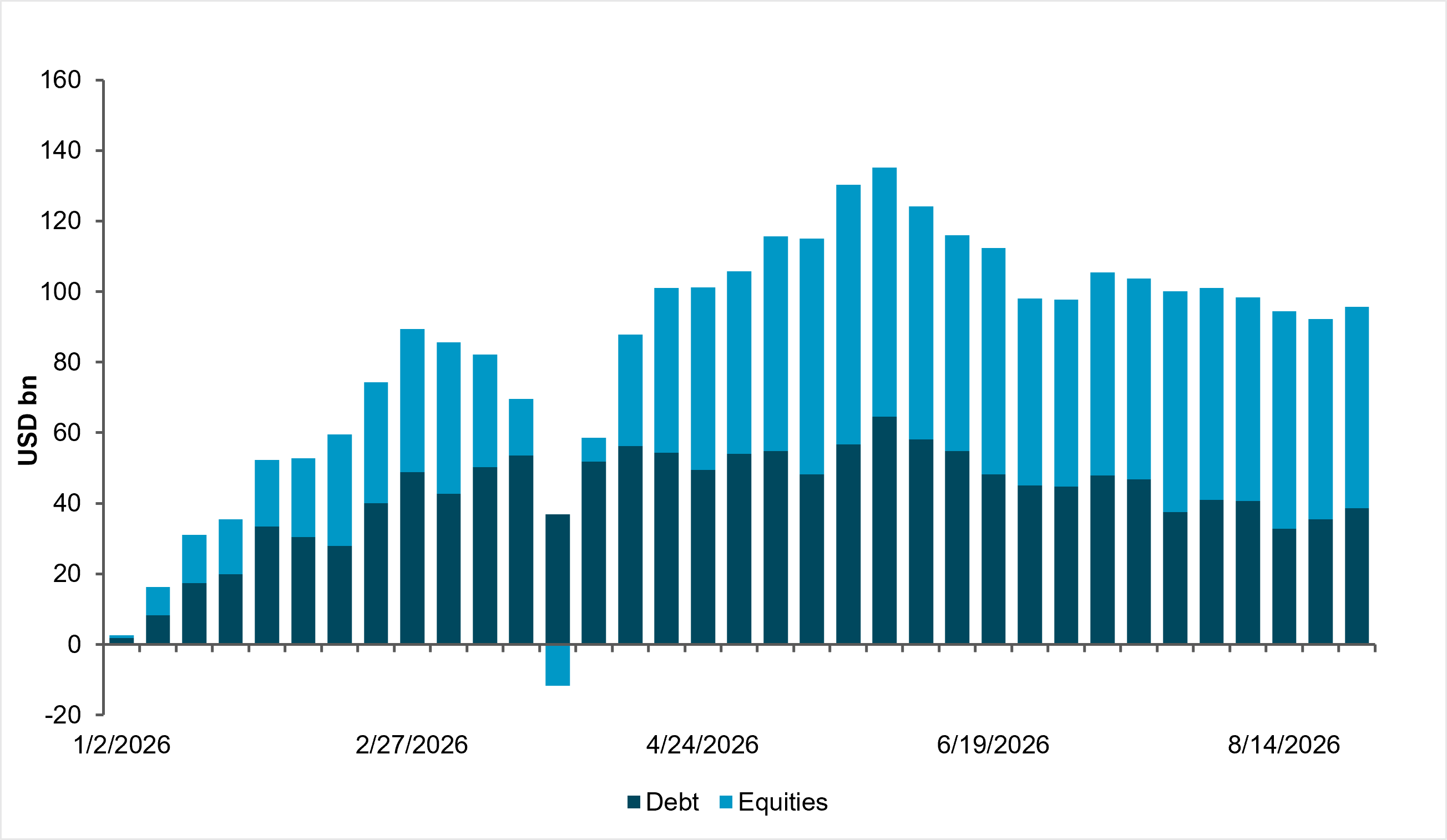
EXHIBIT #1: CUMULATIVE YEAR-TO-DATE FLOWS INTO JAPANESE DEBT AND EQUITY MARKETS
Source: BNY
Our take
Based on official Bank of Japan (BOJ) data, JPY’s sharp moves from mid-week onward aren’t based on official intervention. If so, this is the first sign that the 160 level in USDJPY has been established as a credible deterrence level for FX market participants. As the BOJ is clearly communicating a high chance of an interest rate hike later this month, some near-term anchoring of JGB yields – which recently surged to three-decade highs – should be expected.
JPY remains attractively valued at current levels, and the Japanese government has also signaled a preference for greater inbound portfolio investment, especially by Japanese asset managers. Higher JGB yields may also deter new outflows by Japanese savings pools. Combined, this should represent a very positive environment for greater foreign involvement in Japanese assets, but the data suggest otherwise. Ministry of Finance data note that cumulative flows into Japanese bonds have fallen by over 40% since the end of May. Equities haven’t done as poorly, but cumulative flows are also down nearly 25%.
Forward look
The bulk of the outflows took place in June. Volatility in APAC assets, led by the KOSPI, clearly had an impact on regional equity markets. Global inflation expectations dropped sharply due to equity market struggles and a sharp decline in oil prices, which pushed up real rates elsewhere – a difficult environment for the JGB market. In contrast, USDJPY went on a near-unbroken run from 155 to 164 between May and July but generated very little impact on cross-border asset interest.
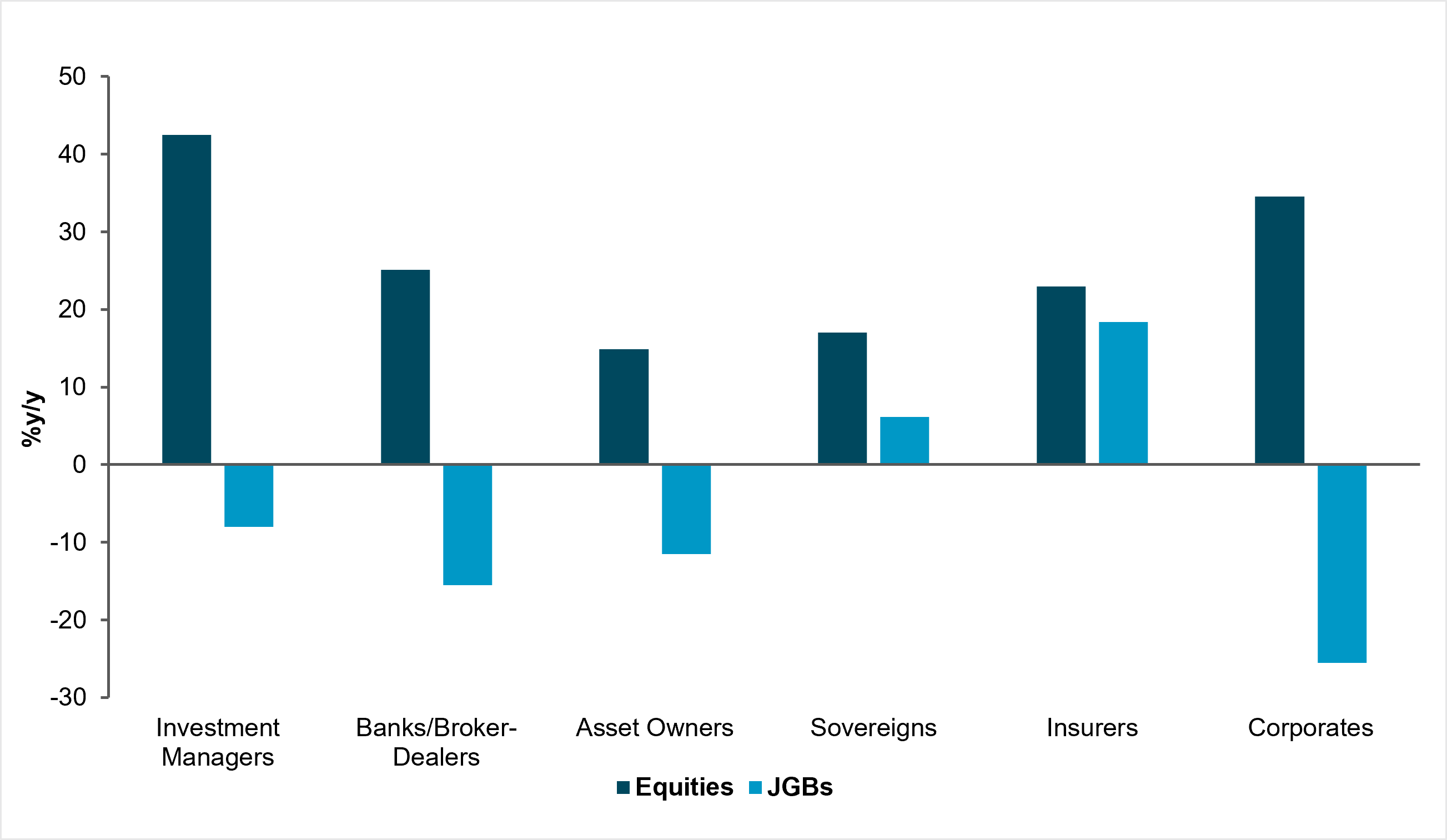
EXHIBIT #2: ALL CLIENT GROUPS ADD TO EQUITY EXPOSURE; JGBS TELL A DIFFERENT STORY
Source: BNY
Our take
Our flow data indicate that JGBs remains the weak link in the financial account. Every single client category was a net buyer of equities year to date. Earnings translation may help on the margin, but performance across developed and emerging market APAC equities with direct links into the U.S.-led AI and technology stack has benefited from the theme. Investment manager flow has been particularly strong with a 40% gain in holdings.
In contrast, only sovereign names and insurers were net buyers of JGBs across all maturities. Sovereigns may have a mandate to own JGBs as part of reserve allocations and will be less price sensitive. Insurers’ JGB purchases almost matched their equity purchases but were not enough to offset outflows from other long-term asset management names.
Forward look
For long-term managers, owning JGBs remains extremely expensive due to hedging costs, which may rise if the BOJ lags peers in rate hikes. The BOJ’s reluctance to increase rates is well-established, and even this week’s interventions by Governor Kazuo Ueda and rate-setter Hajime Takata (who called for a 50bp move) haven’t been able to force down yields materially. The constraints surrounding government debt are clear. Yet, as global central banks are now pushing for additional tightening and governments reacting to fiscal stress, Japan is increasingly looking like an outlier: the central bank is not assertive enough while the government is still pushing for fiscal expansion. Equity performance, on the other hand, has been able to perform independently of these factors. Easier financial conditions are supportive, but this year’s performance and broad-based client demand point to strong fundamentals.
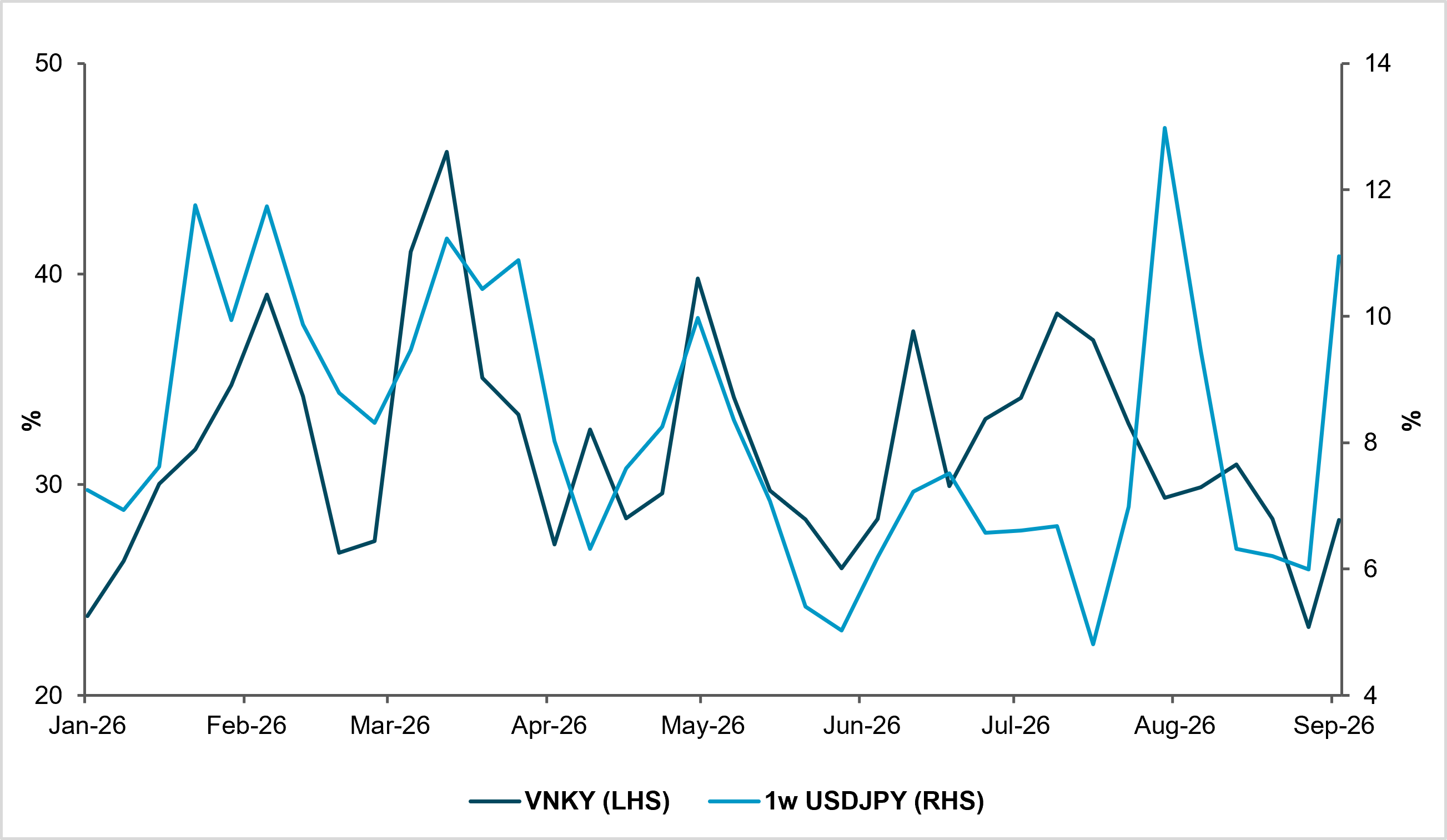
EXHIBIT #3: NIKKEI VOL AT YEAR-TO-DATE LOWS DESPITE USDJPY VOL JUMP
Source: BNY, Bloomberg
Our take
Resilience in Japanese equities is further supported by the distinct lack of a relationship between FX and equity volatility. Exhibit 1 already shows that the intervention episodes in April and July haven’t impacted cross-border investment trends. In other words, a low single-digit appreciation in the JPY will not deter buyers and may not add to take-profit risk either. This is also reflected in volatility barometers –the Nikkei’s volatility peak this year was at the onset of the Gulf conflict. The external shock to Japan’s balance of payments justified such a reaction, but associated risks have been easing since. In contrast, USDJPY’s one-week implied volatility spiked sharply during the July round of intervention, but there was no reaction in Japanese equity volatility. The lack of a reaction has been repeated this week.
Forward look
We have highlighted in recent weeks that fixed income volatility is the most important driver in cross-asset volatility, including FX. Questions over fiscal dominance – of which Japan is one of the most exposed names – are directly driving JPY weakness and shaping central bank and finance ministries’ reaction functions. FX markets are no different, especially as JPY weakness is seen as a lack of credibility in both monetary and fiscal policy. Lower Nikkei levels and the drop in foreign portfolio flows suggest these factors are already in place. FX-specific risk, such as the moves this week, don’t add to risks on the margins. U.S. Treasury Secretary Scott Bessent stated after the July round of intervention that any activity wouldn’t be to the detriment of the U.S. Treasury market. Fixed income volatility will continue to affect FX; we don’t see much of an impact in the opposite direction.
Prefer Japanese equities over JGBs and avoid chasing USDJPY above 160. Equity fundamentals and investor demand remain constructive, while JGBs still offer poor risk-reward given hedging costs, fiscal concerns and an insufficiently assertive BOJ. Treat fixed-income volatility, rather than FX volatility itself, as the key risk to Japanese assets.